Resistance Units commemorate the September 27, 1981 uprising and those executed at Evin while carrying the message of resistance against Iran’s regime into cities across the country.
PMOI Resistance Units carried out 60 coordinated activities in 17 Iranian cities on September 26, commemorating the September 27, 1981 uprising and honoring those who were executed by Iran’s regime during the repression that followed.
The activities took place amid heightened security measures in Tehran, Karaj, Tabriz, Mashhad, Isfahan, Shiraz, Ahvaz, Sari, Kermanshah, Gorgan, Hamadan, Zahedan, Lahijan, Nahavand, Behshahr, Marvdasht, and Naftshahr.
The campaign connected the present-day activities of the Resistance Units with one of the defining episodes in the history of the PMOI’s confrontation with the clerical regime.
Remembering September 27, 1981
September 27, 1981—5 Mehr 1360—marks a major turning point in the history of organized resistance against the regime established after the 1979 revolution.
PMOI supporters and Iranian youth took to the streets in Tehran in a major uprising against the repression imposed by the emerging clerical dictatorship. The regime responded with mass arrests and executions.
Historical accounts from the period document the execution of large numbers of PMOI supporters and other political opponents at Evin Prison. PMOI records place the number of those executed at Evin from the evening of September 27 through the following day at 1,810.
More than 10,000 people were reportedly arrested in Tehran during the crackdown surrounding September 27.
The scale of the repression established a pattern that would continue throughout the following decades: the regime responded to political dissent not through political competition, but through arrests, torture, executions, and systematic suppression.
The anniversary has consequently remained an important date in the PMOI’s historical narrative of resistance.
A History the Resistance Units Say Continues Today
The Resistance Units used the anniversary to link the sacrifices of previous generations with their own activities inside Iran.
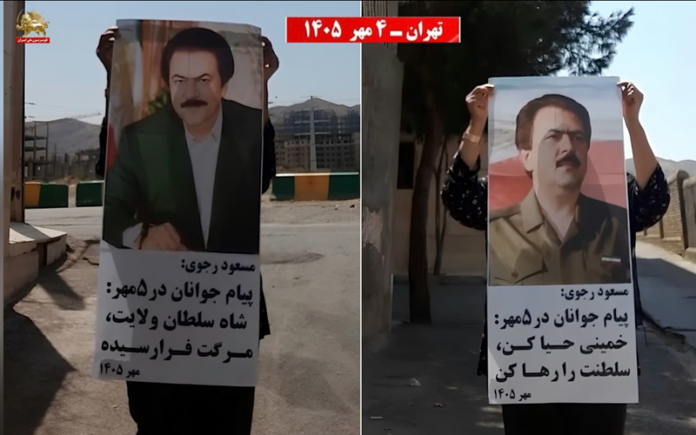
Messages displayed in several cities invoked the memory of those killed during the 1981 crackdown while calling for an end to the regime and freedom for Iran.
In Tabriz, slogans praised the PMOI leadership and called armed resistance the path to liberation. In Shiraz, messages called for support for the People’s Mojahedin Army and urged workers to arm themselves. In Marvdasht, a message attributed to Massoud Rajavi similarly called for the People’s Mojahedin Army as the means of achieving freedom for Iran’s working people.
Other activities focused directly on the broader political message of the Resistance Units.
In Zahedan, a slogan described a century of crimes associated with monarchical and clerical rule. In Hamadan, activists displayed the slogan, “Death to the oppressor, whether Shah or Leader,” emphasizing the Resistance’s rejection of both forms of authoritarian rule.
In Nahavand, a message attributed to Maryam Rajavi stated that the answer to Iran’s crisis is the overthrow of the entirety of the religious dictatorship.
In Behshahr, activists declared that the country’s armed dictatorship could and must be overthrown.
From Commemorating the Past to Organizing Resistance
Several of the activities specifically emphasized the role of young people and the expansion of organized resistance.
In Isfahan, a message called for the expansion of Resistance Units in schools and universities. In Ahvaz, activists carried out wall writing in support of the PMOI. In Kermanshah, wall writing combined support for the PMOI with a call for the overthrow of regime leader Ali Khamenei.
The messages also invoked Maryam Rajavi’s praise for Iran’s younger generation and its resistance to repression. She has described the courage and sacrifice of Iranian youth as a force that has challenged the regime’s security apparatus and demonstrated the determination of Iranians to achieve freedom.
The activities therefore served two purposes: commemorating those who resisted and were killed in the regime’s repression of 1981, while presenting today’s Resistance Units as part of an ongoing struggle.
The Regime’s Own Security Narrative
The historical significance of the confrontation is also reflected in statements by senior regime officials.
Ahmad Vahidi, the current commander of the Islamic Revolutionary Guard Corps and a former interior and defense minister, has previously acknowledged the scale of the PMOI’s activities in Tehran during the early years of the regime. He stated that there was a period when the PMOI carried out hundreds of attacks in Tehran each day.
His admission is significant because it illustrates the extent to which the PMOI was viewed by the regime’s security establishment as an organized political and operational threat during that period.
The September 27 anniversary thus represents more than a commemoration of a historical event for the Resistance Units. It is presented as a continuation of a confrontation that began in the early years of the clerical dictatorship and has persisted through successive waves of repression and popular protest.
Sixty Acts of Defiance
From Tehran and Karaj to Zahedan, Shiraz, Tabriz, Isfahan, Ahvaz, and other cities, the 60 activities across 17 cities carried the same central message: the memory of those who resisted the regime remains connected to the struggle being waged by a new generation.
Four and a half decades after the 1979 revolution, the Resistance Units continue to use public spaces, wall writing, posters, and other forms of activism to challenge the regime’s security apparatus.
The September 27 campaign deliberately connected those activities with the events of 5 Mehr 1360, when thousands were arrested and large numbers of PMOI supporters were executed at Evin.
For the Resistance Units, the anniversary is therefore not simply a remembrance of the past. It is a declaration that the history of resistance against Iran’s regime remains alive—and that a new generation intends to carry that struggle forward.