


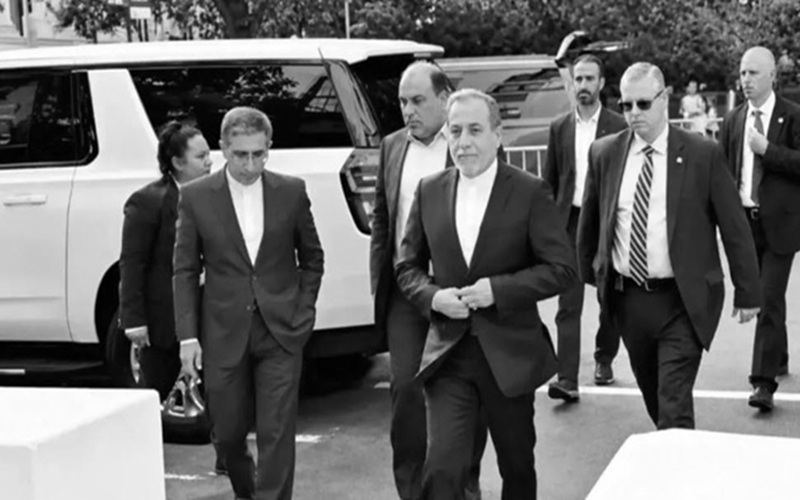

Escalating attacks on negotiators, diplomatic outreach, and even former officials expose widening divisions inside the regime under Mojtaba Khamenei.
Political developments at the beginning of autumn 2026 are exposing increasingly sharp divisions within Iran’s regime. The conflict is no longer confined to private disputes among officials. It is playing out simultaneously in the streets, parliament, state media, and the diplomatic arena, revealing a widening clash between efforts to preserve diplomatic openings and hardline factions demanding confrontation.
At the center of the dispute is the regime’s approach to negotiations with the United States and its relations with regional governments. The conflicting signals suggest that Iran’s foreign policy is being shaped not by a coherent strategy, but by competing power centers struggling over how to respond to mounting external pressure.
Street Pressure Against Former Officials
The factional confrontation has even reached the homes of former senior officials associated with policies favoring negotiations and the nuclear agreement.
On September 25, a gathering described by participants as a “Hezbollah” protest was held outside the Tehran residence of former president Hassan Rouhani. Demonstrators directed aggressive slogans against Rouhani while calling on judicial and security institutions to take action against him.
The protesters identified themselves as supporters of Mojtaba Khamenei and described their gathering as an action “against the nonsense” attributed to Rouhani. Their slogans included “We sacrifice our lives for our leader” and calls for the security forces to support them.
The episode illustrates how disagreements over foreign policy are increasingly being transformed into internal political confrontation, with hardline forces using street mobilization to pressure figures associated with previous attempts at engagement with the West.
State Media Rejects Negotiations
The conflict became even more explicit as the regime’s delegation pursued diplomatic contacts in New York.
On September 26, the hardline Kayhan newspaper published a prominent headline declaring, “Negotiation is a deception operation.” The paper argued that negotiations with Washington amounted to a trap and advocated a military response to what it described as an American and allied air and naval blockade.
Kayhan went further, warning that if Washington and its allies continued the alleged blockade, American oil facilities, military bases, and major technology and economic companies in the region could become targets of missile strikes.
The message directly conflicts with efforts by the government’s diplomatic apparatus to keep channels of negotiation open.
The same contradiction appeared in parliament. Ibrahim Rezaei, a member of the parliamentary National Security and Foreign Policy Commission, warned the negotiating team against what he described as “begging for an agreement and understanding.” He argued that such behavior would be interpreted as weakness and encourage further pressure on the regime.
Saudi Arabia Becomes Another Battleground
The factional struggle has also spread to the regime’s regional diplomacy.
The participation of Mohammad-Jafar Ghaem-Panah, executive deputy to President Masoud Pezeshkian, in Saudi Arabia’s National Day reception at the Saudi Embassy in Tehran triggered attacks from hardline figures.
Hussein Shariatmadari, the representative of the supreme leader at Kayhan, challenged Ghaem-Panah’s explanation that he had attended at the instruction of “competent authorities,” sarcastically asking which authority had issued the order.
The controversy forced Ghaem-Panah to publicly justify the decision. He said that officials involved in foreign-policy decision-making had recommended his participation as part of efforts to improve relations with Saudi Arabia under the region’s current circumstances.
He subsequently linked the decision to the Supreme National Security Council, stating that the body had determined that relations with Saudi Arabia should be maintained at this level.
The explanation itself is revealing: a routine diplomatic appearance required justification through the highest security institutions, underscoring how contested even limited regional engagement has become. Contemporary reporting also confirmed that the government presented Ghaem-Panah’s attendance as an officially authorized act of regional diplomacy.
A Regime Pulled in Opposite Directions
These confrontations point to a deeper problem than an ordinary policy disagreement.
The government needs diplomatic openings to reduce mounting economic, political, and international pressure. At the same time, hardline factions aligned with the supreme leader are publicly portraying negotiations and regional engagement as signs of weakness and attacking those who pursue them.
The result is a contradictory foreign policy in which one part of the regime seeks room for maneuver while another openly undermines those efforts.
The dispute over negotiations with Washington, the attacks on Rouhani, the parliamentary warnings against compromise, and the backlash over Saudi diplomacy all point to the same structural problem: decisions at the top are increasingly contested by rival centers of power.
Rather than projecting a unified strategy, the regime is exposing its internal divisions through its own media, parliament, diplomatic institutions, and street mobilization. The growing gap between diplomatic initiatives and hardline resistance to them is therefore becoming another visible manifestation of the regime’s deepening political paralysis.