


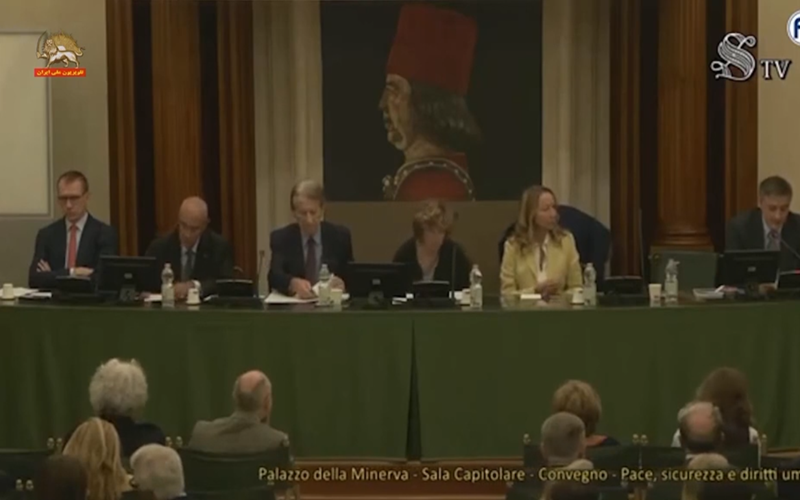

At a conference in Italy’s Senate, Giulio Terzi linked the Iran regime’s regional destabilization and repression to the need for a fundamental policy shift and stronger support for democratic opposition forces.
A senior Italian senator has called for a fundamental shift in Western policy toward Iran’s regime, arguing that continued reliance on diplomacy alone cannot address the regime’s repression at home and destabilizing activities abroad.
Senator Giulio Terzi, president of the European Affairs Committee of Italy’s Senate and a former foreign minister, made the remarks on September 25 during a conference in the Italian Senate devoted to peace, security, human rights, and Italy’s Mediterranean policy. The event was organized by the Fondazione Luigi Einaudi and brought together Italian political and diplomatic figures, human-rights advocates, journalists, and supporters of the Iranian Resistance.
Terzi described Iran’s regime as a major source of international instability and argued that its activities can no longer be addressed through diplomatic engagement without meaningful pressure.
Iran Regime’s Regional Threat
A central theme of Terzi’s remarks was the regime’s role in threatening regional security and international commerce.
He pointed to the regime’s use of its regional network, particularly the Houthis, to threaten shipping in the Red Sea and the Bab el-Mandeb strait. In a separate statement connected to the same conference, Terzi stressed the strategic importance of freedom of navigation and said the Red Sea is particularly vital to Europe and Italy. He also highlighted Italy’s support for the European Aspides maritime mission.
The Italian senator argued that the regime’s regional activities demonstrate why Iran cannot be treated solely as a conventional diplomatic problem. In his assessment, Tehran’s influence through armed proxies has consequences extending well beyond the Middle East, including for international trade and European security.
Diplomacy Alone Is Not Enough
Terzi also challenged an approach centered exclusively on negotiations.
According to the account of his remarks, he argued that diplomacy can only have an effect when accompanied by coordinated and effective economic pressure. In particular, he called for measures designed to prevent the regime from exploiting loopholes to circumvent sanctions.
His position reflects a broader argument that engagement without pressure risks allowing the regime to use negotiations to alleviate external constraints while continuing its domestic repression and regional activities.
Terzi has previously made similar arguments concerning the regime’s role in international instability. Following the September 25 conference, he stated publicly that the regime had been using its remaining resources against Israel, Europe, and the West and argued that supporting forces seeking a free Iran was in the interest of Western democratic institutions and the European Union.
IRGC Designation as a Starting Point
Terzi also pointed to the European Union’s designation of the Islamic Revolutionary Guard Corps (IRGC) as a terrorist organization as an important development, while arguing that additional political and deterrent measures are required.
He emphasized the IRGC’s extensive influence over strategic sectors of Iran’s economy and security apparatus, including energy, transportation, and the regime’s missile and nuclear programs.
The broader implication of his argument was that pressure should target the institutional structures that sustain the regime’s domestic repression and external activities rather than being limited to diplomatic statements.
Support for Iran’s Democratic Opposition
Terzi went further by arguing that the time had come for Western governments to reconsider their relationship with Iran’s opposition forces.
He expressed his longstanding support for the National Council of Resistance of Iran (NCRI), led by Maryam Rajavi, describing its political outlook as based on secularism, democratic principles, and the rule of law. His remarks placed support for Iran’s organized opposition within a broader discussion about what could follow the current regime.
Terzi’s position was echoed at the conference by Elisabetta Zamparutti, a former Italian parliamentarian and human-rights advocate. Addressing the regime’s executions and repression, Zamparutti questioned the extent to which Italy’s foreign policy had accommodated Tehran. She also argued for greater political solidarity among forces sharing democratic and human-rights principles and raised the question of recognizing Iran’s opposition as a legitimate political interlocutor.
Her comments come amid growing attention in Italy to executions and human-rights abuses in Iran. Just days before the conference, Italy’s Senate adopted a motion calling on the government to pursue diplomatic action concerning executions of protesters, arbitrary detention, freedom of expression and assembly, and the protection of Iranian women and other persecuted groups.
A Growing Policy Debate in Europe
The conference in Rome highlighted a widening European debate over how governments should respond to Iran’s regime: whether continued diplomatic engagement can produce meaningful change, or whether negotiations must be accompanied by substantially greater political and economic pressure.
Terzi’s intervention placed the issue more explicitly within the framework of supporting democratic forces inside Iran. He argued that the regime’s nearly five decades of repression and its regional activities have made a fundamental change in policy unavoidable.
For Terzi, the question is therefore no longer simply how Europe should negotiate with Tehran, but how it should respond to a regime that he views as a persistent source of repression and international instability—and how European governments should engage with those seeking a free and democratic Iran.