


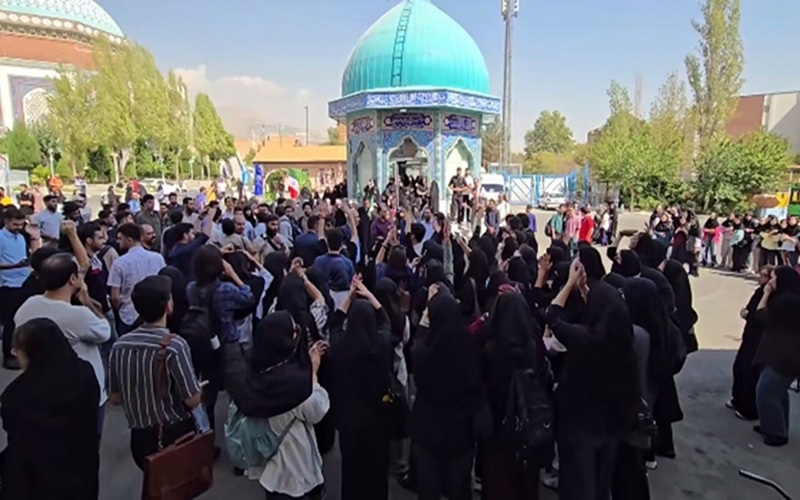

Demonstrations in Tehran and several provinces highlight mounting anger over repression, economic hardship, unpaid rights, fuel shortages, and institutionalized corruption.
Across Iran, protests and strikes by students, retirees, workers, farmers, drivers, and other affected groups have continued in recent days, reflecting growing anger over economic hardship, institutional discrimination, unpaid rights, and the policies of the regime.
Demonstrations have been reported in Tehran, Isfahan, Kermanshah, Tabriz, Kerman, Yasuj, Rasht, Najafabad, Mashhad, Mehrestan, Ahvaz, Shush, and Bijar, involving groups whose grievances range from rising education costs and employment insecurity to fuel shortages, delayed vehicle deliveries, and inadequate retirement benefits.
Students Challenge Repression and Commercialization of Universities
On Monday, September 28, students at Allameh Tabataba’i University in Tehran protested rising tuition fees and restrictive measures imposed by university security, with particular anger directed at pressure on female students.
The students chanted slogans including “Imprisoned students must be freed,” “Hijab and morality police, down with tyranny,” and “Until the mullahs are uprooted, this country will not be free.”
Other chants highlighted the broader economic and social pressures facing students, including “Hardship, unemployment, and mandatory hijab” and “The university is not a garrison or a business; long live the university.”
The protesters also rejected the commercialization of higher education, chanting “We don’t want a profit-driven university.” Their demonstrations underscored how economic grievances and opposition to the regime’s social controls are increasingly converging on university campuses.
Retirees Continue Nationwide Protests
Retirees were also active across several cities.
On September 28, telecommunications retirees held rallies in Isfahan, Kermanshah, and Bijar, demanding their rights and protesting deteriorating economic conditions. Retirees of the Shafarood Company also gathered outside the Gilan Provincial Governor’s Office.
A day earlier, on September 27, retirees of the Isfahan Steel Company staged a protest, while Social Security retirees demonstrated in Shush, Tehran, Khuzestan, and Rasht.
The repeated mobilization of retirees reflects persistent disputes over pensions, benefits, and living costs amid an economic crisis that has sharply eroded household purchasing power.
Workers and Drivers Protest Employment Conditions
On September 26, contract drivers working for Tabriz Municipality gathered outside the City Council. They protested low wages, lack of insurance, and unresolved employment-status issues.
Drivers from the municipality’s ten districts also held a separate protest at the City Council, adding to pressure from workers whose livelihoods depend on increasingly precarious employment arrangements.
Car Buyers Demand Vehicles They Have Already Paid For
In Tehran, buyers of the Shahin automobile gathered outside the Ministry of Industry, Mine and Trade to protest prolonged delays in vehicle deliveries.
The protesters said they had already paid the full amount for their vehicles but remained without delivery or an adequate response to their demands.
In Rasht, applicants for the 624-unit Lakan housing project demonstrated outside the regime’s Housing Foundation in Gilan, protesting unresolved problems surrounding the project.
These protests point to another dimension of the crisis: citizens who have paid for essential goods or housing projects remain caught in prolonged delays while government institutions fail to provide satisfactory answers.
Farmers Hit by Diesel Shortages and Price Surge
Farmers in Mashhad also took to the streets over shortages and the rising cost of gasoline and diesel.
The sharp increase in diesel prices on the open market has created serious difficulties for farmers trying to secure fuel for tractors and other agricultural machinery. For farmers already operating under severe financial pressure, higher fuel costs threaten to further increase the cost of agricultural production.
A Broadening Protest Landscape
The latest demonstrations span multiple social and economic sectors—from university students and retirees to municipal drivers, farmers, homebuyers, and automobile purchasers. Their immediate demands differ, but a common thread runs through many of the protests: citizens are confronting institutions they say have failed to provide basic economic security, contractual obligations, or fundamental rights.
At Allameh Tabataba’i University, the protests also went beyond economic grievances, directly challenging the regime’s enforcement of mandatory hijab and the presence of morality-policing mechanisms.
The geographic spread and diversity of these protests demonstrate the breadth of grievances accumulating across Iranian society. Rather than being confined to a single sector, discontent is appearing simultaneously among groups facing different forms of economic pressure and state control.