


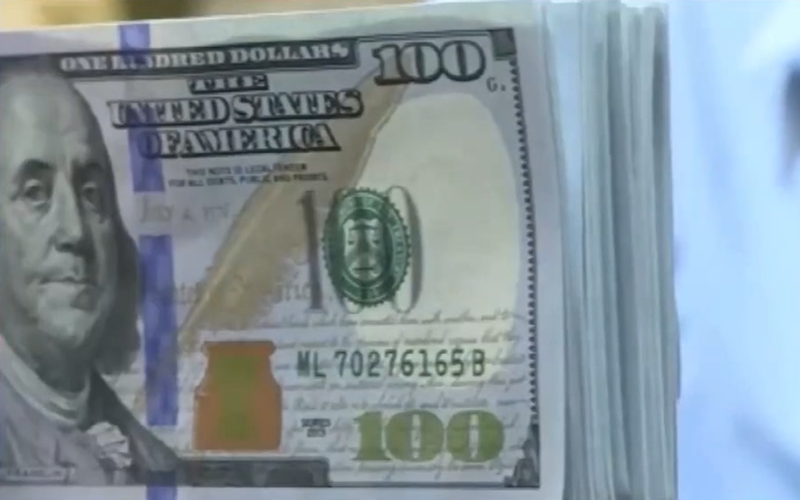

As the Iranian regime pours billions of dollars into the foreign-exchange market, the rial keeps falling, while an internal political fight reveals how deeply the currency crisis is tied to the regime’s broader economic dysfunction.
The dollar has become a political threat
The Iranian regime’s latest attempt to halt the collapse of the rial has done little to calm the currency market. After the Central Bank announced plans to inject up to $2 billion into the foreign-exchange market, the dollar nevertheless approached 2.7 million rials in the open market. By October 3, Reuters reported a rate of around 2.688 million rials per dollar, while the rial had lost more than half of its value over the previous year.
The significance of this intervention goes beyond economics.
The increasingly heated dispute among regime officials over the $2 billion operation reflects a deeper fear: the exchange rate has become directly connected to social and political instability.
That connection was made especially clear by the remarks of regime parliamentarian Gholam-Ali Haddad-Adel’s parliamentary colleague Amir-Hossein Kouchakzadeh, who attacked the plan associated with Central Bank Governor Abdolnaser Hemmati. His argument was straightforward: ordinary Iranians do not have the enormous amount of rials required to purchase thousands of dollars at the subsidized rate. The beneficiaries, he argued, would be those with access to capital and the regime’s privileged financial networks.
The argument points to a fundamental contradiction. A government can inject foreign currency into a market, but it cannot manufacture confidence, productive investment, or purchasing power by decree.
Why the regime is so alarmed by the dollar
For the regime, the dollar is not merely another economic indicator. It has become a barometer of public expectations.
Iran’s January 2026 uprising was preceded by a sharp deterioration in economic conditions, with the exchange rate becoming one of the immediate triggers of widespread anger. That experience remains embedded in the regime’s calculations. When the price of the dollar rises rapidly, it is not simply a matter of import costs or foreign-exchange accounting. It immediately affects food, medicine, housing, transportation and household savings.
That is why regime officials have increasingly treated the currency market as a security issue.
The current situation is particularly sensitive because the rial has continued to deteriorate despite repeated intervention. In September, Hemmati said the Central Bank had already injected $500 million and was prepared to supply as much as $2 billion. At the time, the dollar had already crossed the psychologically important level of two million rials.
By early October, however, the dollar had moved toward 2.7 million rials.
The numbers expose the central problem: foreign currency can temporarily influence the price of the dollar, but it cannot repair the economic structure producing the demand for dollars.
$2 billion cannot fix a structural economic crisis
Currency intervention can work under certain conditions. A central bank with credible monetary policy, adequate reserves, sustainable fiscal accounts and a functioning productive economy can use foreign-exchange operations to smooth temporary shocks.
But an economy suffering from persistent inflation, weak production, capital flight and multiple exchange rates faces a different problem.
The regime’s repeated reliance on currency injections is therefore less a solution than an attempt to manage the symptoms.
The mechanism is familiar. The Central Bank sells dollars below the open-market rate. This can temporarily increase supply and reduce upward pressure on the exchange rate. But if underlying inflation and expectations remain unchanged, demand for foreign currency returns.
Worse, a large gap between official or subsidized exchange rates and the open-market rate creates opportunities for arbitrage. Those who can obtain cheaper foreign currency can potentially resell it at the higher market price. The result is that a policy supposedly designed to protect the economy can become another channel for transferring wealth toward those with privileged access to foreign currency.
This is precisely why the internal dispute over the $2 billion is significant. It is not merely a disagreement over monetary policy. It exposes the regime’s longstanding problem of distributing scarce resources through a system in which access itself can become a source of profit.
The real problem is the economy behind the exchange rate
The dollar is often treated as though it were the cause of Iran’s economic crisis. In reality, the exchange rate is also a measurement of that crisis.
An economy cannot maintain a stable currency indefinitely while suffering from high inflation, weak domestic production, chronic fiscal imbalances and an environment in which capital seeks protection in dollars, gold and other hard assets.
The current flight toward hard currency is already visible. Reuters reported that many Iranians are seeking refuge in dollars, other foreign currencies and gold as the rial loses value and inflation exceeds 70 percent.
This creates a self-reinforcing cycle.
Inflation reduces the purchasing power of the rial. People seek safer stores of value. Demand for dollars rises. The rial weakens further. Imported goods become more expensive. Prices rise again. The public then has even greater incentive to protect its savings from further depreciation.
A $2 billion intervention can interrupt this cycle temporarily. It cannot eliminate it.
Multiple exchange rates deepen the problem
The regime’s exchange-rate system also creates another structural vulnerability: the coexistence of different rates for different categories of users.
Whenever a government provides foreign currency at a preferential rate while the market rate is substantially higher, the difference itself becomes economically valuable.
The history of Iran’s subsidized foreign exchange has repeatedly produced disputes over how much currency was allocated, who received it, and whether it was used for its declared purpose. Such controversies are not accidental side effects. They are symptoms of an economic system in which administrative access to foreign currency can become more profitable than productive activity.
That is why arguments over individual allocations inevitably expand into broader accusations between rival factions.
The dollar crisis thus feeds the regime’s internal political conflict at the same time that the political conflict undermines confidence in the regime’s economic management.
The deeper contradiction
The regime says it has sufficient foreign currency. Hemmati made precisely that argument in September, insisting that the Central Bank had access to reserves and foreign-currency revenues and was prepared to intervene.
Yet the market continues to send a different signal.
The open-market dollar reached approximately 2.7 million rials in early October, even as the Central Bank was selling dollars to support the currency.
This does not mean that every dollar injected into the market is ineffective. It means that intervention has diminishing power when the underlying forces driving depreciation remain intact.
The regime can sell dollars.
It cannot sell its way out of inflation.
It can temporarily suppress the exchange rate.
It cannot permanently suppress the economic pressures that keep pushing people toward the dollar.
And it can intensify the struggle among its own factions over who receives scarce foreign currency, but that struggle does not create production, investment, or purchasing power.
The widening gap between the regime’s official assurances and the market’s behavior is therefore becoming one of the clearest indicators of Iran’s economic predicament. The dollar is not simply rising because of speculation or psychology. It is reflecting a much broader crisis in which monetary intervention has increasingly become a short-term instrument for managing pressures that the regime has been unable to resolve at their source.