


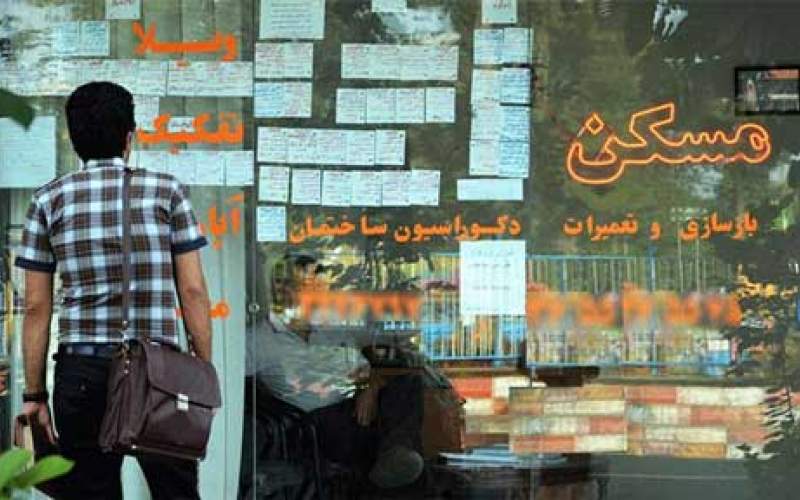

A deepening housing crisis is consuming an ever-larger share of household income while tenants face insecurity, forced displacement, and repression when they demand their rights
Iran’s escalating rent crisis is no longer simply a matter of rising housing costs. It has become a stark measure of the economic and social pressure imposed on millions of households by Iran’s regime. For millions of tenants, keeping a roof over their heads increasingly means sacrificing food, healthcare, education, and other basic necessities.
A recent report by Etemad newspaper, titled “The Nightmare of Rent on Life,” highlights only part of this widening crisis. At its core is a housing market shaped by rampant commodification, entrenched rent-seeking interests, economic instability, and the absence of effective mechanisms through which citizens can defend their rights.
According to a campaign advocating tenants’ rights cited in the report, around 7 million Iranian households are tenants. That represents tens of millions of people exposed to repeated rent increases, non-renewal of leases, forced relocation, and growing insecurity over their housing.
The campaign argues that housing cannot be treated merely as a commodity because access to secure housing directly affects the ability to establish a family, maintain health, educate children, and participate in society.
Housing costs are consuming workers’ livelihoods
The scale of the crisis is reflected in the growing share of household income absorbed by housing.
Data reconstructed by economist Mohammad Maljoo show that housing’s share of the livelihood basket of the working class rose from 24 percent in 2019 to 40 percent in 2024. Among the urban poor, the figure reached an alarming 48 percent.
This means that families already struggling with inflation and declining purchasing power are being forced to devote nearly half of their available resources simply to maintaining a place to live.
The consequences extend far beyond housing. When rent consumes an increasing portion of household income, families have fewer resources for nutrition, medical treatment, education, transportation, and other essential expenditures.
Maljoo has described the tenants’ campaign as a window into the wider crisis of household consumption. Families forced to spend more to preserve the most basic condition of life—their shelter—must inevitably give up other necessities.
This is how the housing crisis becomes a broader crisis of living standards.
Fear prevents tenants from demanding their rights
The economic pressure is compounded by the political environment surrounding any attempt to organize or protest.
Hanieh Bani-Hashem, a researcher and organizer involved in the tenants’ rights campaign, described repeatedly asking tenants why they did not protest or pursue their demands. Their response was revealing: Who should they complain to? Where could they protest? Would anyone listen? Many feared that protesting would result in imprisonment.
This fear is not separate from the housing crisis. It is one of the mechanisms through which the crisis is sustained.
In a society where workers, retirees, teachers, pensioners, and other social groups routinely face security pressure when demanding basic economic rights, tenants confronting eviction or unaffordable rent also face a political barrier to collective action.
The result is a vicious cycle: incomes lose value, housing costs rise, families are pushed into increasingly precarious living conditions, and the mechanisms through which they could collectively demand change remain heavily restricted.
A crisis rooted in the regime’s economic structure
The collapse in the purchasing power of the rial has further intensified the housing crisis. Years of inflation, economic mismanagement, corruption, and the dominance of rent-seeking institutions have steadily eroded household incomes while housing costs have continued to rise.
For millions of tenants, the consequences are visible in forced moves from one neighborhood to another, overcrowding, deteriorating living conditions, and the postponement of other essential expenditures.
The crisis therefore cannot be reduced to fluctuations in the property market. It reflects a wider economic structure in which the interests of powerful institutions and privileged networks take precedence over the basic needs of ordinary people.
The most vulnerable are paying the highest price. Working families and the urban poor are increasingly being forced to choose between maintaining shelter and preserving other dimensions of a decent life.
The rent crisis exposes a wider social breakdown
The housing crisis is ultimately about much more than rent.
When a family must sacrifice healthcare to pay its landlord, postpone a child’s education to renew a lease, or abandon an established neighborhood because it can no longer afford the rent, the damage extends into every part of social life.
A growing housing burden also undermines family stability and deepens class divisions. Those with accumulated property and financial resources can protect themselves against inflation, while wage earners and tenants see their purchasing power deteriorate year after year.
Iran’s regime has repeatedly presented short-term measures and unfinished housing schemes as solutions to the country’s housing problems. But without addressing the deeper economic and political structures that produce inflation, declining real incomes, speculation, and insecurity, such measures cannot resolve the underlying crisis.
The growing tenants’ rights movement is therefore significant beyond the question of housing. It reflects a broader demand for economic dignity and the right to live without permanent fear of displacement.
For millions of Iranians, the demand is increasingly basic: the right to maintain a safe and secure home without surrendering most of their income or facing repression when they demand that right.
The persistence of this crisis underscores a broader reality. As long as Iran’s ruling structure places the interests of powerful economic networks above the basic rights of its citizens and responds to social demands through repression, housing will remain both an economic burden and a source of insecurity.