


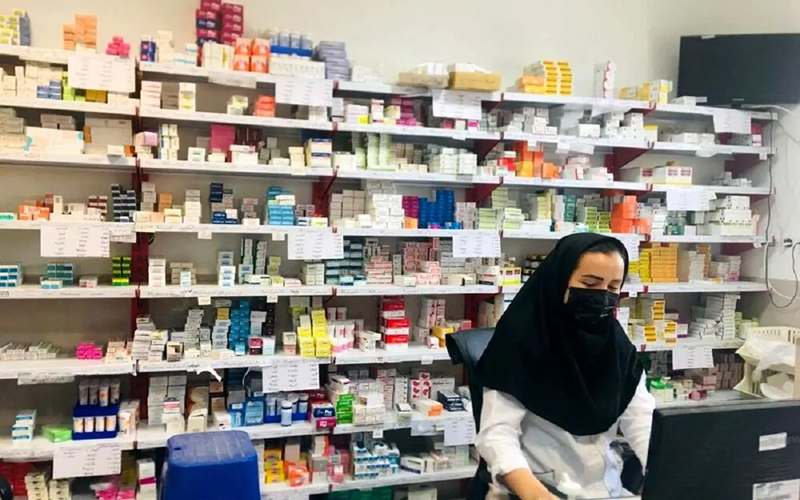

As the cost of treatment soars and more than 80 percent of healthcare expenses are reportedly paid out of pocket, an Iranian regime official admits that patients can no longer count on treatment after falling ill.
In Iran, the economic crisis is increasingly reaching one of the most basic aspects of everyday life: the ability to obtain medical treatment. As the value of the rial continues to collapse and the cost of medicine and healthcare rises, illness is becoming a financial catastrophe for millions of families.
The starkest admission has come from Salman Es’haqi, spokesperson for the regime parliament’s Health and Treatment Commission. Addressing the rising cost of healthcare, he said, “We have closed our eyes to our people being killed due to the lack of medicine and the high cost of treatment.”
Es’haqi also stated that more than 80 percent of healthcare costs are being paid directly by patients. With the dollar surpassing 270,000 rials, the purchasing power of Iranian households has been severely eroded, making even essential medical treatment increasingly inaccessible.
Medicine shortages cannot simply be blamed on sanctions
The regime routinely attributes economic hardships and shortages to international sanctions and external pressure. But even officials within the regime are increasingly acknowledging that this explanation cannot account for the depth of the healthcare crisis.
Es’haqi explicitly rejected the idea that medicine shortages can be attributed solely to war and sanctions, noting that Iran has the possibility of importing medicine and pharmaceutical raw materials from countries such as Russia and China.
This admission points toward a deeper problem: the crisis is not simply one of access to foreign currency or international trade. It is also rooted in the regime’s economic structures, corruption, mismanagement, and networks of privilege and rent-seeking.
The healthcare sector has not been immune to these practices. On the contrary, the growing inability of patients to obtain essential medicines has exposed how deeply corruption has penetrated a system that should be centered on protecting human life.
“The end of illness is not treatment, but death”
Es’haqi’s most alarming statement concerned the consequences of this situation for ordinary people.
Referring to corruption in the healthcare sector, he said: “We have reached a point where we wish people would not get sick, because if they do, the end of that illness is not treatment, it is death.”
This is more than an acknowledgment of expensive medicine. It is an extraordinary admission that one of the most basic responsibilities of governance—the provision of access to healthcare—is failing.
When becoming ill means facing unaffordable costs, shortages, and uncertainty over whether treatment will even be available, a medical condition becomes a broader social and economic crisis. Families are forced to absorb the consequences, often while already struggling with inflation, falling wages, and rising food prices.
For poorer households, the choices can become devastating: buy medicine or food; continue treatment or pay rent and utilities; purchase the full prescription or reduce the dosage and postpone care.
Such choices can lead patients to delay treatment, cut doses, abandon medication, or simply endure worsening conditions until treatment is no longer effective.
Poverty is becoming a barrier to survival
The healthcare crisis therefore cannot be separated from Iran’s broader economic collapse. When the majority of treatment costs come directly from patients’ pockets, those with the fewest resources inevitably suffer first and most severely.
The result is a vicious cycle. Economic hardship prevents people from obtaining timely treatment, untreated illness reduces their ability to work and earn income, and the resulting financial pressure pushes families deeper into poverty.
Medicine, like food, has effectively become part of the regime’s expanding “siege of life”—a basic necessity increasingly beyond the reach of ordinary citizens.
At the same time, the existence of pharmaceutical shortages alongside the regime’s substantial economic resources raises fundamental questions about priorities. When national wealth and public resources are diverted toward maintaining the regime’s political and security apparatus, corruption, and networks of privilege, ordinary citizens are left to bear the cost.
The admission from a regime parliamentarian is therefore significant. It exposes a system in which the consequences of economic mismanagement are no longer measured merely in inflation rates or currency depreciation, but in whether a sick person can obtain the medicine needed to survive.
For millions of Iranians, the healthcare crisis is no longer simply about expensive drugs. It is about the erosion of the most basic security of life: the ability to become sick without being condemned to poverty—and to receive treatment without facing death as the final outcome.