



Iran regime’s president acknowledges the dangers of economic collapse and public disillusionment as security institutions dominate oil revenues and deepen the crisis facing ordinary citizens.
Speaking about the challenges facing his government, Pezeshkian described the situation as a dangerous turning point. He said: “Our war now is that if they strike us with guns or missiles, we can deal with that; what is worse is the economic situation they have created for us.”
He also acknowledged the government’s responsibility for addressing public grievances, warning that failure to resolve people’s problems would make the authorities culpable.
His remarks point to a central dilemma for Iran’s regime: military confrontation and diplomatic uncertainty are serious challenges, but economic hardship and public anger threaten the foundations of its rule from within.
Pezeshkian Warns of Public Disillusionment
Pezeshkian’s assessment goes beyond the immediate consequences of war. He has also described Iranian society as deeply troubled, warning that if the government fails and people turn away from it, the authorities will no longer be able to claim legitimacy in the name of Islam.
The significance of this statement lies in its recognition that the regime’s political and religious claims cannot indefinitely compensate for deteriorating living conditions.
Economic hardship has become a major source of pressure, while the government struggles to reconcile its financial obligations with the costs of maintaining its security apparatus and pursuing its military ambitions.
Against this backdrop, threats concerning the Strait of Hormuz and displays of military defiance by senior Islamic Revolutionary Guard Corps (IRGC) figures serve another purpose: projecting strength while the regime confronts serious vulnerabilities at home.
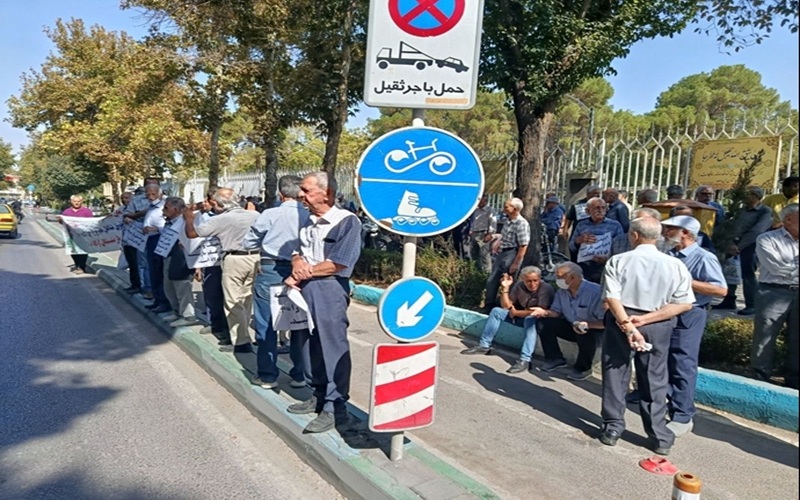
The danger identified by Pezeshkian is therefore not confined to the choice between war and negotiations. It also concerns the possibility that accumulated social and economic grievances could develop into renewed public unrest.
Oil Revenues and the Security Apparatus
The structure governing Iran’s oil revenues offers another indication of how economic power is concentrated within the regime.
Shamseddin Hosseini, chairman of the parliament’s economic affairs commission, has described a committee established before the previous administration that continues to make decisions about oil sales, including which buyers receive Iranian oil.
According to Hosseini, the committee includes the head of the Planning and Budget Organization, the economy minister, and the governor of the Central Bank. Other members have not been publicly identified in the account.
A particularly revealing detail concerns oversight: the Ministry of Intelligence reportedly serves as the committee’s auditor instead of the national audit organization.
The arrangement raises serious questions about transparency and accountability in the management of public resources. When decisions over oil sales involve senior economic officials but oversight rests with a security institution, independent scrutiny of the use of national revenue becomes a central concern.
Former communications minister Mohammad Javad Azari Jahromi has also pointed to the role of oil-trading networks linked to the IRGC and the regime’s security and military institutions.
These networks operate within a system in which oil revenue is essential to the state’s finances. The central question is how much of that wealth serves the public interest and how much supports the institutions responsible for domestic repression and the regime’s military ambitions.
The Cost of Preserving the Regime
The economic crisis cannot be separated from the regime’s spending priorities. Resources that could help address public needs are also used to sustain security institutions, military programs, and regional policies that carry substantial costs.
Meanwhile, the government faces the challenge of meeting public expectations while operating within a system where powerful institutions and opaque financial networks limit accountability.
Pezeshkian’s admission that the government will be responsible if it fails to resolve people’s problems highlights the contradiction. The authorities recognize the danger of public disillusionment, yet the structures sustaining the regime continue to place competing demands on national resources.
Iran’s ruling establishment may attempt to manage the crisis through rhetoric, coercion, or shifting responsibility among officials. But these measures do not resolve the underlying economic grievances.
The regime’s most serious vulnerability may ultimately lie not in the military confrontation it publicly emphasizes, but in the growing distance between the ruling establishment and a population struggling with the consequences of its policies. As long as public resources are directed toward preserving the regime’s coercive apparatus rather than addressing the needs of society, the pressures driving public discontent will remain unresolved.