


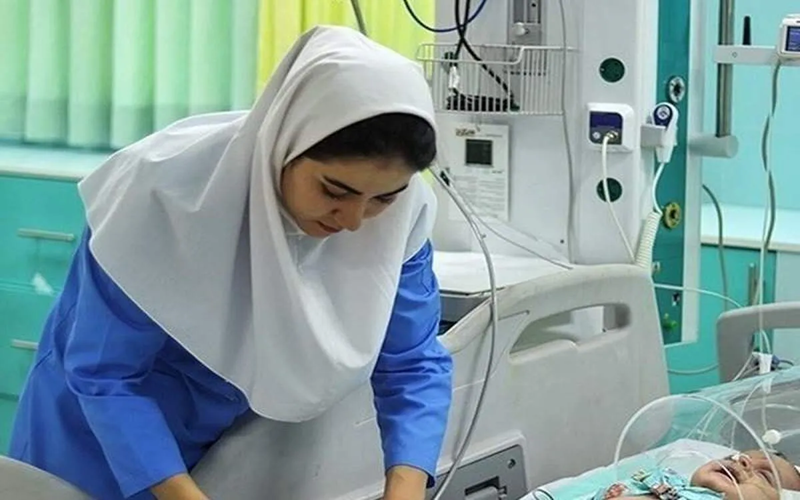

Low wages, forced overtime, and deteriorating working conditions are driving thousands of nurses out of the profession each year, while hospitals struggle to maintain safe patient care despite a large pool of trained but inactive nurses.
Iran’s Health System Faces a Critical Nursing Shortage
Iran’s healthcare system is grappling with a severe nursing shortage, even as tens of thousands of trained nurses remain unemployed or outside the profession. Official statements by nursing-sector representatives point to a structural crisis driven by low pay, difficult working conditions, and the failure to retain qualified personnel.
On October 13, 2026, the head of Iran’s Nursing Organization reported that the country needed at least 100,000 additional nurses. Meanwhile, the secretary-general of the Nursing Home Association estimated that approximately 70,000 nurses were unemployed or staying at home, with his estimates in separate statements ranging from 70,000 to 80,000.
The figures expose a fundamental contradiction: hospitals cannot recruit enough nurses to meet patient needs, while a substantial number of trained professionals are unwilling or unable to work under existing conditions.
According to the head of the Nursing Organization, the required staffing level is approximately 1.8 nurses per hospital bed. In Tehran, the situation is particularly difficult, with only 0.8 nursing personnel per bed. He attributed the capital’s staffing problems partly to the high cost and difficulty of living and working there, which discourages nurses from taking positions in the city.
The Nursing Home Association’s secretary-general has also pointed to the failure of recruitment announcements by medical universities to attract sufficient applicants. The central problem, he said, is the profession’s declining appeal.
Low Wages Drive Nurses Out of the Profession
Financial pressures are a major factor behind the exodus from nursing. According to statements by nursing officials, the average monthly salary of nurses is approximately 25 million to 28 million tomans—equivalent to roughly $100 at the exchange rate cited in the report.
The gap between earnings and living costs has become increasingly difficult to sustain. Nursing Organization head Mohammad Mirza Beigi’s counterpart in the source reporting, Jafar Najatian, has stated that nurses’ monthly salaries are insufficient to cover even ten days of expenses.
The compensation crisis extends to the payment of nursing service tariffs. Najatian said an agreement had been reached the previous year for a 100 percent increase in these tariffs, but the actual increase amounted to approximately 67 percent.
Such discrepancies, combined with low wages and demanding shifts, have weakened incentives to remain in the profession.
Najatian has also reported that approximately 5,000 nurses leave their jobs annually. Not all of them emigrate. Some remain at home, while others turn to work unrelated to their training.
The result is a costly loss of trained personnel at a time when hospitals are struggling to fill vacancies. Years of professional education and clinical experience are being underused, while patients and the nurses who remain in service bear the consequences.
Overloaded Nurses Put Patient Care at Risk
The staffing crisis is already visible in individual hospitals.
At Tehran University of Medical Sciences’ Children’s Medical Center, approximately 420 nurses are employed, yet the hospital faces a shortage of another 40, according to its head of nursing services.
The reported nurse-to-bed ratio is approximately one nurse for every eight beds in general wards and one for every three beds in intensive care units. Nursing officials have emphasized that caring for children can impose additional demands on staff, making shortages especially difficult to manage.
The situation is not confined to Tehran. The nursing management director at Mashhad University of Medical Sciences has identified staffing shortages and the mismatch between the number of nurses and available hospital beds as major concerns.
More alarming is the account provided by the Nursing Home Association’s secretary-general, who said that nurses who should care for five patients may now be responsible for 20 to 30.
Such workloads raise serious concerns about the ability of nursing staff to monitor patients, administer treatment on time, recognize complications, and provide adequate bedside care. The association’s secretary-general has warned that the consequences can extend to patient deaths.
As nurses resign, the workload of those who remain increases. Hospitals increasingly rely on compulsory overtime to compensate for missing personnel, but longer shifts cannot sustainably replace adequate staffing. Instead, excessive workloads can deepen exhaustion, encourage further resignations, and perpetuate a cycle of shortages.
Unemployed Nurses, Unfilled Vacancies, and Questions Over Funding
The coexistence of widespread vacancies and tens of thousands of inactive nurses points to a failure to make the profession financially and professionally sustainable.
Recruitment alone cannot resolve the problem if salaries remain inadequate, working conditions continue to deteriorate, and existing staff are driven away by excessive workloads. The fact that medical universities reportedly struggle to fill advertised positions suggests that the crisis extends beyond the absolute number of trained nurses.
The allocation and use of healthcare funding are also under scrutiny. Najatian has called for greater transparency in the financial resources of the health system, arguing that the public should be able to see where healthcare funds come from and how they are spent.
Without transparent accounting and effective workforce planning, increased budget allocations alone cannot guarantee improvements in staffing or patient care. The decisive questions are whether available resources reach frontline services, whether hospitals can offer competitive compensation, and whether trained nurses can be retained.
A Healthcare Crisis With Serious Human Consequences
The nursing shortage reflects a broader failure to protect the foundations of public healthcare. A system that leaves trained nurses unemployed while hospitals operate with insufficient staff is failing to match its human resources to the population’s needs.
The crisis is particularly troubling given the importance of medical personnel during periods of political unrest. During the 2022 uprising and the December 2025–January 2026 protests, reports of medical workers treating injured demonstrators and facing subsequent repression raised serious concerns about the safety and independence of healthcare professionals. Allegations of killings, imprisonment, and exile involving medical personnel have further intensified concerns over the treatment of those providing care during unrest.
At the same time, the regime continues to devote substantial resources to strategic and military programs, including its nuclear, missile, and drone capabilities, as well as support for regional armed groups. Critics argue that these priorities stand in stark contrast to the difficulties facing hospitals and the financial hardship of healthcare workers.
The nursing crisis cannot be resolved through temporary recruitment drives or compulsory overtime. It requires adequate compensation, improved working conditions, transparent healthcare spending, and a staffing policy that places patient safety at the center of decision-making.
Until these problems are addressed, Iran’s hospitals will continue to face the damaging combination of vacant positions, unemployed trained professionals, exhausted staff, and mounting risks to patients. The ultimate cost is borne by ordinary Iranians, whose access to safe and timely medical care depends on a healthcare workforce that the current system is struggling to sustain.