



An open letter challenges the decision to honor the son of Iran’s former shah, citing organized violence by monarchist supporters against Iranian dissidents in exile and warning against the revival of the Shah’s repressive security apparatus.
The decision by Germany’s Friedrich Naumann Foundation to award its 2026 Freedom Prize to Reza Pahlavi, the son of Iran’s deposed shah, has drawn a forceful protest from 129 Iranians living in Europe. In an open letter, the signatories urged the foundation to reconsider its decision, arguing that honoring Pahlavi disregards the experiences of Iranian dissidents who oppose both the current religious dictatorship and the restoration of monarchical rule.
The signatories describe themselves as active participants in demonstrations against Iran’s ruling regime who have also faced harassment and physical attacks from supporters of the monarchist current. They argue that presenting Pahlavi with a freedom award risks lending democratic legitimacy to a political figure whose supporters have been associated with intimidation of other Iranian opposition groups.
Their appeal raises a fundamental question for a foundation whose work centers on liberal democracy: whether a political figure should be honored in the name of freedom without adequately considering his record, political program, and the conduct of forces mobilizing in his support.
Open Letter Cites Physical Attacks and Legal Proceedings
The signatories describe repeated incidents in recent years in which Iranian protesters and opposition activists abroad were allegedly subjected to assaults, severe verbal abuse, and intimidation by groups supporting Pahlavi. According to the letter, some incidents resulted in serious injuries, head trauma, loss of consciousness, and hospitalization.
The authors maintain that these incidents should not be treated as isolated confrontations. They describe a recurring pattern across Europe, the United States, Canada, and Australia, in which opponents of the monarchist current—including leftists, members and supporters of the People’s Mojahedin Organization of Iran (PMOI/MEK), and advocates of the rights of Iran’s ethnic communities—are targeted with hostile slogans and physical aggression.
The letter also criticizes Pahlavi for failing to clearly condemn such conduct. Its authors argue that meetings with individuals involved in confrontations, alongside the continued political mobilization of groups operating in his support, raise questions about his responsibility toward the behavior of his political base.
The signatories state that several cases involving violence are being examined by police and judicial authorities in different countries. These are serious matters that must be assessed through the relevant legal processes, but the authors argue that the foundation should not ignore the broader political concerns raised by Iranian opponents of both monarchism and the current regime.
Canadian and New York Incidents Highlight the Concerns
The letter points to specific cases to illustrate what its authors regard as the risks posed by organized intimidation within the Iranian diaspora.
It refers to the imprisonment of two individuals in Canada in connection with the killing of Masoud Masjudi, an Iranian academic described in the letter as an opponent of monarchist activists. The signatories also cite an incident involving Reza Ebrahimi, whom they say met Pahlavi and his wife in Canada on September 19 before attacking a large Iranian demonstration outside United Nations headquarters in New York on September 22. According to the letter, a demonstrator was injured in the incident and Ebrahimi became the subject of prosecution by New York authorities.
These references are presented by the signatories as evidence that hostility toward rival opposition groups warrants serious scrutiny. Their central argument is that democratic institutions should not overlook violence and intimidation simply because those involved present themselves as opponents of Iran’s ruling regime.
The letter’s broader concern is that Iranian exiles who mobilize against the current dictatorship should be able to exercise their political rights without being threatened or attacked by another political faction.
The Dispute Extends Beyond a Prize to the Legacy of the Shah
The signatories also challenge Pahlavi’s record on the former monarchy’s repression. They accuse him of defending his father’s rule rather than clearly acknowledging the abuses committed under the Shah, including torture, executions, and the activities of SAVAK, the former regime’s secret police.
They warn that efforts to restore the monarchy risk reviving the authoritarian structures associated with that period. The letter specifically raises concerns about what its authors describe as attempts to rebuild the Shah-era security apparatus and normalize its legacy.
For the signatories, the award is therefore not simply a disagreement over the merits of one political figure. They see it as a question of whether the language of freedom and democracy is being used to legitimize a project that does not offer a clear break with Iran’s history of authoritarian rule.
Iran’s modern political history has been marked by successive systems of repression. The current regime’s persecution of dissidents does not erase the abuses of the monarchy, just as opposition to the Shah does not justify the religious dictatorship that replaced him. The signatories’ position rests on rejecting both forms of authoritarianism rather than treating the restoration of one as an answer to the other.
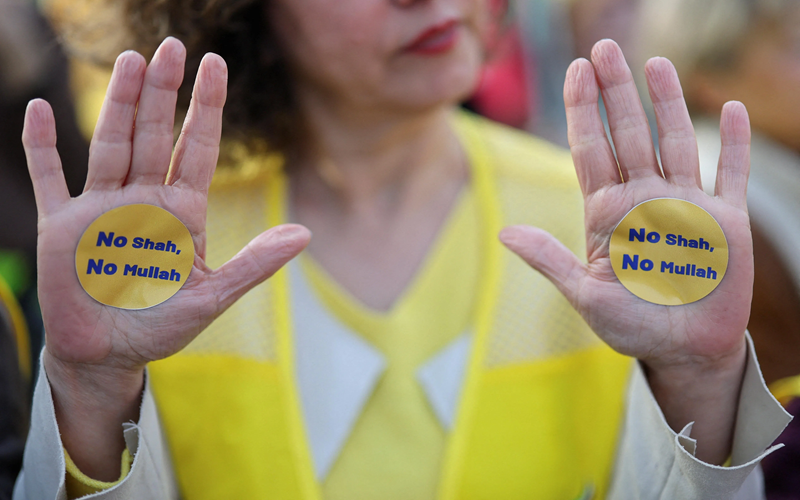
Their message is encapsulated in the longstanding democratic slogan, “No Shah, No Mullahs,” which rejects both monarchical restoration and the ruling theocracy in favor of popular sovereignty.
Signatories Urge the Foundation to Reconsider Its Decision
The 129 signatories call on the Friedrich Naumann Foundation to reverse its decision to award Pahlavi the 2026 Freedom Prize. They propose that the foundation retain the award until it can be presented to representatives freely chosen by the Iranian people.
The proposal places the right of Iranians to determine their own political future at the center of the controversy. Rather than endorsing an individual on the basis of dynastic lineage or claims to represent the opposition, the authors argue that democratic legitimacy must come from the free choice of the people themselves.
Their appeal also challenges European institutions to distinguish between supporting the Iranian people’s struggle for freedom and endorsing a particular faction that claims to speak for them. The signatories argue that a freedom award should reflect democratic principles in practice, including political pluralism, accountability, and the rejection of intimidation.
The controversy over the Friedrich Naumann Foundation’s decision thus reaches beyond the award itself. It raises the question of whether international democratic institutions will assess Iran’s opposition according to the principles they publicly uphold—or confer legitimacy on a political project despite serious concerns raised by other Iranian opponents of dictatorship.
For the signatories, the answer should begin with a clear principle: Iran’s future must be determined by its people, not imposed through the restoration of a hereditary system or the continuation of religious authoritarianism.