


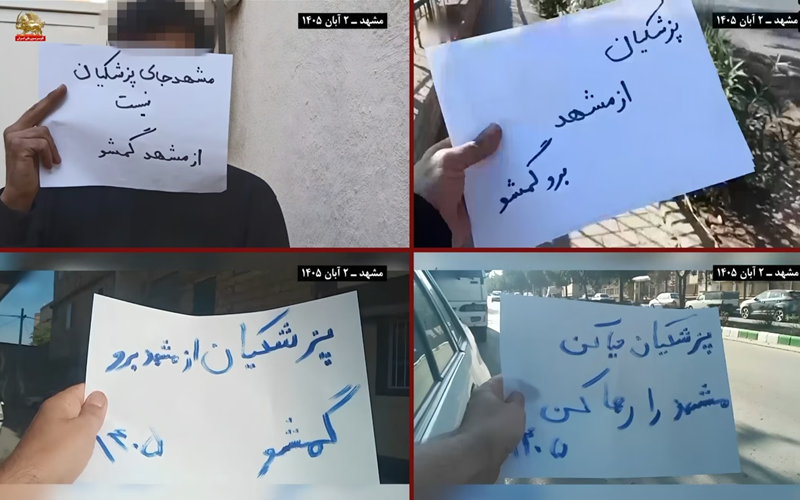

Protest leaflets and photo messages denounce the Iranian regime’s president during his November 2 visit, accusing his government of executing young people and innocent citizens.
Young protesters in Mashhad used leaflets and photo messages to denounce Iranian regime President Masoud Pezeshkian during his visit to the city on Saturday, November 2, 2026, declaring that he was unwelcome and condemning the wave of executions and repression across Iran.
The protest actions delivered a direct challenge to Pezeshkian’s presence in the northeastern city, with slogans rejecting his visit and holding his administration responsible for the regime’s treatment of young people and ordinary citizens. The messages reflected opposition to executions and state repression, placing the president’s visit against the backdrop of Iran’s escalating use of capital punishment.
One leaflet carried the blunt slogan: “Pezeshkian, Mashhad is no place for you. Get lost!” Another declared: “Pezeshkian, have some shame and leave Mashhad alone.” A third message stated: “The people of Mashhad despise you. Get lost!”
The language left little room for ambiguity. Rather than treating the visit as a routine presidential engagement, the protesters used it to challenge Pezeshkian’s legitimacy and confront him with public anger over the regime’s policies.
Executions at the Center of the Protest
Several of the messages focused specifically on the regime’s execution campaign. One leaflet accused Pezeshkian of having a record defined by the execution of young people and innocent citizens, declaring:
“Pezeshkian’s only record is the execution of young people and innocent people. Get lost from Mashhad!”
Another slogan described him as “the president of Velayat, a partner in every crime.” The wording challenged the distinction between the presidency and the broader ruling establishment, portraying Pezeshkian as accountable for the actions carried out under the system he represents.
The protests thus connected the president’s visit to a wider indictment of the Iranian regime’s use of executions as an instrument of repression. By emphasizing the deaths of young people and innocent citizens, the messages sought to make the human cost of the regime’s policies central to the public response.
The slogans also rejected any attempt to present the presidency as separate from the ruling system’s coercive institutions. The description of Pezeshkian as a partner in the regime’s crimes underscored the protesters’ position that responsibility extends beyond those who directly carry out arrests, imprisonment, and executions to the political leadership that presides over the system.
A Message of Continued Resistance
Alongside the condemnations, one of the protest actions featured a young activist affirming the determination to continue resisting oppression.
The message declared: “I swear by the blood of our comrades, we will stand firm until the end.”
The statement invoked those who have lost their lives in the struggle against repression and presented continued resistance as a commitment to their memory. Its emphasis on perseverance contrasted with the authority projected by the presidential visit, conveying a message that opposition would continue despite the regime’s coercive measures.
The combination of leaflets, photo messages, and defiant slogans gave the protest actions a clear political focus: rejecting Pezeshkian’s presence, condemning executions, and affirming continued opposition to the ruling establishment.
Although the available account does not provide details about the number of participants, the locations of the actions, or any response by security forces, the messages themselves conveyed an unmistakable challenge to the president.
Mashhad Becomes a Platform for Defiance
The protest actions during Pezeshkian’s visit brought together three central themes: rejection of the regime’s political leadership, condemnation of executions, and determination to continue resisting repression.
By directly addressing Pezeshkian, the protesters sought to hold the president personally and politically accountable for the policies of the government he leads. Their slogans portrayed executions not as isolated judicial decisions but as part of a broader system of repression for which the ruling establishment bears responsibility.
The closing message of standing firm until the end gave the actions a broader significance beyond the visit itself. It expressed the protesters’ determination to continue opposing oppression and to remember those who have paid the ultimate price in that struggle.
The central message from Mashhad was direct: the regime’s president could visit the city, but his presence would not silence opposition to executions and repression.