


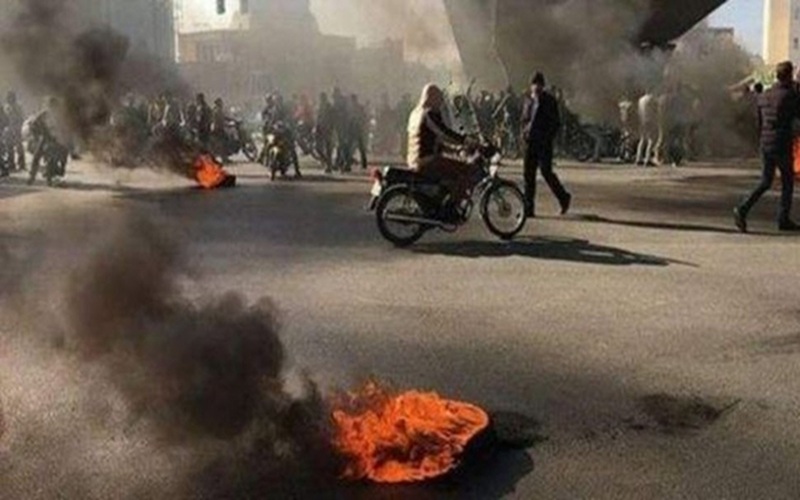

Open conflict between rival factions of Iran’s regime over renewed war and foreign infiltration exposes a deepening crisis at the top of power. As the anniversary of the November 2019 uprising approaches, the central question is whether these divisions will create greater space for the Iranian people to challenge the entire system.
The intensifying confrontation between rival factions of Iran’s regime is revealing more than a dispute over foreign policy. It is exposing a system increasingly struggling to contain its internal contradictions, as accusations of foreign infiltration, complicity in external aggression, and deliberate efforts to restart war become weapons in the struggle for power.
For years, the factions governing Iran have shared responsibility for a system built on domestic repression, regional intervention, and confrontation with its adversaries. Now, policies once defended as essential to the regime’s survival are becoming ammunition for one faction to discredit another.
This escalation raises a fundamental question: What does the deepening conflict at the top of power mean for the Iranian people?
The answer is not that factional infighting will automatically bring freedom. Rather, the public exposure of these divisions can weaken the ruling establishment’s ability to project unity, shift the political atmosphere, and create opportunities for society to press its own demands.
Accusations of Infiltration Signal a New Stage of Infighting
An article by Ahmad Zeidabadi in the Iranian newspaper Ham-Mihan, published on November 24, 2026, under the title “Come, Officer, Arrest Me!”, offers an indication of how far the confrontation has escalated.
Zeidabadi wrote:
“Considering the coincidence between the call for withdrawal from the NPT in the Jebheh-ye Paydari statement and the new pretext for renewed aggression against Iran to be accidental is extraordinarily difficult, and the possibility of some form of division of labor through infiltration should by no means be overlooked.”
The significance of this accusation lies in its implications. A dispute over Iran’s nuclear policy and withdrawal from the Nuclear Non-Proliferation Treaty is being linked to the possibility that a domestic political faction could be facilitating external aggression through infiltration.
Such language moves the confrontation beyond disagreements over policy. It raises questions about loyalty, responsibility for external threats, and whether positions advanced by one faction could serve the interests of Iran’s adversaries.
When competing factions begin portraying one another as potential instruments of foreign powers, the struggle for political advantage becomes inseparable from questions about the security and stability of the entire ruling structure.
The public is left to consider an uncomfortable question: Who benefits from policies that keep Iran exposed to escalating confrontation, and who pays the price?
The answer is particularly important for ordinary Iranians, who bear the consequences of decisions made at the top through economic hardship, insecurity, repression, and the risk of renewed conflict.
The Politics of War Becomes a Weapon Against Rivals
The confrontation has also exposed a striking contradiction in the regime’s political discourse.
The regime has long presented confrontation with foreign adversaries as a pillar of its governing doctrine. Yet the same orientation is now being used by rival factions to accuse one another of recklessness and of deliberately pushing Iran toward another war.
In his article, Zeidabadi accused the Jebheh-ye Paydari faction and its political and ideological allies of working around the clock to resume the war.
The accusation illustrates how a policy once defended in the name of the system’s survival can become a liability when its potential consequences threaten the interests of those competing for power.
Each faction has an incentive to portray itself as the responsible party while assigning blame for dangerous policies to its rivals. The result is a political contest in which responsibility for the consequences of confrontation becomes another front in the struggle for control.
But the central issue extends beyond which faction prevails.
A renewed war would not be an abstract political setback for the ruling elite alone. Its consequences could reach into every aspect of Iranian life, from public safety and economic conditions to the country’s long-term future. The people would bear costs without having meaningful control over the decisions that expose them to those risks.
That is why the question raised by the public accusations deserves broader attention: What objectives are being pursued through calls for renewed war, and whose interests would another conflict serve?
Answering that question requires looking beyond the competing narratives of the factions themselves.
Internal Divisions Do Not Automatically Produce Freedom
The declining capacity of rival factions to maintain even the appearance of unity is a sign of a deepening crisis. Their mutual accusations suggest that the mechanisms through which the establishment has traditionally managed internal disputes are under increasing strain.
Yet a divided ruling system is not, by itself, a democratic alternative.
Political factions can weaken one another while continuing to defend the same fundamental structures of power. Their conflict may be driven by competing calculations about survival, influence, and responsibility rather than by any commitment to political freedom or popular sovereignty.
For the Iranian people, therefore, the significance of these divisions lies not in choosing one faction over another but in recognizing the vulnerabilities they expose.
The central political challenge remains the system itself and the policies imposed on society under its authority. A change in the balance of power among rival factions would not necessarily resolve the problems of repression, economic deprivation, or the absence of democratic accountability.
The decisive question is whether the public can use the political space opened by these divisions to advance its own demands.
The November 2019 Uprising and the Question of Popular Agency
The timing of the intensifying factional confrontation is particularly significant as Iran approaches the anniversary of the November 2019 uprising, when protests challenged the ruling establishment and were met with a deadly crackdown.
That uprising remains a reminder that the stability projected by the regime can be challenged by popular mobilization. It also underscores the gulf between the interests of the governing elite and the demands of a society burdened by political repression and economic hardship.
Today, the growing visibility of divisions within the establishment may reinforce public awareness that Iran’s political and economic crises cannot be separated from the system responsible for the country’s major decisions.
But awareness alone is not enough. Nor does factional conflict guarantee that the resulting political conditions will benefit the public.
The outcome depends on whether social discontent finds expression in independent demands for accountability, freedom, and fundamental political change, rather than being absorbed into the power struggle between competing factions.
The ruling establishment’s internal confrontation may create openings, but it cannot determine how those openings will be used.
Ultimately, the intensifying conflict at the top of Iran’s power structure points to a fundamental contradiction: a system whose factions once defended confrontation as a means of preserving their rule now find themselves using the prospect of war to discredit one another.
For the Iranian people, the priority is not to decide which faction is more credible in its accusations against the other. It is to recognize that the struggle over the regime’s future is not the same as the struggle for Iran’s democratic future.
As the anniversary of November 2019 approaches, the decisive issue is whether the divisions exposed within the ruling establishment will translate into greater space for popular action and a stronger pursuit of fundamental change.
The regime’s factions may be turning against one another, but Iran’s future will ultimately be determined not by their mutual accusations, but by the Iranian people’s ability to challenge the system as a whole and pursue a democratic alternative.