


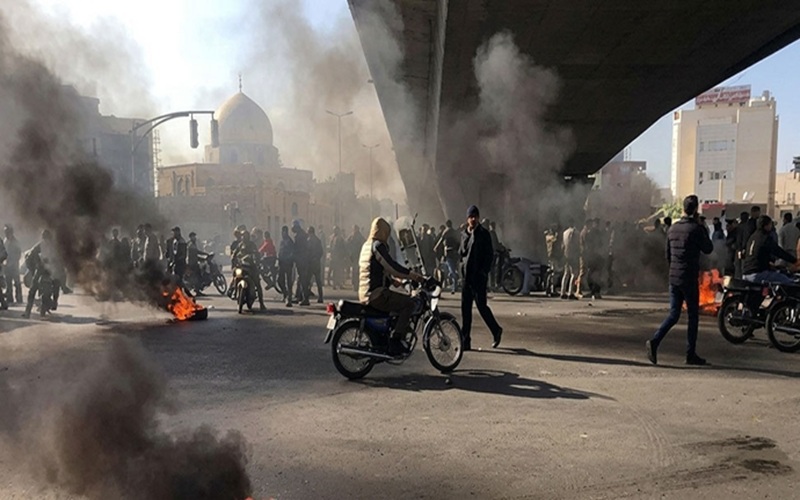

Seven years of mounting economic hardship, deepening political fractures, and the evolution of organized resistance have kept the causes of Iran’s November 2019 uprising alive, making it a defining turning point in the struggle against religious dictatorship.
The uprising exposed the depth of popular hostility toward Iran’s religious dictatorship and demonstrated that grievances extending far beyond a single economic decision could rapidly turn into a nationwide political challenge. The regime responded with lethal force, killing protesters and attempting to restore control through fear. Yet repression could suppress demonstrations without resolving the conditions that had brought people into the streets.
Seven years later, those underlying conditions remain central to understanding Iran’s political crisis. The pressures confronting society have intensified, while the regime faces a combination of economic, social, and political challenges that cannot be overcome through coercion alone.
The Economic Pressures Behind the Next Uprising
The immediate trigger for the November 2019 uprising was a sudden increase in gasoline prices, announced without warning and followed by protests that spread rapidly across dozens of cities. The speed of that expansion revealed how much anger had accumulated beneath the surface.
The price increase was the spark, not the underlying cause. Years of corruption, economic mismanagement, inequality, and political repression had eroded public confidence in the system. For many Iranians, the decision represented another attempt to make ordinary people pay for a crisis created by those in power.
Today, the economic pressures extend across almost every dimension of daily life. Persistent inflation, declining purchasing power, widespread poverty, and the deterioration of basic public services have made survival increasingly difficult for millions of households. Water shortages, land subsidence, and environmental degradation add another layer of insecurity, threatening livelihoods and communities while exposing the consequences of years of failed governance.
The crisis is no longer confined to the cost of fuel or food. It reaches the basic requirements of human life: access to water, affordable housing, adequate nutrition, and the ability to support a family through work.
These conditions do not make a new uprising inevitable on a predetermined timetable. They do, however, deepen the grievances that have repeatedly brought people into conflict with the regime. The lesson of November 2019 is that a seemingly specific economic decision can become the catalyst for a much broader confrontation when public anger has accumulated over years and citizens see no credible institutional route to change.
The regime can attempt to contain individual crises, but each unresolved emergency adds to the burden of accumulated resentment.
From November 2019 to a More Experienced Resistance
The November uprising also exposed a central question in the struggle against dictatorship: how can spontaneous public anger develop into a sustained challenge capable of confronting an entrenched security apparatus?
The protests demonstrated the speed with which discontent could spread beyond its initial trigger. They also highlighted the importance of local initiative, coordination, and the ability to sustain political momentum in the face of repression.
In the years since, successive waves of protest and resistance have added to the experience of Iranian society. The 2022 uprising, in particular, demonstrated the continuing capacity of younger generations to challenge the regime’s authority and reject its attempts to impose ideological and social control. Other protests by workers, pensioners, students, and residents confronting water shortages have kept distinct grievances in the public arena.
For the organized opposition, the experience of November 2019 reinforced the importance of building connections between political resistance and the wider society. The People’s Mojahedin Organization of Iran (PMOI/MEK) and its network of Resistance Units have presented organized resistance as a means of translating public opposition into a sustained challenge to the machinery of repression.
The broader strategic question remains how effectively organized forces can connect with the diverse demands of a society under pressure. No network can substitute for the participation of the population itself. But the experience of repeated confrontations has underscored the importance of political organization, continuity, and a clear alternative to the existing system.
November 2019 was therefore not only an expression of anger. It was also a lesson in the relationship between popular mobilization, organized resistance, and the regime’s determination to prevent either from developing into a threat to its survival.
Mass Repression Did Not Restore Political Legitimacy
The regime’s response to the November 2019 uprising revealed its priorities. Rather than address the grievances driving the protests, the authorities deployed security forces, imposed an internet shutdown, and used lethal violence against demonstrators.
The killing of more than 1,500 protesters, according to figures cited by the Iranian opposition, became one of the most consequential episodes of state repression in the regime’s history. The exact toll remains disputed internationally, but the scale of the killing and the deliberate suppression of information demonstrated the lengths to which the authorities were prepared to go to retain control.
Such violence may raise the immediate cost of protest, but it cannot manufacture political legitimacy. Nor can it erase the memory of those killed or the questions raised by their deaths.
The uprising also exposed the contradiction at the heart of the regime’s approach to power. Its survival depends on preventing public discontent from becoming an organized political challenge. Yet every violent crackdown deepens the divide between the state and the people, while reinforcing the perception that the authorities have no answer to social grievances beyond force.
The years since November 2019 have brought further confrontations, renewed repression, and recurring signs of conflict within the political establishment. These developments do not establish that the regime is on the verge of collapse. They do demonstrate that repression has not resolved the underlying crisis of legitimacy.
The regime’s pursuit of political consolidation has likewise failed to eliminate internal rivalries. Competition among factions, disputes over policy, and tensions surrounding the exercise of power reflect a system under pressure. Whether such divisions translate into significant defections or institutional paralysis must be judged by concrete developments, not assumptions. Nevertheless, the need to manage both internal competition and public opposition places additional demands on the ruling establishment.
Regional Setbacks Cannot Resolve a Domestic Crisis
November 2019 unfolded under circumstances different from those confronting Iran’s regime today. Since then, its regional position, international relationships, and economic constraints have continued to evolve. The weakening of allied forces and networks, alongside mounting external pressures, has challenged aspects of the regional strategy through which Tehran sought to extend its influence.
These developments matter because the regime has long treated regional power projection as an instrument of deterrence and political survival. Resources devoted to foreign intervention have also carried domestic costs in a country where millions struggle to afford basic necessities.
Yet external pressure alone cannot deliver democratic change in Iran. Nor should war be mistaken for a solution to the country’s political crisis. The decisive issue remains the relationship between the regime and the Iranian people, including the population’s ability to organize, resist repression, and pursue a democratic alternative.
International isolation and economic constraints may intensify the pressure on the ruling establishment, but they do not automatically produce political transformation. That requires a domestic force for change, a clear political objective, and a credible vision of what should replace the existing system.
The Iranian opposition’s demand for a democratic republic, including the National Council of Resistance of Iran’s Ten-Point Plan, offers a framework centered on popular sovereignty, political pluralism, and the separation of religion and state. Such an alternative is essential to a political transition that rejects both the current religious dictatorship and a return to monarchical rule.
The choice facing Iran is not between competing forms of authoritarianism. It is between continued dictatorship and a future in which the Iranian people determine their own political system.
November 2019 Remains an Unfinished Chapter
The significance of November 2019 cannot be measured solely by the number of cities where protests erupted or the number of people killed in the crackdown. Its enduring importance lies in what it revealed: the depth of social discontent, the regime’s dependence on coercion, and the speed with which an economic grievance can develop into a political challenge.
The years since have not followed a simple or inevitable path toward change. Protests have ebbed and returned; repression has intensified; and the regime has continued to adapt its methods of control. But the underlying conflict has not disappeared.
Economic insecurity, environmental degradation, political exclusion, and the denial of basic freedoms continue to shape the lives of Iranians. Meanwhile, the experience accumulated through successive confrontations has become part of the country’s political landscape.
For the regime, the central problem is that restoring order is not the same as resolving a crisis. A government can shut down the internet, arrest demonstrators, and deploy force to empty the streets. It cannot, through those measures alone, restore the trust it has destroyed or eliminate the grievances that drive people to resist.
November 2019 should therefore be understood neither as a completed revolution nor as a memory preserved only through mourning. It was a defining moment in an ongoing struggle whose outcome remains dependent on political developments, social mobilization, and the capacity of the Iranian people and their organized opposition to advance a democratic alternative.
The bloodshed of November 2019 changed the terms of the confrontation between society and the state. The regime may seek to consign that uprising to the past, but its causes remain part of Iran’s present. The question is not whether the calendar has moved on. It is whether the ruling establishment can overcome the crisis that the uprising exposed.
Seven years later, that question remains unanswered.