


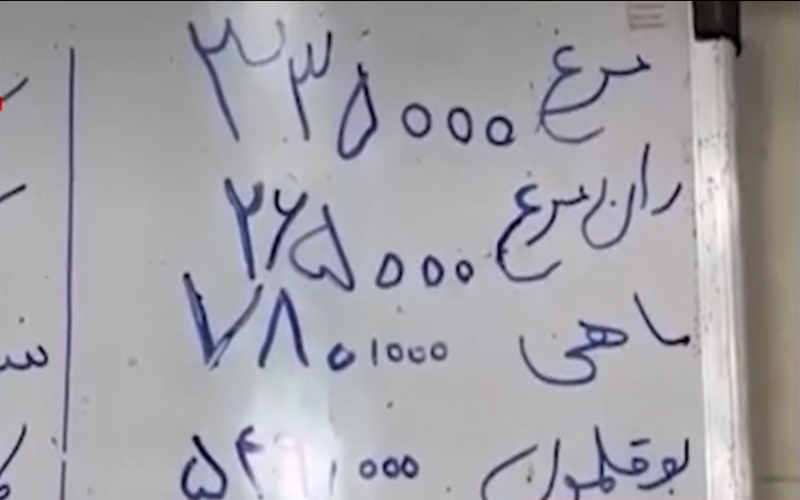

A 25 percent increase in chicken prices exposes the failure of the regime’s price-control pledges, as soaring production costs, currency policy, export mismanagement, and institutional profiteering further erode household purchasing power.
Iran’s worsening cost-of-living crisis is increasingly reflected in the shrinking food baskets of ordinary families. Even basic food products that have remained within reach of lower-income households are becoming unaffordable, while the regime continues to promote price-control schemes that bear little resemblance to conditions in the marketplace.
The latest example is chicken, one of the few remaining sources of animal protein for millions of Iranian households. According to reports in state-controlled media, chicken prices have increased by at least 25 percent, adding further pressure on families already struggling with the cost of food.
The state-run Ham-Mihan newspaper described the increase as an “agonizing torment” for people who have long been unable to afford red meat or fish. The newspaper illustrated the scale of the crisis by noting that purchasing four chickens could cost approximately four million tomans—a sum equivalent to one-fifth or one-sixth of the monthly income of a wage-earning household.
The report added that large sections of the population have effectively joined the ranks of the urban poor and are now struggling to afford even the basic protein products remaining in their diets.
This deterioration comes amid growing criticism of the regime’s economic priorities. While foreign currency allocations for essential medicines and basic commodities have been cut, the same system continues to facilitate imports of luxury vehicles, some reportedly valued at up to one trillion tomans.
Tehran’s ‘zero inflation’ promise collapses at the market
The latest price increases have also exposed the gap between the regime’s publicity campaigns and economic reality.
On October 7, Tehran Mayor Alireza Zakani announced a program branded as “zero inflation,” promising to keep the prices of 15 essential commodities unchanged for six months.
The scheme initially covered products such as rice, meat, legumes, pasta, soy products, dates, sugar, and cooking oil. Zakani said these goods would be available through 108 municipal fruit and vegetable markets, with prices remaining fixed throughout the six-month period.
He also promised that chicken, tomato paste, and cheese would be added to the subsidized basket beginning in November.
Yet the announcement has done little to reassure consumers facing daily price increases. Reports from the marketplace indicate that chicken prices have already climbed sharply. One local seller reported that chicken had reached 335,000 tomans per kilogram, while chicken legs were selling for 265,000 tomans.
The contrast is stark: while municipal authorities advertise price stability, households are confronting increasingly expensive food bills.
Export mismanagement and conflicting policies destabilize the poultry market
Even figures within the regime’s economic establishment have acknowledged the disorder surrounding agricultural production, imports, and exports.
A representative of the agricultural sector at Iran’s Cooperative Chamber criticized the lack of professional management in poultry exports, arguing that arbitrary export decisions have disrupted the domestic protein market.
He pointed out that Iranian companies have failed to establish recognizable brands among the leading poultry exporters in the Middle East. Instead, the country has largely relied on bulk sales, while export licenses and opportunities have reportedly been handed to individuals without the necessary expertise.
He described a system in which people involved in the poultry industry are encouraged to enter export markets in exchange for unrelated privileges, including vehicles or other benefits.
Such arrangements, rather than strengthening domestic production and export competitiveness, contribute to market instability and undermine the interests of both producers and consumers.
The problem, however, extends beyond poor export management. The concentration of economic power in institutions affiliated with the Islamic Revolutionary Guard Corps (IRGC) and the supreme leader’s office has further distorted production and distribution, allowing politically connected interests to benefit from markets that ordinary citizens increasingly struggle to afford.
Four forces driving chicken prices higher
Several interconnected factors are contributing to the surge in poultry prices, exposing the structural problems behind the regime’s food crisis.
1. Repeated increases in corn and soybean prices
Corn and soybeans are the principal components of poultry feed. Their rising prices directly increase production costs, placing additional pressure on poultry farmers and ultimately consumers.
2. Removal of preferential exchange rates for veterinary medicines and vaccines
The elimination of preferential foreign currency allocations for imported veterinary medicines and vaccines has made essential production inputs more expensive. These additional costs are passed through the poultry supply chain.
3. Rising feed costs justified by wartime conditions
The use of wartime circumstances to justify increases in the prices of livestock and poultry feed has added another layer of pressure on producers. Instead of protecting domestic food production during a period of economic instability, the regime’s policies have further increased operating costs.
4. Profiteering by supervisory and judicial institutions
Institutions supposedly responsible for regulating markets and preventing exploitation have themselves become part of a system accused of profiteering from the population. Rather than ensuring transparent pricing and protecting consumers, competing centers of economic and political power have contributed to the disorder.
A crisis that cannot be solved with publicity campaigns
The chicken price surge is more than an isolated market fluctuation. It exposes the consequences of an economic system in which essential production inputs become increasingly expensive, currency policies undermine access to basic goods, exports are managed through patronage, and powerful institutions exercise control over major economic sectors.
Zakani’s promise of six months of price stability cannot change these underlying conditions. Nor can government announcements compensate for the loss of purchasing power among households whose incomes are increasingly disconnected from the cost of living.
For millions of Iranians, chicken has become a last affordable alternative to red meat and fish. When even this basic food becomes increasingly inaccessible, the consequences extend beyond household budgets to nutrition, food security, and the living standards of an already impoverished population.
The regime’s repeated promises of economic stabilization are therefore colliding with a reality visible in every marketplace: the cost of survival continues to rise, while the ability of ordinary people to afford even basic necessities continues to shrink.