


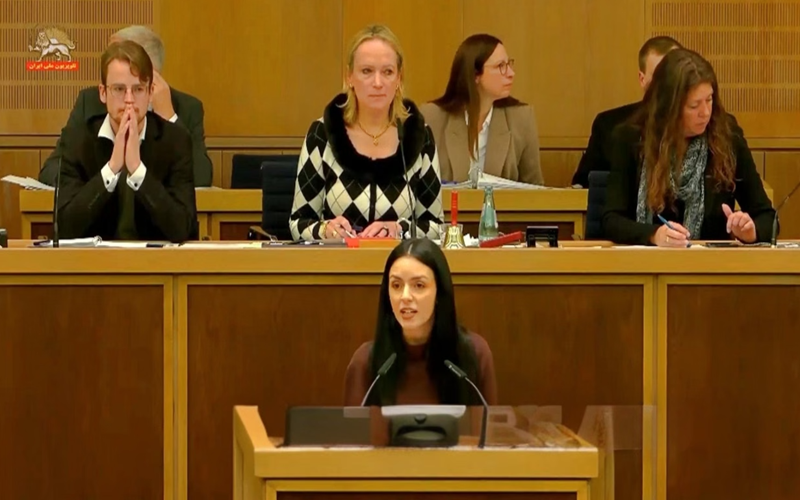

Representatives of the SPD, The Left, Greens, and Volt challenge Pahlavi’s democratic credentials, condemn hereditary monarchy, and warn against disregarding the victims of the Shah’s dictatorship and SAVAK.
Members of Frankfurt’s City Council from four different political parties have publicly challenged the decision to award Reza Pahlavi the Friedrich Naumann Foundation’s Freedom Prize, arguing that honoring the son of Iran’s last Shah risks legitimizing hereditary rule and disregarding the crimes committed under the former monarchy.
During the council’s November 5, 2026, session, representatives of the Social Democratic Party (SPD), The Left (Die Linke), Alliance 90/The Greens, and Volt voiced serious objections to Pahlavi receiving an award supposedly on behalf of the Iranian people. Their interventions highlighted the Shah’s record of political persecution, imprisonment, torture, and executions, as well as Pahlavi’s failure to clearly distance himself from his father’s dictatorship.
The speakers also challenged the assumption that an unelected individual can claim to represent Iran’s diverse population without a democratic mandate.
SPD: Reza Pahlavi has no mandate from the Iranian people
Sarya Atac of the Social Democratic Party (SPD) rejected the idea that Reza Pahlavi could legitimately accept the award on behalf of Iran’s population.
She pointed to his position as the son of the last Shah and recalled the systematic persecution, torture, imprisonment, and execution of political opponents under his father’s rule. Human rights were violated on a massive scale, she emphasized, while Pahlavi has never credibly distanced himself from that historical record.
Atac also stressed Iran’s ethnic and national diversity, noting that its population includes Persians, Azerbaijanis, Kurds, Baluchis, Arabs, and other communities.
She criticized the tendency among Pahlavi supporters to label advocates of minority rights as separatists, arguing that such attitudes exclude significant parts of Iranian society from the country’s political future.
The Iranian people, she maintained, are not a royal dynasty and do not need an inherited successor. They need representatives whom they freely choose themselves.
Atac argued that anyone genuinely seeking to honor the Iranian people’s courageous struggle for freedom and justice should not allow the former Shah’s son to receive the prize. This is particularly inappropriate at the Paulskirche, a historic symbol of democracy.
She called instead for recognition of the women, men, children, political prisoners, persecuted individuals, and ordinary people who have struggled for freedom. The honor, she argued, should go to those who have fought to achieve political power through their struggle, not someone who inherits the name and legacy of a ruling dynasty.
The Left: Monarchist rhetoric excludes minorities and silences dissent
Mona Waissi of The Left (Die Linke) challenged both the political implications of the award and the conduct of sections of the monarchist movement toward critics.
She argued that presenting a man who has never been elected by the Iranian people with an award on their behalf effectively grants him political legitimacy and reinforces the principle of hereditary monarchy.
Waissi described the hostility she encounters from monarchist supporters when discussing the persecution her family experienced under both the Shah’s dictatorship and the current ruling system. She recalled being subjected to ethnic insults and derogatory labels, including being called a separatist simply for speaking as a Kurd about Iran’s political future.
She stressed that this exclusionary rhetoric is not directed only against Kurds. Baluchis and other ethnic communities, as well as people who resisted dictatorship under both the monarchy and the current regime, face similar attempts to deny them a place in the definition of the Iranian people.
Anyone who excludes these communities from the Iranian nation, she argued, has no legitimate authority to speak in their name.
Waissi also questioned Pahlavi’s suitability as a symbol of freedom, pointing to his failure to unequivocally condemn the torture apparatus of SAVAK, the Shah’s notorious secret police.
She noted that numerous Iranian organizations in exile, former and current political prisoners, and survivors of SAVAK torture have protested against the award. In recent weeks, victims and survivors of the Shah’s security apparatus had also appeared before municipal committees to describe the brutality they experienced under the monarchy.
Waissi further questioned the consistency of the city’s political commitments, arguing that expressions of solidarity with victims of dictatorship in municipal committees cannot be reconciled with political cooperation that disregards their experiences.
Greens question the Foundation’s lack of transparency
Julia Eberz of Alliance 90/The Greens criticized the Friedrich Naumann Foundation’s handling of the award and the lack of transparency surrounding its decision.
She pointed out that the Foundation disclosed the identity of the intended recipient only after the rental agreement for the Paulskirche had already been signed.
This delayed disclosure, she argued, had understandably triggered intense controversy and public debate.
Her criticism highlighted how the decision to use a historic democratic venue for the ceremony had been made without adequately addressing the political implications of the proposed recipient.
Volt: Honoring Pahlavi deeply hurts survivors of torture
Tiara-Maria Mengel, parliamentary group leader of Volt in Frankfurt’s City Council, distinguished between supporting the Iranian people’s struggle for freedom and endorsing the individual selected to receive the award in their name.
She expressed solidarity with Iranians who risk imprisonment, torture, and death by taking to the streets to demand freedom. Recognizing their courage, she said, was entirely justified and deserved full support.
However, she emphasized that the identity of the person receiving an award on their behalf was not a minor detail.
Mengel recalled the deeply moving accounts presented before municipal committees by people who had suffered repression and torture under the Shah. For these survivors, the prospect of the former ruler’s son being presented as the representative of Iran’s freedom struggle was profoundly distressing.
She criticized the Foundation for elevating such a highly controversial political figure and called on it to refrain from handing the prize to Pahlavi.
Mengel reiterated that Volt supported honoring the Iranian people at the Paulskirche but rejected the decision to make Pahlavi the recipient.
A democratic future cannot be based on hereditary legitimacy
The interventions by representatives of four political parties demonstrate that opposition to the award extends beyond the Iranian exile community. Their arguments raise fundamental questions about democratic representation, historical accountability, minority rights, and the distinction between honoring a people’s struggle and endorsing an unelected political figure.
The controversy also exposes a central contradiction in presenting Reza Pahlavi as a symbol of freedom while leaving unresolved the historical legacy of the monarchy he seeks to politically succeed.
Iran’s future cannot be determined by hereditary entitlement or by the self-appointed representation of its people. Nor can the country’s diverse communities, including Kurds, Baluchis, Arabs, and Azerbaijanis, be excluded from the definition of the Iranian nation because they reject authoritarian rule or oppose the restoration of monarchy.
The Iranian people’s struggle is against dictatorship in all its forms. Replacing the current religious dictatorship with hereditary rule would not fulfill their demand for democracy.
A free Iran requires popular sovereignty, political pluralism, equality of citizenship, and the right of the people to determine their own future through democratic elections. The Frankfurt council debate has made clear why an award intended to recognize freedom should not be used to confer political legitimacy on an unelected heir to a former dictatorship.