


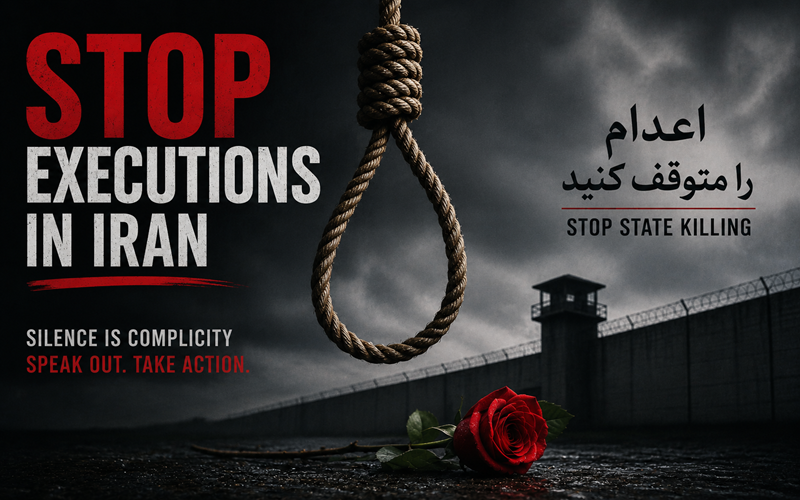

The executions of Amirhossein Maleki and Amirhossein Ebrahimi bring the death toll in the so-called Ali Khani Square case to nine. Meanwhile, the 145th consecutive week of coordinated protests in 66 prisons underscores the growing domestic and international resistance to the regime’s execution machinery.
The two executions coincided with the 145th consecutive week of the No to Executions Tuesdays campaign, which now involves prisoners in 66 prisons across Iran. What began as a weekly hunger strike against capital punishment has evolved into a sustained movement of resistance, connecting political prisoners, families of death-row inmates, social activists, and international human rights advocates.
Its significance extends beyond the prison walls. After more than two and a half years of uninterrupted activity, the campaign has become a focal point for international solidarity and a growing challenge to the regime’s systematic use of executions.
International support puts Iran’s execution crisis on the diplomatic agenda
The campaign has attracted support from governments, United Nations experts, human rights organizations, legal professionals, and prominent international figures.
Canada’s Foreign Affairs Office for Human Rights and Freedoms has publicly expressed support for the campaign, calling for an immediate halt to executions and the release of detainees. This intervention has brought the prisoners’ demands directly into the diplomatic arena, alongside continuing condemnations of Iran’s execution wave by countries including Germany, France, and the United Kingdom.
Several UN special rapporteurs and human rights experts have also supported efforts to challenge the regime’s violations of the right to life. Among them are Andrea Boland Vargas, Special Rapporteur on human rights defenders; Ana Lorena Delgadillo Pérez, Vice-Chair of the Working Group on Enforced or Involuntary Disappearances; Gina Romero; Leopoldo Maldonado Gutiérrez; and David R. Boyd.
International solidarity has also come from prominent figures in the human rights and legal communities. These include Oleksandra Matviichuk, recipient of the 2022 Nobel Peace Prize, and Alexis Anagnostakis, president of the European Criminal Bar Association’s Human Rights Committee. A joint letter signed by nine Nobel Peace Prize laureates has further reinforced international calls to oppose executions in Iran.
Members of the European Parliament, including Petras Auštrevičius, Helmut Brandstätter, and Milan Zver, have also voiced their support.
These expressions of solidarity have been reinforced by demonstrations, sit-ins, and international conferences organized by Iranian activists and supporters of the resistance, including the conference in Cuneo, Italy. Together, these initiatives have helped advance a concrete political demand: international relations with Iran’s regime should be conditioned on an end to executions.
Prison resistance undermines the regime’s strategy of intimidation
The significance of the No to Executions Tuesdays campaign lies not only in its opposition to individual death sentences but also in its growing impact on the relationship between prisons and Iranian society.
Its coordinated activities across 66 prisons challenge the isolation that the regime seeks to impose on political prisoners. Weekly hunger strikes create a shared platform through which prisoners can communicate their resistance, maintain solidarity, and ensure that executions and prison conditions remain visible beyond prison walls. Instead of allowing prisons to become places of enforced silence, the campaign has turned them into centers of organized protest.
The connection between prisoners and wider society has also become increasingly visible. Recent demonstrations by retirees and working-class protesters have incorporated demands for the abolition of executions and the release of imprisoned workers and teachers. Slogans such as “By the blood of our comrades, we stand until the death penalty is abolished” reflect how opposition to executions has expanded beyond a narrowly defined human rights demand and become part of the broader language of social protest.
Another important development is the growing public activism of prisoners’ families. Whereas executions and political repression have historically been accompanied by efforts to silence relatives and isolate them through intimidation, the campaign has helped create space for families to speak out, organize protests, and challenge death sentences publicly.
This growing solidarity has raised the political cost of executions for the regime. Death sentences can no longer be carried out with the same expectation of silence and indifference. Each execution risks triggering further protests, drawing international attention, and deepening the regime’s legitimacy crisis.
From weekly hunger strikes to a sustained movement of resistance
The 145-week continuity of the No to Executions Tuesdays campaign demonstrates the emergence of a sustained form of organized resistance inside Iran’s prison system. Its expansion to 66 prisons, together with the growing involvement of families, social movements, and international supporters, has made it increasingly difficult for the regime to isolate prisoners or conceal the consequences of its repression.
The executions of Maleki and Ebrahimi, bringing the number of victims in the Ali Khani Square case to nine, demonstrate that the regime continues to rely on capital punishment to terrorize society. But the persistence of organized resistance shows the limitations of this strategy.
Rather than restoring the climate of fear the regime seeks to impose, executions increasingly expose its dependence on repression and generate new demands for accountability. The No to Executions Tuesdays campaign has turned opposition to capital punishment into a sustained collective challenge, demonstrating that the struggle against executions is inseparable from the broader fight for freedom and democratic change in Iran.