


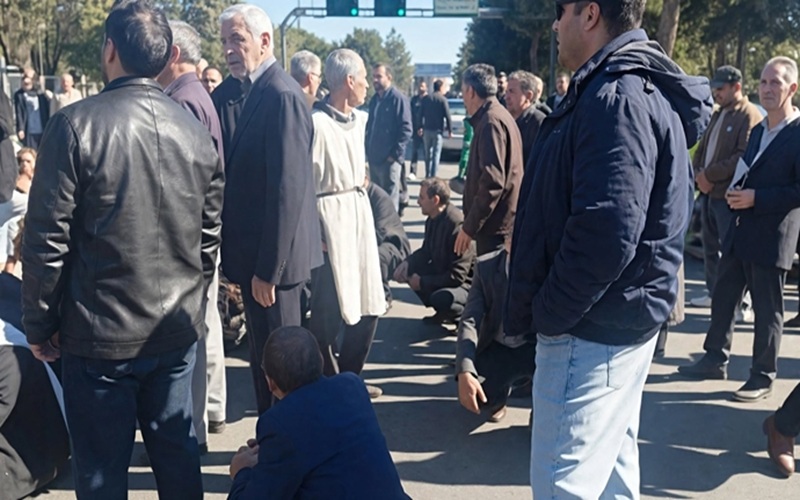

Despite promises to adjust wages for inflation and protect livelihoods, the Pezeshkian government is preparing another budget that prioritizes military spending, regional intervention, and religious institutions while workers struggle to afford basic necessities.
Inflation and falling wages expose the widening gap between government promises and workers’ lives
Iran’s workers are facing an accelerating decline in purchasing power as soaring inflation continues to erode wages and household incomes. Despite President Masoud Pezeshkian’s earlier promise to adjust workers’ and minimum-wage earners’ salaries in the middle of the year in line with inflation, no such increase has materialized. Meanwhile, the government is already preparing its budget for the next fiscal year, offering familiar promises of inflation control, production support, infrastructure reconstruction, and improved living standards.
The gap between these promises and the economic reality facing ordinary Iranians continues to widen. Workers who have already lost a substantial portion of their purchasing power since the beginning of the year are struggling to cover even basic household expenses.
The government’s proposed 1406 (2027–28) budget raises a fundamental question: how can the regime claim to be pursuing financial discipline and protecting people’s livelihoods while maintaining spending priorities that divert enormous resources away from the population?
Budget promises cannot conceal the reality of soaring inflation
Pezeshkian’s budget circular emphasizes controlling inflation, preserving production, rebuilding infrastructure, and protecting household livelihoods. Yet these objectives remain largely rhetorical when measured against the government’s actual economic record.
Even government-affiliated media have acknowledged the disconnect between official declarations and economic practice, observing that the government has turned paper into a convenient arena for displaying its supposed commitment to reform.
The problem is not a shortage of promises. Successive governments have repeatedly pledged to reduce inflation, create employment, and improve living conditions. Nevertheless, inflation has continued to accelerate, with official figures pointing toward levels approaching 90 percent. For some commonly consumed goods, reported price increases have already reached three-digit rates.
Under these conditions, declarations about financial discipline and economic stabilization offer little reassurance to households whose incomes are being overtaken by rising prices.
Military spending and religious institutions take priority over people’s livelihoods
The structure of government spending provides a clearer explanation of why promises of economic reform have repeatedly failed.
A meaningful assessment of the budget must examine not only its projected revenues but also how public resources are allocated. A substantial portion of the country’s resources continues to be directed toward military activities, missile and drone programs, and the regime’s regional interventionist policies.
Funding allocated to groups such as Hezbollah, alongside expenditures associated with military expansion and regional operations, represents a major drain on resources that could otherwise support the domestic economy and improve living standards.
Another significant burden comes from the extensive budgets assigned to religious institutions and clerical establishments. These allocations stand in stark contrast to the limited resources available for ordinary citizens.
The imbalance is particularly revealing when public funding for these institutions is compared with the amounts effectively allocated to individual citizens. While millions of Iranians struggle below the poverty line, the regime continues to protect financial structures that serve its ideological and political priorities.
This pattern undermines the government’s repeated declarations about austerity and fiscal discipline. Genuine budget reform would require a fundamental change in spending priorities, rather than merely announcing new economic targets.
A proposed 35 percent wage increase cannot compensate for inflation
The government’s proposed 35 percent increase in salaries for public-sector employees further illustrates the inadequacy of its approach.
Under the announced budget framework, the government has allocated resources for a 35 percent salary increase for its own employees. Wages in the private sector and other parts of the workforce, however, are determined separately by the Supreme Labor Council, which traditionally makes its decision close to the Persian New Year.
Even if the same 35 percent increase were extended to all workers and wage earners, it would remain far below the prevailing rate of inflation.
With inflation estimated at approximately 88–90 percent and year-on-year increases in some categories considerably higher, a 35 percent adjustment would leave workers facing another substantial loss of real income.
In practical terms, such an increase would not restore the purchasing power already lost since the beginning of the year, let alone compensate for the continuing rise in food, housing, and other essential expenses.
For millions of minimum-wage earners and salaried employees, the result would be continued deterioration in their ability to provide for their families.
Economic policy protects the regime’s priorities, not the majority of Iranians
The widening gap between wages and living costs exposes the limitations of Pezeshkian’s economic promises. The government speaks of controlling inflation and protecting livelihoods while preserving expenditure patterns that place military expansion, regional intervention, and clerical institutions ahead of the population’s basic needs.
The proposed budget offers no convincing mechanism for reversing the decline in workers’ purchasing power. Even its announced salary increases fall dramatically short of inflation, leaving wage earners to absorb the consequences of economic policies over which they have little control.
The central issue is therefore not simply how much salaries will increase next year. It is how the regime distributes the country’s resources and whose interests its economic policies are designed to protect.
As poverty spreads and household purchasing power continues to collapse, promises of reform and financial discipline increasingly appear disconnected from everyday life. For Iran’s workers, the government’s budget announcements offer little prospect of relief while the priorities responsible for draining the country’s resources remain untouched.