


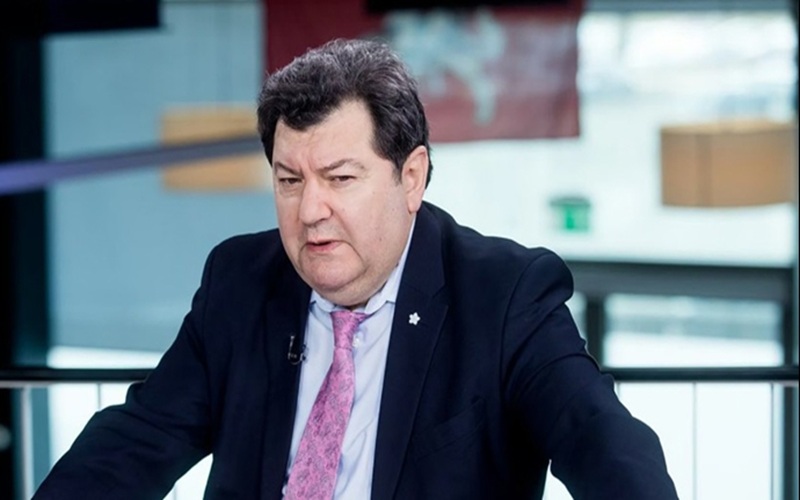

Emanuelis Zingeris, a member of Lithuania’s parliamentary Foreign Affairs Committee and a co-author of the country’s Magnitsky legislation, says the Iranian boxing champion’s message from death row turned his case into a powerful symbol of the struggle for human rights. He calls on European governments to put an end to executions and repression in Iran at the center of every engagement with Tehran.
The awarding of the 2026 Magnitsky Award to Iranian political prisoner and boxing champion Mohammad Javad Vafaei Sani has given international recognition to the plight of political prisoners in Iran and brought renewed attention to the regime’s systematic use of executions to suppress dissent.
Emanuelis Zingeris, a member of the Lithuanian Parliament’s Foreign Affairs Committee and one of the initiators of Lithuania’s Magnitsky legislation, described Vafaei Sani’s case as an extraordinary symbol of resistance against repression. Reflecting on the award ceremony, he emphasized that the message sent from Iran’s death row had a profound impact on the international human rights figures and political representatives attending the event.
Zingeris has been elected to Lithuania’s parliament nine times and served for four years as general rapporteur on human rights defenders at the Parliamentary Assembly of the Council of Europe. Drawing on this experience, he said he had rarely encountered a case with such a powerful human rights message.
Magnitsky Award puts Iran’s political prisoners in the international spotlight
Zingeris recalled that he had helped initiate Lithuania’s Magnitsky legislation 12 years ago. The legislation subsequently became part of a wider international effort to defend political prisoners and individuals subjected to torture and persecution because of their political beliefs.
He described the Magnitsky Award as one of the most prestigious international distinctions for individuals who put their lives at risk in the struggle for freedom and democracy. Its recipients are selected through a rigorous process by an international committee, making the recognition of Vafaei Sani particularly significant.
In Zingeris’s assessment, the Iranian boxing champion’s case has come to represent the broader pattern of human rights violations in Iran. His imprisonment and death sentence are not isolated incidents but reflect a system of repression directed against anyone who challenges the ruling establishment.
The choice of Vafaei Sani was therefore highly symbolic. His case drew attention not only to his own situation but also to the thousands of people who have suffered imprisonment, torture and other forms of persecution under Iran’s ruling regime.
A message from death row that moved the award ceremony
The Lithuanian lawmaker described the presentation of Vafaei Sani’s message at the ceremony as one of its most emotionally powerful moments.
According to Zingeris, hundreds of participants, including prominent human rights advocates and freedom activists, listened in profound silence as the message from the imprisoned boxer was read aloud. The account of his situation and his determination to continue defending the freedom of the Iranian people deeply affected those present, with some visibly moved to tears.
What made the case particularly extraordinary, Zingeris explained, was that Vafaei Sani was communicating from a prison where he remains under the threat of execution. Despite facing the possibility of death, he used his voice to appeal for continued international support for the Iranian people rather than focusing solely on his personal fate.
Zingeris viewed this as an exceptional act of courage and a historic appeal for freedom. He compared the scene to an ancient Greek tragedy, describing the extraordinary contrast between the imprisoned athlete’s precarious situation and the strength of his message.
For the Lithuanian parliamentarian, the significance of the appeal extended far beyond the fate of one prisoner. It expressed the demand of an entire population to live without fear, punishment for political beliefs or restrictions on fundamental freedoms.
He stressed that Iranian women, younger generations and ethnic minorities must be able to defend their dignity and enjoy the rights guaranteed by democratic principles. The Iranian people, with their rich cultural heritage and educational achievements, deserve the same freedoms and human dignity as people elsewhere in the world.
EU relations with Tehran must begin with the demand to stop executions
Zingeris called on European governments and other democratic countries to make the human rights situation in Iran their foremost concern in dealings with Tehran.
He argued that diplomatic engagements must not be dominated by nuclear issues, regional military developments, oil, gas or the strategic importance of the Strait of Hormuz while the regime continues to use capital punishment as an instrument of political repression.
In his view, the first demand in every meeting between European Union representatives, democratic allies and Iranian officials should be an immediate end to executions and the systematic killing of political opponents.
He said he intended to pursue this approach through European parliamentary institutions, including the Parliamentary Assembly of the Council of Europe, so that the issue of executions would become an established priority in international dealings with Tehran.
Zingeris also called for pressure on the Iranian authorities from all levels of government and the international community to end the widespread abuse of capital punishment.
He emphasized that human lives must take precedence over economic and strategic interests.
The lawmaker further argued that the regime’s reliance on executions is not only profoundly unjust but also counterproductive as a means of suppressing dissent. The elimination of one freedom advocate, he observed, does not extinguish the desire for freedom; instead, many others will emerge to continue the struggle.
He questioned how a government could claim to represent the Iranian people while simultaneously executing and persecuting them on a massive scale. In his assessment, the regime’s lack of legitimacy becomes increasingly evident as its repression intensifies.
Freedom for Vafaei Sani must become an international demand
Zingeris made a direct appeal for international action to secure Vafaei Sani’s release, urging governments, human rights organizations and individuals to maintain pressure on Tehran.
He called for the boxer’s case to remain at the center of international attention, emphasizing that the Magnitsky Award should serve not merely as recognition of his courage but as a catalyst for practical action to save his life.
The Lithuanian parliamentarian concluded that the international community must fundamentally reconsider its priorities toward Iran. The suffering of its people, the torture of political prisoners and the execution of those who defend freedom must no longer be overshadowed by geopolitical calculations.
His central message was clear: the lives and freedom of the Iranian people must come before oil, gas, the Strait of Hormuz and other strategic considerations.
The recognition of Mohammad Javad Vafaei Sani through the 2026 Magnitsky Award has provided an important opportunity to turn that principle into sustained international pressure for an end to executions and the release of political prisoners in Iran.