

Messages honoring the 1,500 victims of the November uprising reaffirm calls for continued resistance, an end to dictatorship, and the establishment of a democratic republic in Iran.
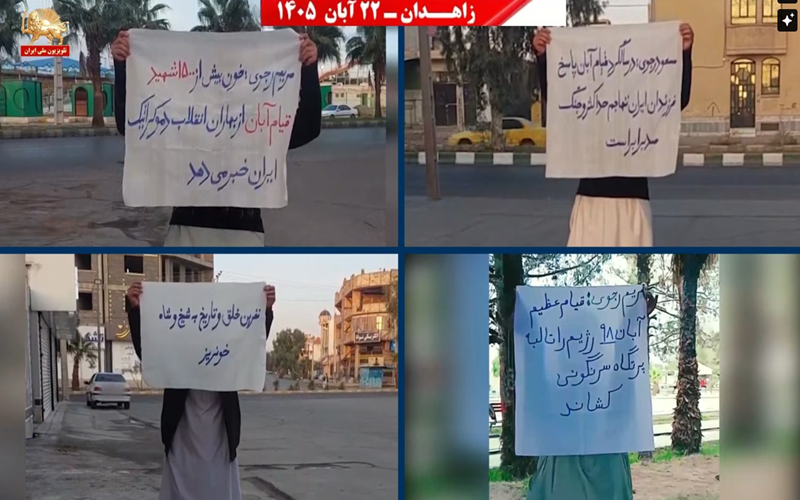
Young people and Resistance Units in Zahedan marked the anniversary of Iran’s November 2019 uprising by publishing messages and slogans highlighting the lessons of the revolt, commemorating its 1,500 victims, and calling for the continuation of the struggle for freedom.
The campaign featured statements by Iranian Resistance leaders Maryam and Massoud Rajavi, alongside slogans rejecting both the former monarchy and the current clerical dictatorship. Its central message was that Iran’s future must be built on freedom and a democratic republic, rather than another form of authoritarian rule.
The activities in Zahedan reaffirmed the significance of the November uprising as a turning point in Iran’s struggle against dictatorship and emphasized that the sacrifices of those killed in the protests remain a driving force for continued resistance.
Massoud Rajavi: The November uprising remains a guide for resistance
Messages attributed to Massoud Rajavi emphasized that the experiences and lessons of the November 2019 uprising continue to provide a model for action.
Marking the anniversary, he called for maximum offensive action and a hundredfold struggle, presenting continued resistance as the response to the regime’s repression.
Other messages highlighted the determination of Iran’s younger generation, declaring that the memory of the 1,500 victims of the uprising had rekindled the flames of resistance.
The campaign stressed that the blood of those killed, particularly the November 2019 victims, continues to inspire opposition to the regime.
One of its central messages was that the November uprising would continue until the overthrow of dictatorship.
The slogans also recalled the uprising’s defiant spirit, declaring that it had demonstrated that liberation required confronting repression rather than submitting to it.
Another key message addressed the political significance of the slogan “Death to the oppressor, whether Shah or Supreme Leader.” It described the rejection of both monarchist and clerical dictatorship as a barrier against authoritarianism and foreign domination.
The messages further emphasized that the struggle to liberate Iran from religious dictatorship requires an unequivocal rejection of monarchist fascism and adherence to the guiding principle of “No Shah, No Mullahs.”
Maryam Rajavi: November exposed the regime’s vulnerability
Messages from Maryam Rajavi recalled the scale and significance of the November 2019 uprising, describing it as a revolt that brought the ruling regime to the brink of overthrow.
She emphasized that the uprising demonstrated the continuing potential for nationwide revolt and that the struggle to bring down the regime had not ended.
One message recalled the regime’s response to the protests, noting that Ali Khamenei was so frightened by the uprising that he resorted to the killing of at least 1,500 protesters in an attempt to suppress it.
The November uprising, she stressed, remains a defining moment in Iran’s contemporary history, with enduring lessons for the struggle for freedom.
Another message highlighted how, within just 48 hours, the uprising provided a striking demonstration of the possibility of bringing down the entire ruling establishment.
Maryam Rajavi also linked the sacrifices of more than 1,500 protesters to the prospects of a democratic revolution in Iran, declaring that their blood heralded the spring of a democratic revolution.
Her messages stressed that the Iranian people, through their uprisings and slogans, had demonstrated their determination to overthrow the entire regime and reject every form of dictatorship, whether monarchical or clerical.
The ultimate objective, she emphasized, is to end the rule of the velayat-e faqih and establish a democratic republic.
“No Shah, No Mullahs”: Rejecting every form of dictatorship
A prominent feature of the activities in Zahedan was the repetition of slogans rejecting both the former monarchy and the current clerical establishment.
These included:
- “Death to the oppressor, whether Shah or Supreme Leader.”
- “Monarchy and velayat-e faqih: A century of crimes.”
- “People and history curse the bloodthirsty Shah and Mullahs.”
- “We want neither Shah nor Mullahs. Down with dictators.”
- “Dictatorship is dictatorship, whether under a turban or a crown.”
- “Neither Mullahs nor Shah; freedom and a democratic republic.”
The slogans reinforce a fundamental political distinction: opposition to the current regime does not mean support for restoring the monarchy. Rather, the demand is for a democratic alternative that ends the cycle of dictatorship.
The campaign also carried the message beyond Zahedan, declaring: “From Zahedan to Tehran, death to the oppressor, whether Shah or Supreme Leader.”
The memory of November 2019 and the continuing struggle for freedom
The November 2019 uprising remains one of the most significant episodes of popular resistance against Iran’s ruling regime. The killing of at least 1,500 protesters during the crackdown became a symbol of the regime’s determination to preserve its rule through extreme violence.
The activities by young people and Resistance Units in Zahedan connected the memory of those victims with the continuing demand for political change.
Their message was that the November uprising was not an isolated episode but part of an ongoing struggle to end dictatorship in Iran.
By honoring the victims, recalling the lessons of the revolt, and rejecting both monarchist and clerical authoritarianism, the campaign reaffirmed its call for a future based on popular sovereignty, freedom, and a democratic republic.
The message from Zahedan was clear: No Shah, No Mullahs — a free Iran and a democratic republic.