



From Hezbollah-linked organizations in Germany to assassination plots in Greece and the United States, recent investigations reveal the international reach of Tehran’s security and intelligence networks.
The Iranian regime’s activities beyond its borders have come under renewed scrutiny following a series of developments in Europe and the United States. Within days, German authorities banned an organization accused of supporting Hezbollah, North Macedonia announced the dismantling of an Iranian-linked network preparing an assassination in Greece, and a Pakistani operative convicted of plotting to assassinate U.S. political leaders was sentenced to 27 and a half years in prison.
Although the cases involve different organizations, individuals and methods, they point to several dimensions of the regime’s foreign operations: ideological and financial support networks, the recruitment of criminal intermediaries, and the use of operatives to organize targeted killings abroad.
Germany Bans Hezbollah-Linked Organizations in Berlin
On November 17, 2026, Berlin authorities banned the association El-Irschad e.V. and three affiliated organizations over their support for Hezbollah, the Iran-backed Lebanese organization designated as a terrorist organization by Germany.
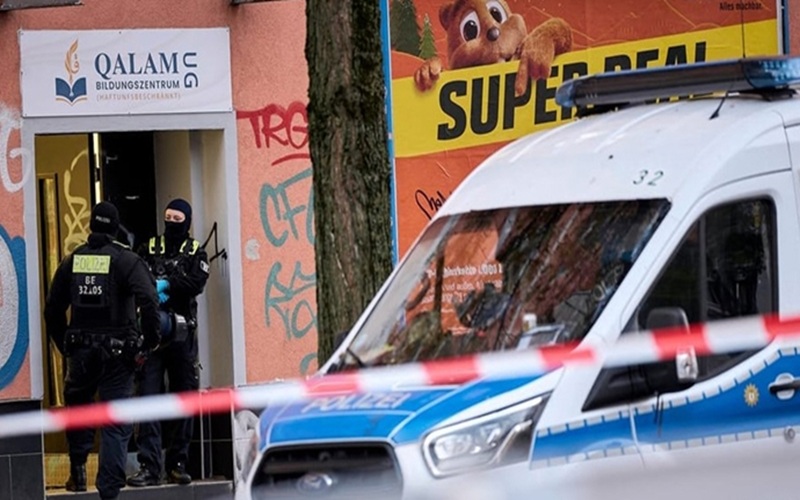
The prohibition covers Al-Qaem e.V., Al-Thaqalyn e.V. and Qalam Bildungszentrum UG. Berlin’s Senate Department for the Interior said the organizations were involved in providing Hezbollah with organizational and financial support and a platform for disseminating its propaganda and unconstitutional ideology among Berlin’s Shiite community.
Police simultaneously carried out searches at 28 locations, including the association’s cultural and community center, offices, commercial premises and the homes of board members and other associates. The operation was intended to secure additional evidence and confiscate remaining organizational assets.
Berlin Interior Senator Iris Spranger said the association’s activities were directed against international understanding and violated criminal law. According to the authorities, El-Irschad used its youth activities, modeled on Hezbollah’s Imam al-Mahdi Scouts, and its Markaz Al-Qaem mosque in Berlin’s Neukölln district to promote the organization’s ideology.
The ban also prohibits the public use or distribution of the organizations’ symbols. Their websites are to be shut down, and their assets have been confiscated.
German security authorities had monitored El-Irschad for years because of its proximity to Hezbollah. The decision followed extensive cooperation among Berlin and federal security and judicial authorities, as well as recent legally binding convictions of Hezbollah officials in Germany.
Germany prohibited Hezbollah’s activities throughout the country in 2020. The latest action demonstrates that German authorities are also targeting organizations accused of providing the group with an operational and ideological support infrastructure.
North Macedonia and Greece Uncover Iranian-Linked Assassination Network
On the same day, North Macedonia’s Agency for National Security announced that it had dismantled a network allegedly connected to Iranian intelligence services that was preparing an assassination in neighboring Greece.
The investigation, conducted in cooperation with Greece’s National Intelligence Service and other partner agencies, began in early 2026. According to the North Macedonian security agency, the network consisted of individuals embedded in criminal organizations who carried out preparatory and logistical activities under the direct instructions of an Iranian national.
Agency director Bojan Hristovski described the operation as the dismantling of an Iranian proxy network involved in planning a terrorist attack against a previously identified individual in Greece.
The agency identified the alleged Iranian coordinator as Edris Jahangiri Mavaneh, whom it described as connected to other intermediaries associated with Iranian security and intelligence services. These connections reportedly included Naji Sharifi Zindashti, an Iranian organized-crime figure wanted in the United States over his alleged involvement in a criminal network targeting Iranian dissidents and activists abroad.
According to the investigation, the network held clandestine meetings in several countries, including Iran, and used criminal intermediaries to conceal its activities and connections.
Searches in North Macedonia uncovered firearms, ammunition, handwritten notes, contact information and sketches marking locations believed to be connected with the planned operation.
Greek media reported that the intended target may have been an executive associated with an Israeli company operating in Athens. However, North Macedonian authorities have not publicly identified the intended victim.
The investigation led to the arrest of a North Macedonian national in Greece, who was subsequently transferred to North Macedonia, followed by the arrest of four additional suspects in Skopje. A fifth individual was also questioned, while a sixth suspect remained at large, according to the initial announcement.
The Associated Press and Reuters reported that five people had been arrested across the two countries, with another suspect still being sought.
The case illustrates how criminal networks can serve as intermediaries in operations attributed to Iranian intelligence, allowing those organizing an attack to distance themselves from the people recruited to carry it out.
IRGC Operative Sentenced to 27.5 Years for Plot Against U.S. Political Leaders
In the United States, a federal court in Brooklyn sentenced 48-year-old Pakistani national Asif Merchant to 330 months, or 27 and a half years, in prison on November 17, 2026, for his role in an assassination plot directed by the Islamic Revolutionary Guard Corps (IRGC).
Merchant was convicted by a federal jury in March 2026 of attempting to commit an act of terrorism transcending national boundaries and conspiracy to commit murder for hire. According to the U.S. Department of Justice, his mission was to recruit criminals or members of organized crime groups to assassinate American political figures at a political rally.
The principal intended target was Donald Trump, who was a presidential candidate at the time. Former President Joe Biden and former U.S. Ambassador to the United Nations Nikki Haley were also identified as possible targets.
The investigation established that Merchant had been recruited by the IRGC around 2022. Through a relative, he was introduced to his handler, Yousef Merhardad, and met him approximately 15 times in Tehran over the following year and a half. During these meetings, he received training in counterintelligence techniques and instructions for carrying out the assassination operation in the United States.
The operation was intended to avenge the January 2020 killing of Qasem Soleimani, the former commander of the IRGC’s Quds Force, in a U.S. strike.
In April 2024, after spending approximately a week in Iran, Merchant traveled to the United States to organize the operation. He approached an acquaintance for assistance in recruiting individuals to carry out the killings. Instead, that person informed the FBI and became a confidential informant.
Merchant subsequently met three times with individuals he believed were hired assassins but who were actually undercover FBI agents. He explained the assassination plan and paid them $5,000 as an initial payment, with the money supplied through relatives abroad.
Investigators also recovered electronic evidence showing that Merchant had followed the 2024 U.S. presidential election and searched for the location of a Trump campaign rally in New Jersey using Google Maps.
During the trial, Merchant acknowledged his involvement in the conspiracy but argued that he had acted against his will because of concerns for his family in Tehran. The Justice Department, however, cited his own testimony that he had voluntarily joined the IRGC, received intelligence training and carried out the assignment on its behalf.
The FBI arrested him in Richmond, Texas, on July 12, 2024, before he could leave the country. The planned assassination was prevented before any attack could take place.
A Pattern of Foreign Operations Through State-Linked and Criminal Networks
Taken together, these developments expose different mechanisms through which the Iranian regime’s security apparatus and associated organizations have operated abroad. In Germany, authorities targeted an organizational infrastructure accused of providing Hezbollah with financial, ideological and logistical support. In Greece, investigators uncovered an alleged assassination network that relied on criminal intermediaries. In the United States, a federal jury convicted an operative who had received instructions and training from the IRGC to organize political assassinations.
The cases also demonstrate the involvement of multiple layers of intermediaries, from religious and community organizations to organized-crime figures and recruited operatives. Such structures can provide channels for financing, recruitment, intelligence gathering and the concealment of those directing operations.
The German prohibition, the joint investigation by North Macedonia and Greece, and the U.S. prosecution represent separate legal and security responses to these activities. Together, they highlight the international dimension of the Iranian regime’s security operations and the challenges facing countries seeking to identify and disrupt networks operating within their borders.