


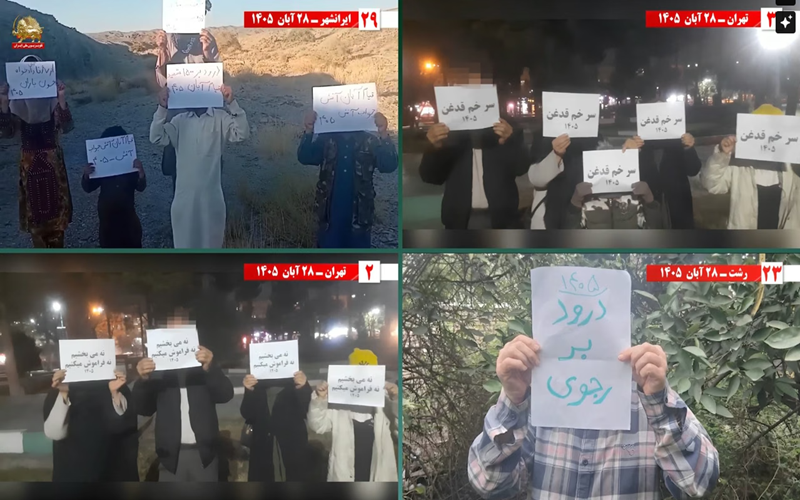

The eighth round of the November Uprising Campaign featured political slogans, street graffiti, collective activities, and visual displays in Tehran, Karaj, Tabriz, Isfahan, Shiraz, and other cities, honoring the uprising’s martyrs and calling for the overthrow of the clerical dictatorship and the establishment of a democratic republic.
Resistance Units carried out 50 revolutionary activities across 18 Iranian cities in the eighth round of the November Uprising Campaign, marking the anniversary of the November 2019 protests. The activities included political slogans, collective street actions, handwritten messages, wall graffiti, and visual displays in Tehran, Bandar Abbas, Sanandaj, and numerous other cities.
Under the slogan of honoring the martyrs of the November uprising, the campaign reaffirmed the continuity of popular resistance against the clerical dictatorship. Its messages paid tribute to those killed during the November 2019 crackdown while emphasizing the determination to continue the struggle for a democratic republic.
One of the campaign’s central messages declared: “Damnation by the people and history upon the bloodstained Shah and Mullah.” Other slogans rejected both monarchical and clerical rule, expressing the position that Iran’s future must be free of dictatorship in either form.
Honoring the November 2019 Uprising and Its Martyrs
Visual displays in Tehran, Bandar Abbas, and Sanandaj specifically commemorated the November 2019 uprising and its impact on the regime.
In Tehran, along Niavaran Highway, a message declared:
– “The November uprising dealt devastating blows to the regime’s decaying body.”
In Bandar Abbas, on Isar Street, a visual display honored the victims:
– “Salute to the 1,500 martyrs of the November uprising.”
In Sanandaj, on Soleiman Khater Street, another message emphasized the legacy of the generation that took part in the protests:
– “The generation of the November uprising is the generation of revolt and rebellion.”
The campaign also recalled the successive nationwide uprisings of 2017–2018, November 2019, 2022, and 2025, presenting them as part of an ongoing struggle against the ruling establishment. One of its messages declared that the Iranian people had risen four times in eight years and that a fifth uprising was approaching.
Revolutionary Activities Across 18 Cities
The 50 activities covered a wide geographical area, with slogans addressing political repression, the legacy of the uprisings, resistance, and the demand for democratic change.
Tehran: Collective activities included the messages “Freedom is coming through our determination and action,” “We neither forgive nor forget,” and “No more bowing our heads.” Other slogans expressed commitment to democracy, freedom, and Maryam Rajavi’s Ten-Point Plan. Messages also called for perseverance in the struggle and rejected both the Shah and the clerical establishment.
Karaj: Messages included a call attributed to Massoud Rajavi to continue fighting until the religious fascism ruling Iran is dismantled. Other slogans declared: “Don’t call me a troublemaker; you are the oppressor,” and “We stand by our comrades’ blood, present and committed until the end.”
Tabriz: Activities highlighted the November 2019 uprising’s impact on the regime, with messages attributed to Maryam Rajavi describing how the uprising brought the ruling establishment to the brink of overthrow. Other slogans included “Death to Khamenei, hail Rajavi” and “From 1988 to November, we demand justice for our fallen comrades.”
Isfahan: A prominent slogan rejected both forms of dictatorship: “Neither crown nor turban; the mullah’s rule is finished.”
Shiraz: Collective activities emphasized the rejection of both the Shah and the Sheikh and called for a democratic republic. Other messages highlighted the Ten-Point Plan, the National Liberation Army, and the role of the Resistance Units in rebuilding Iran. Graffiti also carried the slogans “The November uprising: fire answered with fire” and “Salute to the 1,500 martyrs of the November 2019 uprising.”
Rasht: Messages recalled the November uprising’s impact on the regime and described the Rajavis as the clerical establishment’s enduring nightmare. Other slogans reiterated the rejection of both the crown and the turban.
Qazvin: A message declared that the November uprising had demonstrated the continuing momentum of protests and uprisings aimed at overthrowing the regime.
Zahedan: A visual display carried the message attributed to Maryam Rajavi that the November uprising had dealt devastating blows to the regime.
Iranshahr: Collective activities honored the victims of the 1988 massacre and the November 2019 uprising, with the slogan: “From 1988 to November, we demand justice for our fallen comrades. The November uprising: fire answered with fire. Salute to the 1,500 martyrs.”
Sarpol-e Zahab: Messages called for an end to clerical rule and the system of absolute religious authority. Another recalled how the November 2019 uprising brought the regime close to overthrow.
Kangavar: Activities emphasized that the Iranian people’s democratic revolution would prevail through the sacrifices of its martyrs. Other messages called for an end to clerical and monarchical dictatorship.
Mahabad: A slogan declared: “Neither Shah nor Sheikh. Hail Rajavi.”
Javanrud: A message attributed to Massoud Rajavi described the lessons, experiences, and model of the November 2019 uprising as a guide for future action.
Graffiti and Visual Actions in Additional Cities
The campaign also included wall graffiti and photo-call activities in several other cities, extending its messages beyond the locations where the 50 collective actions were reported.
In Kermanshah, graffiti declared: “Death to the oppressor, whether Shah or Supreme Leader.”
In Ahvaz, a message stated: “Neither crown nor turban; the mullah’s rule is finished.”
Additional graffiti and photo-call activities carrying the slogans “Hail Rajavi” and “Death to Khamenei” were reported in Mashhad, Kermanshah, Ahvaz, Hamedan, Rasht, Ilam, and Babolsar.
The November Uprising’s Legacy and the Demand for a Democratic Republic
The eighth round of the November Uprising Campaign connected the memory of those killed in November 2019 with the broader history of resistance to dictatorship in Iran. Its messages emphasized that the demands expressed during successive uprisings remain unresolved and that the struggle against the clerical establishment continues.
A recurring theme throughout the activities was the rejection of both monarchical and religious dictatorship. The slogans “Neither Shah nor Sheikh” and “Death to the oppressor, whether Shah or Supreme Leader” reflected the campaign’s stated commitment to a democratic alternative rather than a return to the former monarchy.
Through 50 activities in 18 cities, the Resistance Units commemorated the November 2019 uprising while presenting its legacy as part of an ongoing movement for freedom, democracy, and the establishment of a democratic republic in Iran.