


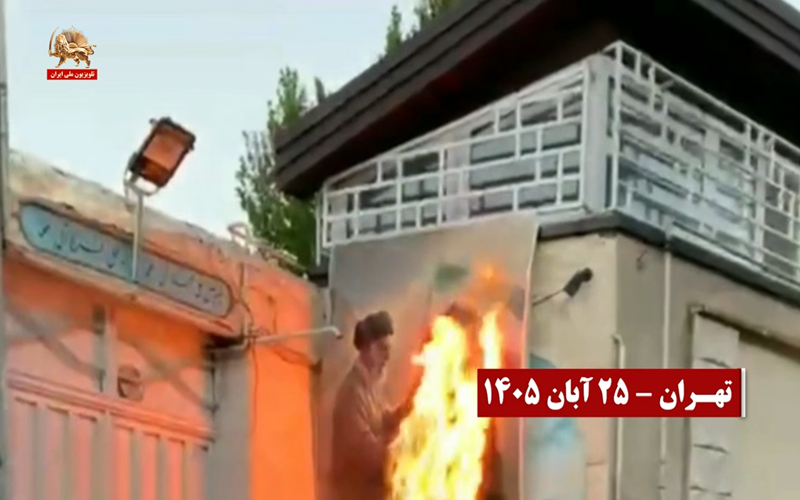

From attacks on Basij facilities and regime propaganda symbols to coordinated slogans demanding a democratic republic, Resistance Units marked the anniversary of the November 2019 uprising with widespread activities across Iran, rejecting both monarchical and clerical dictatorship.
November 13–19, 2026
Resistance Units mark November 2019 uprising with nationwide campaign of defiance
The fourth week of Aban 1405 saw an extensive new wave of activities by the Resistance Units across Iran, combining attacks on regime-linked facilities and propaganda symbols with revolutionary slogans, wall inscriptions, and collective political actions. Reported activities spanned dozens of locations, including Tehran, Isfahan, Kermanshah, Zahedan, Ahvaz, Mashhad, Shiraz, Tabriz, and Rasht.
Carried out under the message “The people and history curse the bloodthirsty Shah and Mullah,” the activities underscored the movement’s rejection of both the former monarchy and the current clerical dictatorship. They also renewed the call for a democratic republic, linking the struggle against the present regime to the demand for justice for the victims of decades of repression.
Widespread activities of defiance against the regime’s repressive apparatus
According to the reported activities, numerous operations described as revolutionary operations took place in Tehran, Shahr-e Rey, Isfahan, Ahvaz, Kermanshah, Zahedan, Rask, Mahshahr, Nikshahr, Marivan, and Jolfa.
The reported actions included explosions targeting a seminary associated with the regime’s ideological indoctrination and repression of women in Kermanshah, as well as attacks on Basij facilities in several cities.
Other reported incidents involved the burning of regime propaganda banners and symbols associated with Supreme Leader Ali Khamenei and Mojtaba Khamenei.
Among the locations mentioned were:
- Kermanshah: Reported explosions at a seminary and a Basij facility, alongside the burning of Basij and regime-leadership banners.
- Ahvaz: An attack involving a Molotov cocktail against the provincial supervisory office of the state-affiliated Ettela’at newspaper.
- Shahr-e Rey and Isfahan: Attacks involving the burning of Basij facilities and propaganda banners.
- Zahedan and Nikshahr: Attacks involving the burning of Basij-related facilities and banners depicting Khamenei.
- Mahshahr and Rask: Attacks involving the burning of Basij facilities.
- Jolfa and Marivan: The burning of banners associated with the regime and its security apparatus.
- Tehran: Several reported incidents involving the burning of banners depicting Khamenei and Mojtaba Khamenei.
These activities targeted institutions and symbols that the campaign identifies with the regime’s machinery of repression, ideological control, and propaganda.
A nationwide political message: Neither Shah nor Mullah
Beyond the reported operations, the Resistance Units carried out a broad campaign of collective political activities, slogans, and wall inscriptions in dozens of locations.
In Tehran, collective actions emphasized the rejection of both clerical rule and monarchical dictatorship. One slogan declared:
“The rule of the mullah and the sultan’s guardianship must end.”
Other messages called for the implementation of Maryam Rajavi’s Ten-Point Plan as the foundation for a free Iran. One declared that democracy means no individual owns an entire nation.
The activities also conveyed a message of readiness for another nationwide uprising:
“We, the Resistance Units, are awake. The uprising continues. We will neither bend nor tire; with unity and determination, the closed road will open.”
Another slogan addressed the Iranian public directly:
“We are Resistance Units, ready for the uprising. O awakened people, get ready to rise.”
In another collective message, participants pledged their commitment to establishing a democratic republic in Iran, invoking the blood of those killed during previous uprisings and the suffering of the families of political prisoners and victims of repression.
November 2019 uprising remains a central reference
A substantial part of the campaign focused on the November 2019 uprising, known in Iran as the Aban uprising. Six years after the nationwide protests and the regime’s bloody crackdown, Resistance Units used the anniversary to emphasize the continuity of popular resistance.
In Tabriz, messages attributed to Massoud Rajavi and Maryam Rajavi highlighted the continuing significance of the uprising and the determination of younger generations to challenge the regime.
One message stated that the November uprising demonstrated the continued momentum of rebellious Iranian youth. Another emphasized that the blood of those killed, particularly the November 2019 victims, continues to fuel the struggle for freedom.
In Mashhad, slogans described the lessons and experiences of the 2019 uprising as a guide for future action. Other messages recalled how the uprising brought the regime close to the brink of collapse.
In Karaj, participants similarly invoked the sacrifices of those killed during the protests, while in Qazvin, messages described the uprising as having dealt fundamental blows to the regime.
The anniversary campaign also connected the struggle for justice for the victims of the 1988 massacre of political prisoners with the November 2019 crackdown. In Shiraz and Bushehr, slogans declared:
“From 1988 to Aban, we demand justice for our fallen comrades.”
This connection reflects the Resistance Units’ emphasis on accountability for successive waves of political executions and the killing of protesters.
Activities extend from Tehran to cities across Iran
The political campaign reached far beyond the locations of the reported operations.
In Isfahan, participants displayed messages supporting the Ten-Point Plan and pledging to continue the struggle despite the sacrifices of previous generations. In Shahin Shahr, slogans expressed solidarity with the People’s Mojahedin Organization of Iran (PMOI/MEK) and opposition to all forms of authoritarianism.
In Rasht, messages highlighted the prospect of freedom and justice through organized resistance. In Gilan-e Gharb, slogans again invoked the November uprising as evidence of the regime’s vulnerability.
Activities were also reported in Zanjan, Sari, Hamedan, and Bushehr, with messages supporting the resistance movement and demanding an end to clerical rule.
Wall inscriptions and photo campaigns in Tehran, Ramhormoz, Gorgan, Isfahan, and Zahedan carried slogans including:
- Death to Khamenei.
- Down with the rule of the mullahs.
- Long live the democratic republic.
- Salute to the fallen freedom fighters.
In Ramhormoz, two particularly direct inscriptions declared:
“Iran is awake; it rejects both Shah and Mullah.”
And:
“After all these years of crimes, death to the rule of the Supreme Leader.”
A movement rejecting both dictatorship and political succession
The fourth-week Aban campaign brought together several interconnected messages: opposition to the regime’s repressive institutions, remembrance of those killed during previous uprisings, solidarity with the organized resistance, and the demand for a democratic alternative.
The repeated rejection of both the Shah and the Mullah is particularly significant. It reflects the insistence that replacing the current clerical establishment with another form of hereditary or authoritarian rule would not fulfill the Iranian people’s aspirations for freedom.
The Ten-Point Plan, repeatedly featured in the activities, provides the political framework promoted by Maryam Rajavi for a future Iran based on a democratic republic, separation of religion and state, gender equality, abolition of the death penalty, and the rule of law.
From Tehran and Tabriz to Zahedan, Rasht, Shiraz, and smaller cities, the reported activities carried a common message: the struggle is not simply against one ruling figure or one political establishment, but against dictatorship itself.
The anniversary of November 2019 thus became another occasion for the Resistance Units to reaffirm their commitment to a future in which neither the monarchy nor the clerical establishment determines Iran’s political destiny.