
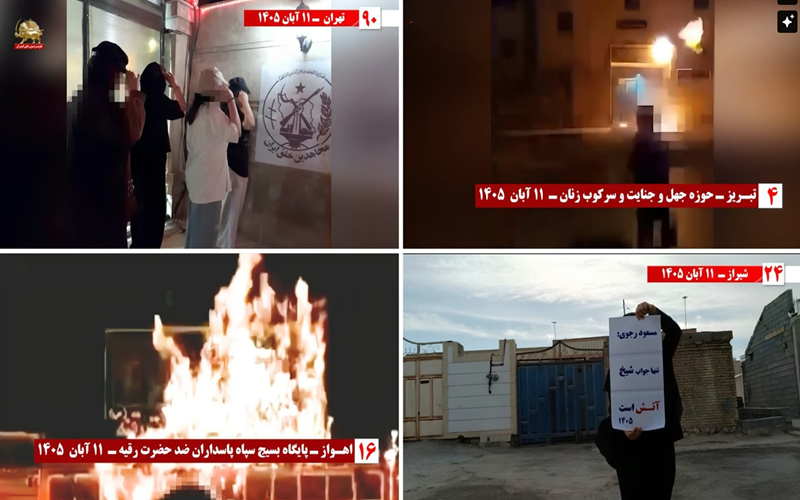

Eight nationwide campaigns by Resistance Units during the anniversary of the November 2019 uprising highlight the persistence of organized resistance, even as the regime deploys tens of thousands of security forces to prevent renewed protests.
Iran’s regime has intensified its security measures amid growing economic discontent and the anniversary of the November 2019 uprising. Yet, despite an extensive security mobilization, Resistance Units have continued their activities across the country, carrying out 150 anti-repression operations and 709 revolutionary activities in eight nationwide campaigns over the past month.
The scale and continuity of these activities highlight the ongoing confrontation between the regime and a society that has repeatedly demonstrated its unwillingness to accept authoritarian rule. They also raise a fundamental question: if the regime exercises such extensive control over the country, why does it continue to mobilize such enormous resources against organized resistance?
The answer lies partly in the regime’s enduring fear that localized acts of defiance could contribute to a broader uprising.
Organized resistance under extraordinary security pressure
The eight nationwide campaigns addressed a range of issues, from executions and economic repression to the destruction of people’s livelihoods and the commemoration of previous uprisings.
Among the reported activities were:
- Campaigns in Tehran and Mashhad marking the anniversary of the November 2019 uprising.
- Thirty operations in response to the execution of two prisoners in Isfahan.
- Sixty revolutionary activities and slogan-writing campaigns commemorating the November uprising.
- Continued activities by Resistance Units in Zahedan.
- Activities marking Cyrus the Great Day on November 7, particularly around Pasargadae.
- Ten operations following the assault by regime forces on Tehran’s wholesale market and the destruction of street vendors’ property.
- Ten operations in response to the demolition of small businesses and cafés belonging to economically disadvantaged people in Khorramshahr.
These activities address issues that reach far beyond political symbolism. Executions, the destruction of livelihoods, economic deprivation, and restrictions on public expression are all part of the daily reality confronting millions of Iranians.
The significance of organized resistance lies in connecting these individual grievances to a broader political demand: ending the system responsible for repression and establishing a democratic alternative.
The reported figures also point to the considerable organizational and security challenges involved. Under conditions of extensive surveillance, every public activity requires preparation, coordination, and an assessment of potential risks. The continuation of these campaigns despite such obstacles indicates that the regime has not succeeded in eliminating organized opposition.
Tens of thousands of security forces deployed against the threat of another uprising
The regime’s response provides another indication of its concerns.
According to information published by the National Council of Resistance of Iran on November 20, security preparations around the anniversary of the November uprising and rising bread prices included the deployment of approximately 35,000 Islamic Revolutionary Guard Corps (IRGC) and Basij personnel, 4,000 proxy forces, and 21,000 law enforcement personnel tasked with controlling Greater Tehran.
Additional measures reportedly included armed patrols, the deployment of forces authorized to act independently, and extraordinary surveillance of public spaces.
One particularly revealing detail concerned the protection of selected banners. Three personnel were reportedly assigned to guard certain banners from evening until the following morning, receiving meals and a payment of 500,000 tomans.
Such measures illustrate the extraordinary security resources devoted to preventing even symbolic expressions of opposition. When a government must assign personnel throughout the night to protect banners, it reveals the extent to which the authorities fear the spread of dissent.
Other official statements reinforced this picture. Judiciary Chief Gholamhossein Mohseni Ejei called for increased attention to those he described as threats to security and warned officials against failing to act. Meanwhile, a deputy commander of the Basij announced plans for military training bases alongside historical sites such as Persepolis and the Bam Citadel.
Taken together, these developments point to a security establishment increasingly preoccupied with the possibility of renewed unrest.
Economic hardship makes repression an increasingly fragile strategy
The timing of the heightened alert is particularly significant. The anniversary of the November 2019 uprising coincided with growing public frustration over the rising cost of essential goods, including bread.
For a population already struggling with inflation, unemployment, declining purchasing power, and widespread poverty, increases in the price of basic food items can become powerful catalysts for public anger.
The regime understands that economic grievances cannot be separated from political discontent. The November 2019 uprising demonstrated how rapidly anger over living costs can develop into a nationwide confrontation with the ruling establishment.
The reported reduction in subsidized flour allocations, from 12 to eight kilograms per household, further illustrates the pressures facing ordinary families in a country with enormous oil and gas resources.
Instead of addressing the structural causes of public dissatisfaction, the regime continues to rely on security measures. But deploying additional forces cannot resolve poverty, restore purchasing power, or reverse the destruction of livelihoods.
Nor can censorship eliminate the grievances that fuel opposition.
Resistance and the question of Iran’s political future
The activities of the Resistance Units should also be understood within the broader debate over Iran’s political future. Their stated objective is not simply to protest individual government policies but to challenge dictatorship itself and reject the restoration of another authoritarian system.
This distinction matters in a country whose modern history has been marked by successive forms of dictatorship. The demand for political change is inseparable from the question of what comes next: a democratic republic based on popular sovereignty, political pluralism, and the rejection of both monarchical and clerical rule.
The determination demonstrated by Resistance Units reflects this longer-term perspective. Their continued activities, despite the risks, limited resources, and extensive security pressure, point to a commitment that goes beyond individual campaigns or commemorative occasions.
Victory in such a struggle is not simply a final political event. It is also shaped by the sustained efforts to preserve resistance, challenge repression, and build the foundations of an alternative.
Iran’s regime may be able to deploy tens of thousands of personnel, censor reports, and impose restrictions on public life. But these measures cannot erase the underlying political and economic grievances of Iranian society.
The reported 150 operations and 709 activities are not, by themselves, evidence of an imminent political transformation. Their significance lies in demonstrating the persistence of organized opposition under conditions designed to suppress it.
For a regime haunted by the memory of successive uprisings, that persistence is itself a serious challenge. The central question is not how many security forces can be deployed to prevent another uprising, but how long a government can rely on repression while the conditions generating public resistance remain unresolved.