

With up to 530 million cubic meters of gas potentially missing from daily winter demand, 11 provinces facing supply difficulties, and rolling electricity cuts already underway, Iran’s regime confronts an energy crisis that years of neglect have made increasingly difficult to contain.
The crisis is already extending beyond the gas sector. Industrial consumers face supply restrictions, power plants are struggling to secure sufficient fuel, and scheduled electricity cuts for households and businesses began on November 22. Despite possessing some of the world’s largest natural gas reserves, Iran’s regime is once again struggling to provide reliable energy to its own population.
The regime’s President Masoud Pezeshkian acknowledged the severity of the situation on November 21, warning that the country would face energy supply problems during the winter. He said attacks on gas infrastructure had further aggravated an existing imbalance.
According to Pezeshkian, the attacks initially knocked out 240 million cubic meters of daily gas production capacity. Approximately 100 million cubic meters have since been restored, leaving around 140 million cubic meters of capacity unavailable.
This additional loss comes on top of a pre-existing daily supply deficit of 250 million to 300 million cubic meters during periods of peak consumption.
Eleven provinces face gas supply difficulties
Warnings from government officials indicate that the consequences will extend across much of the country.
Saeed Tavakoli, managing director of the National Iranian Gas Company, has warned that at least 11 of Iran’s 31 provinces could experience difficulties maintaining gas supplies this winter. The most vulnerable include Mazandaran, Golestan, and North Khorasan, although other regions are also expected to face supply imbalances.
Government spokeswoman Fatemeh Mohajerani has put the projected daily gas deficit at approximately 430 million cubic meters, compared with around 300 million cubic meters in previous years. Other official estimates have reached 530 million cubic meters.
The possibility of restrictions is not limited to provincial areas. Mohajerani has warned that gas cuts could affect Tehran itself if consumption remains high.
The government has responded by urging households to reduce consumption. Parliament Speaker Mohammad Baqer Qalibaf has called for a 10 percent reduction in gas use, while First Vice President Mohammad Reza Aref has raised the possibility of higher gas prices if excessive consumption continues amid reduced supply.
These appeals, however, do little to address the underlying production and infrastructure problems.
South Pars damage compounds years of underinvestment
The immediate wartime damage has had a substantial impact because of the strategic importance of the South Pars gas field.
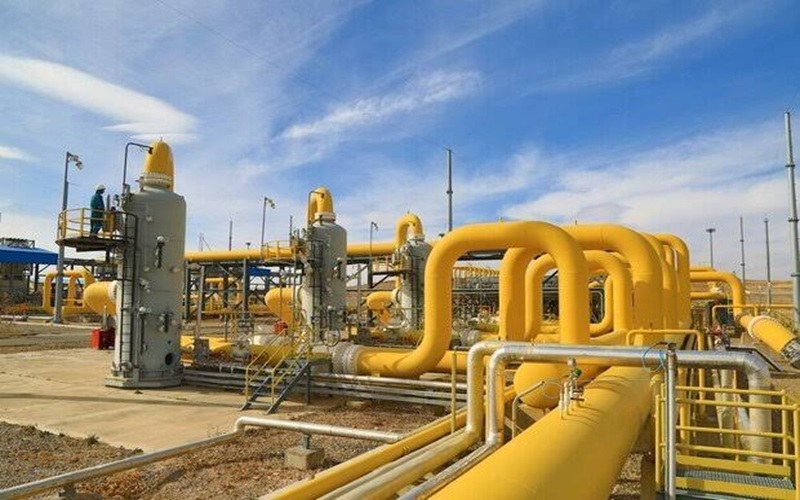
On March 18, Israeli forces struck gas-processing facilities in the South Pars industrial complex near Asaluyeh. The installations process natural gas extracted from the offshore field, which is the backbone of Iran’s domestic gas supply.
Human Rights Watch subsequently documented extensive damage to at least four sections of the South Pars complex using satellite imagery and other evidence. The organization also warned of the potentially serious consequences for civilians who depend on the facilities for energy.
The International Energy Agency’s Global Gas Security Review 2026, published in November, provides further evidence of the impact. It estimates that the March attacks disrupted approximately 12 percent of Iran’s natural gas production. South Pars itself accounts for more than 70 percent of the country’s total gas output.
The IEA estimates that Iran’s natural gas production fell by approximately 9 percent year-on-year during March-September 2026, a decline of more than 13 billion cubic meters. For the full year, it projects a production decline of around 6 percent.
The attacks have therefore compounded an already fragile supply system. Even before the conflict, Iran repeatedly experienced winter gas shortages and electricity disruptions.
Years of insufficient investment, aging production facilities, deteriorating pipelines, limited access to advanced technology, and heavily subsidized domestic consumption have prevented the regime from keeping supply in line with demand. International sanctions have further complicated access to foreign investment, equipment, and technical expertise.
The fundamental problem is that the country has enormous natural gas resources but lacks the infrastructure and investment required to reliably deliver enough of that gas to consumers.
Gas shortages trigger electricity cuts and industrial disruption
The consequences are already visible in the electricity sector.
On November 21, Mohammad Allahdad, chief executive of state electricity company Tavanir, announced that electricity distribution restrictions would begin the following day because of difficulties securing sufficient fuel for power plants.
The initial restrictions were expected to involve outages of approximately two hours every two days, with the possibility of cuts lasting up to two hours daily depending on regional conditions and temperatures.
Scheduled outages began on November 22. Reports from Tehran, Isfahan, Shiraz, Mashhad, Yazd, Kermanshah, and Ardabil described electricity interruptions affecting households, businesses, and schools.
The shortages also threaten industrial production. The regime has already restricted gas supplies to some factories, with disruptions reported in the cement and petrochemical sectors. These industries depend heavily on reliable energy supplies, and prolonged restrictions can reduce production, delay deliveries, and increase operating costs.
Power plants face an additional challenge. With less natural gas available, the government expects to rely more heavily on mazut, a heavy and highly polluting fuel oil, to maintain electricity generation.
This creates another problem for a country already struggling with severe air pollution in major urban centers. Burning more mazut to compensate for inadequate gas supplies risks worsening environmental and public-health conditions.
The crisis thus extends well beyond the energy sector, threatening industrial output, employment, public services, and the quality of life of ordinary Iranians.
Vast gas reserves, but no reliable energy security
Iran possesses the world’s second-largest proven natural gas reserves, yet its inability to meet domestic demand has become a recurring feature of its energy system.
The contradiction reflects years of structural failures. Rather than developing the country’s energy infrastructure to meet growing demand, the regime has allowed production facilities and distribution networks to deteriorate while maintaining policies that encourage excessive consumption through heavily subsidized prices.
The consequences are particularly damaging during winter, when household heating competes with industrial users and power plants for available gas.
The latest crisis also demonstrates how vulnerable the country’s energy system remains to external shocks. Damage to a limited number of strategically important facilities has translated into nationwide supply concerns because the system lacks sufficient flexibility and spare capacity.
The regime now faces difficult choices: restrict household consumption, reduce industrial supplies, burn more mazut, or impose further electricity rationing. None of these measures addresses the underlying structural imbalance.
For ordinary Iranians, the consequences are immediate. Families face uncertainty over heating and electricity, businesses must contend with interruptions, and workers risk losing income when factories reduce production.
The winter gas crisis is therefore more than a temporary supply problem caused by wartime damage. It is the latest manifestation of an energy system weakened by years of inadequate investment, mismanagement, and policy failures. The war has intensified the crisis, but it did not create the vulnerabilities that made the country so exposed.
A country with Iran’s enormous natural gas resources should not repeatedly enter winter facing the prospect of shortages, factory shutdowns, and electricity rationing. The widening gap between its energy potential and the daily hardships experienced by its population exposes the long-term consequences of the regime’s failure to manage the country’s resources in the public interest.