

Truck drivers, workers, retirees, and emergency medical personnel are taking to the streets over deteriorating living conditions, while repression and government inaction deepen the connection between economic demands and political opposition.
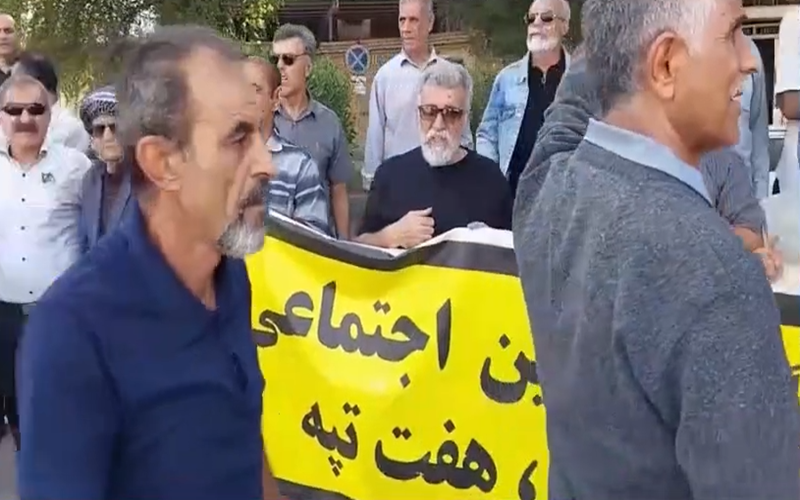
The nationwide truck drivers’ strike, which began on November 22, was among the most significant labor actions of the week. It coincided with protests by workers at the Machinery Unit of the Travers Company in Karaj, demonstrations by emergency medical personnel working in the 115 pre-hospital emergency services over their livelihood conditions, and gatherings by retirees in Kermanshah Province outside the Labor Department.
These actions are part of a broader pattern of recurring protests across the country. Workers and retirees who have spent years contributing to the economy increasingly find themselves forced to demonstrate simply to demand their wages, benefits, and basic entitlements.
The situation is particularly revealing in the case of retirees, many of whom must continue protesting long after completing decades of work. Instead of enjoying financial security and a dignified retirement, they are compelled to gather in the streets, regardless of weather conditions, to demand rights that should already be guaranteed.
The regime’s response has further exposed the gap between public demands and government priorities. In Qazvin, demonstrators who had gathered outside the provincial governor’s office were reportedly attacked with stun guns and tear gas.
Rather than addressing the grievances behind the demonstrations, authorities have resorted to force against people demanding their basic rights.
The protests are unfolding against a backdrop of currency depreciation, soaring prices, and wages that are steadily losing purchasing power. As economic pressures spread across society, the distinction between isolated labor disputes and a broader social crisis is becoming increasingly difficult to maintain.
From economic demands to political confrontation
One of the most significant developments is the persistence of protests despite repeated demonstrations, strikes, threats, and the absence of meaningful government responses.
When workers repeatedly demand unpaid wages or better working conditions and receive neither solutions nor assurances, their grievances do not simply disappear. Instead, the protests tend to continue, spread to other sectors, and increasingly challenge the policies and institutions responsible for the situation.
This progression is reflected in the slogans heard at demonstrations across Iran. Protesters have increasingly moved beyond demands concerning wages, pensions, and prices to directly criticize the political structure, corruption, repression, and government policies.
Among the slogans reported in recent demonstrations are:
- “Neither parliament nor government cares about the people.”
- “Enough of war and corruption; our tables are empty.”
- “United and allied against the death penalty.”
- “Retirees are fighting; the mafia is trembling.”
These slogans reveal how economic grievances are becoming intertwined with broader political demands.
The slogan “Enough of war and corruption; our tables are empty” captures a particularly important contradiction. While ordinary Iranians struggle to afford food and meet basic household expenses, the regime continues to devote national resources to its confrontational policies, proxy forces, nuclear ambitions, and terrorist activities.
Similarly, the slogan opposing executions demonstrates how different forms of public discontent are increasingly finding common ground. Opposition to economic deprivation is no longer separate from demands for freedom, justice, and an end to repression.
This convergence suggests that the crisis extends well beyond individual workplaces or specific economic disputes. It increasingly concerns the policies and structures that shape people’s everyday lives.
Repression cannot resolve the causes of public anger
The regime has responded to mounting discontent by tightening security measures, threatening protesters, and using force to disperse demonstrations.
Such tactics may temporarily prevent a particular gathering from continuing, but they do not address the conditions that brought people into the streets in the first place.
Poverty, unemployment, inflation, corruption, and the erosion of purchasing power remain unresolved. Repeated promises cannot compensate for unpaid wages, inadequate pensions, or the rising cost of essential goods.
The persistence of demonstrations despite the risks also illustrates the limits of repression as a means of containing public discontent. When successive protests produce no meaningful response, frustration can deepen and spread beyond the original group of protesters.
The regime’s inability to address these demands is closely connected to its economic and political priorities. As long as resources and policies remain directed toward preserving the ruling establishment and advancing its strategic objectives, the needs of ordinary citizens continue to be subordinated.
The result is a widening gap between society and the state, with each new protest exposing another dimension of the crisis.
A growing convergence of social grievances and organized resistance
The expanding protests should be viewed within the broader context of Iran’s economic, social, and political crises. No single strike or demonstration can fully represent the country’s wider discontent. However, the recurrence of protests across different occupations and provinces points to a persistent pattern.
Truck drivers, industrial workers, emergency medical personnel, and retirees have different immediate concerns, but their demands increasingly converge around basic economic security, dignity, and freedom from repression.
The regime may use arrests, intimidation, and force to contain individual demonstrations. It cannot, however, eliminate the underlying grievances through security measures alone.
The growing convergence of economic and political demands also raises the question of how these separate expressions of discontent can develop into a broader challenge to the ruling system.
From the perspective of Iran’s organized opposition, this requires a connection between popular resistance and organized action. Resistance Units, despite the regime’s extensive security presence, have continued their activities, including operations targeting symbols of the ruling establishment.
Ultimately, the central issue is not simply the number of protests taking place, but the conditions driving them and the regime’s inability to resolve the underlying crisis. As economic hardship spreads and repression fails to silence public demands, the social foundations of discontent remain firmly in place.