
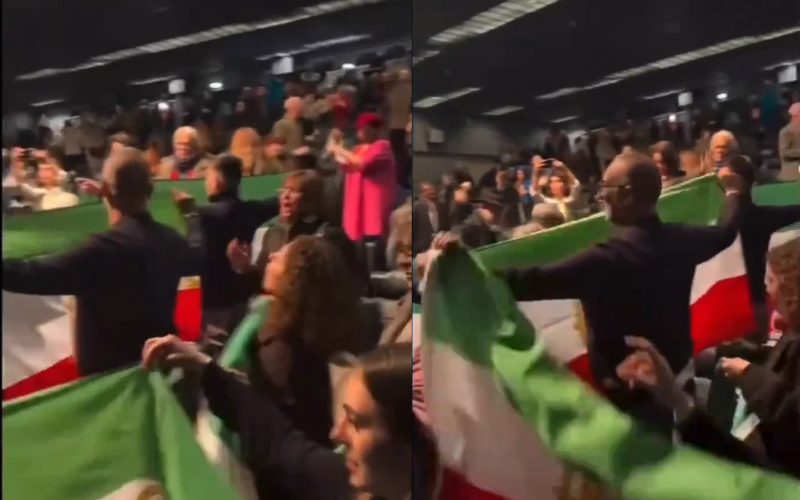

Pro-Pahlavi supporters interrupted a gathering at the Institut du monde arabe with pro-Shah slogans, insults, and threats after a campaign urging supporters to attend with Lion and Sun flags. The incident exposes the intolerance of a faction claiming to represent Iran’s future.
The incident exposed a troubling contradiction within a political current that presents itself as an alternative to Iran’s ruling regime while displaying intolerance toward those who reject its preferred leadership. The Iranian people have endured decades of authoritarian rule. Their struggle for freedom cannot be served by a movement that seeks to silence political opponents rather than defend their right to speak.
J’apprends qu’un grave incident s’est produit hier soir à l’institut du monde arabe où se tenait une soirée de soutien au peuple iranien organisée à la demande du quai d’Orsay. Des militants monarchistes d’extreme droite encouragés par le raid numérique lancé par @JafarianMona et… pic.twitter.com/doThVtgnYJ
— Chirinne Ardakani (@CArdakani) November 26, 2026
A gathering for Iranian women becomes a target
The IMA event was held at the initiative of France’s Foreign Ministry, in the presence of Foreign Minister Jean-Noël Barrot. It marked the fourth anniversary of the Woman, Life, Freedom movement and brought together artists and members of Iranian civil society for an evening of testimonies, music, poetry, and film.
In his opening remarks, Barrot reaffirmed that Iranian voices would always find refuge and a platform in France where they could express themselves freely. The gathering was intended to honour the courage of Iranian women and the wider civil society confronting repression.
But the programme was repeatedly interrupted by monarchist activists. According to Le Nouvel Obs, several dozen supporters of Reza Pahlavi disrupted the proceedings over approximately two and a half hours. Speakers were subjected to insults, threats, and heckling. Iranian comedian Armand Baniasadi faced a prolonged barrage of abuse when he took the stage. Some participants had to be escorted out of the venue.
The insults directed at Baniasadi included “son of a bitch” and “leftist,” while activists repeatedly shouted pro-Shah slogans and other political chants. Videos circulated after the incident showed activists waving Lion and Sun flags and chanting “Long live King Pahlavi,” “Long live Iran,” and “Long live Israel.” These details were also reported by Le Parisien in its November 27 account.
Chirinne Ardakani, a lawyer and participant at the event, described the incident as an organized attempt to intimidate speakers. She reported that the activists had threatened participants and that one person was shoved. Ardakani announced that complaints would be filed and those responsible would be held accountable.
Mobilization before the event
The disruption followed a public mobilization campaign by supporters of the monarchy. In Instagram Stories published before the gathering, Mona Jafarian urged followers to register in large numbers and attend with Lion and Sun flags. One of the appeals, quoted by Le Nouvel Obs, read: “Take your Lion and Sun flags and come to the venue! Long live Iran, long live the Shah!”
Jafarian also attacked the choice of speakers, directing particular criticism at Baniasadi. She described him as “a far-left clown” and accused the organizers of sidelining Reza Pahlavi. Her posts portrayed the event not as a gathering to honour Iranian women and civil society, but as a political programme that monarchist supporters should challenge through their presence.
The response after the disruption was equally revealing. In a November 26 post, Jafarian praised what she called “patriotic Iranians” for going to protest the “leftist programme” organized by the French foreign minister. She also attacked Ardakani. The post presented the confrontation as a successful political protest rather than addressing the reported intimidation of speakers.
The episode should be examined in the context of a wider campaign in which opponents of the monarchist current are increasingly portrayed as traitors, enemies, or illegitimate participants in Iran’s political future.
A wider pattern of targeting political opponents
A March 30 investigation by Revue21, conducted by journalists Mehdi Bouzouina and Thomas Guichard, examined the online activism surrounding the monarchist movement and Jafarian’s role in it. The report described campaigns targeting critics of Reza Pahlavi, including public denunciations, accusations of betrayal, mass messaging, and efforts to circulate information about individuals viewed as opponents.
One of the cases documented by the investigation involved Kevan Gafaïti, an academic who filed a complaint for harassment after being publicly targeted. The report said that photographs and personal information about members of his family subsequently appeared on an account associated with doxing. It also described how calls for information about targeted individuals were circulated and amplified through Persian-language Telegram groups, including messages urging supporters to send information privately and overwhelm targets with emails.
The investigation also reported a complaint filed by Élisabeth Sandjivy, then mayor of Neauphle-le-Château, after Jafarian accused her of serving the Iranian regime. Sandjivy described receiving large numbers of abusive emails. Revue21 said it had identified at least two harassment complaints that explicitly mentioned Jafarian in connection with online campaigns.
The significance of this reporting lies in the broader political environment it documents: an increasingly hostile atmosphere in which people who challenge the monarchist leadership or reject the restoration of the monarchy can become targets of organized online pressure. The Paris incident brought that hostility into a public cultural institution.
The return of the “Rastakhiz” mentality
Among the most disturbing slogans reported by the Iranian Resistance were “The only party is Rastakhiz” and calls for the death of leftists and the People’s Mojahedin Organization of Iran (PMOI/MEK).
Rastakhiz was the single party imposed by Mohammad Reza Shah in 1975. Its creation embodied the monarchy’s effort to eliminate independent political organization and force citizens into a political structure controlled by the state. The reported use of its name at an event celebrating Iranian civil society is therefore deeply revealing.
The Iranian Resistance drew a parallel between the reported monarchist slogan and the Iranian regime’s own slogan, “The only party is Hezbollah.” Both express the same principle of political exclusion: one faction claims the right to define the boundaries of legitimate political activity.
Iran has experienced authoritarian rule under both the monarchy and the clerical regime. Replacing the current dictatorship with another form of political monopoly would not constitute liberation. No individual, family, or faction has the right to claim exclusive ownership of Iran’s opposition or dictate who may speak in the name of the Iranian people.
A democratic Iran must guarantee the right of republicans, monarchists, leftists, ethnic and religious minorities, and all other political currents to organize and express their views peacefully. That right must apply equally to those who reject Reza Pahlavi.
French judicial proceedings had already identified a risk
The possibility of violence involving monarchist opponents of the Iranian Resistance had already appeared in French judicial proceedings months before the November 25 incident.
On June 20, 2026, France’s Conseil d’État issued a decision concerning a ban on a planned demonstration in Paris organized by the Association nouveaux droits de l’Homme. In reviewing the case, the court referred to the lower administrative court’s assessment that the demonstration faced a risk of violent action from either Iranian authorities or Iranian monarchists supporting the return of Mohammad Reza Pahlavi. The lower court had cited a reported call by an active monarchist supporter to “barricade” or block the procession’s route.
The Conseil d’État’s proceedings form part of the relevant public record: French judicial authorities had already considered the risk of violent action by monarchist groups against an Iranian Resistance demonstration.
Iran’s future cannot be built on political intimidation
The Iranian regime has spent decades suppressing independent voices through censorship, imprisonment, intimidation, and executions. Those who oppose it cannot credibly claim to defend freedom while attempting to silence other opponents through threats and disruption.
The regime’s foreign minister, Abbas Araghchi, also used the Paris event to attack France for providing a platform to Iranian voices, describing the incident as a “circus.” Such exploitation does not establish coordination between the regime and monarchist activists. It does, however, demonstrate how incidents that intimidate Iranian civil society can be turned into propaganda against those seeking freedom.
France must ensure that Iranian artists, activists, and political voices can participate in public events without intimidation. The reported threats and physical incidents should be examined, those targeted should be protected, and future gatherings should be allowed to proceed safely.
The struggle for a democratic Iran is not a contest over who gets to inherit political power. It is about the Iranian people’s right to choose their own future, organize freely, criticize every political current, and reject dictatorship in all its forms.
No Shah, No Mullahs: Iran’s future must belong to its people.
Sources
- Institut du monde arabe — “Voix iraniennes,” November 25, 2026
- French Foreign Ministry — Jean-Noël Barrot’s speech at “Voix iraniennes,” November 25, 2026
- Le Nouvel Obs — On the disruption of the event and the mobilization campaign, November 26, 2026 (reproduction of the Le Nouvel Obs report)
- Le Parisien / AFP — “Paris: an evening at the Institut du monde arabe disrupted by monarchist activists,” November 27, 2026
- Revue21 — Mehdi Bouzouina and Thomas Guichard, “From Instagram to CNews: Mona Jafarian, the Parisian enforcer of Iranian monarchists,” March 30, 2026
- Conseil d’État — Decision No. 516908, June 20, 2026
- Mona Jafarian’s November 26, 2026 post on X