


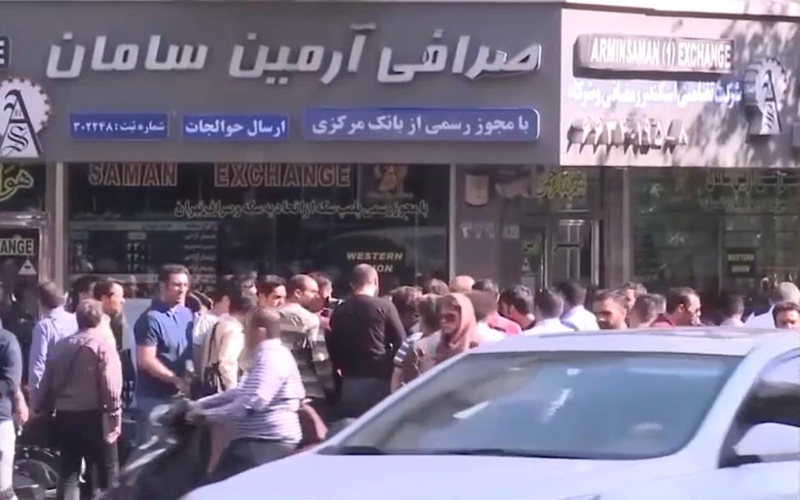

The rial’s record decline, excessive money creation, and shrinking access to foreign currency are driving capital away from productive investment, fueling inflation, and pushing more Iranians toward poverty.
The rush toward dollars, gold, and real estate reflects a growing loss of confidence in the national currency and the government’s ability to stabilize the economy. What might appear to be individual decisions to protect personal savings has become part of a broader economic cycle in which declining confidence accelerates capital flight, increases demand for foreign currency, and puts further pressure on the rial.
Several interconnected factors are driving this deterioration: chronic budget deficits, excessive money creation, structural weaknesses in production, restrictions on access to foreign currency, and the consequences of the regime’s confrontational foreign policies and regional intervention.
The government’s economic policies have compounded these pressures. Persistent budget deficits, corruption, and destructive economic management have weakened the foundations of the domestic economy. Meanwhile, external confrontation and economic sanctions have further restricted the government’s access to foreign currency and complicated trade.
These pressures are particularly damaging because a substantial share of industrial raw materials and essential goods depends on imports. As the exchange rate rises, the cost of importing these products increases, eventually feeding into the prices paid by ordinary consumers.
Currency speculation replaces productive investment
The continued depreciation of the rial has created an environment in which businesses and investors increasingly prioritize protecting existing assets over expanding productive activities.
Manufacturers and importers face considerable uncertainty when exchange rates fluctuate continuously. Unable to predict future costs or calculate the value of their investments, many seek protection against further currency depreciation by purchasing dollars and gold or investing in real estate.
This behavior increases demand in already volatile markets, pushing prices higher and diverting resources away from productive sectors.
The underlying problem is a widening imbalance between rapidly expanding liquidity and weak growth in actual production. The government’s reliance on money creation to finance its chronic budget deficit has further aggravated inflationary pressures. Structural imbalances within the banking system add another layer of instability.
Multiple exchange rates and repeated government interventions have also undermined confidence in economic policymaking. Rather than addressing the underlying causes of currency depreciation, the authorities have repeatedly attempted to manipulate exchange rates through administrative measures.
The currency crisis therefore extends beyond the dollar’s rising market price. It also reflects mounting pressure on the country’s foreign-exchange resources and growing doubts about the authorities’ ability to manage accumulated economic imbalances.
As confidence deteriorates, individuals and businesses have stronger incentives to move their savings into foreign currency and other assets, reinforcing the cycle of depreciation.
Rial depreciation accelerates poverty and stagflation
The consequences are increasingly visible in household consumption.
A weaker rial makes imported food, medicines, industrial inputs, and other essential goods more expensive. Since wages and pensions generally do not adjust at the same pace as prices, households experience a continuous decline in purchasing power.
The result is a shrinking consumption basket. Families are forced to reduce purchases, abandon certain necessities, or spend a growing share of their income on basic food and other essential expenses.
Wage earners and retirees are particularly vulnerable because their incomes are often fixed or adjusted only periodically, while prices can rise much faster.
The crisis also threatens the productive economy. Higher production costs, uncertainty over imported materials, and declining domestic demand place additional pressure on businesses already struggling with stagflation.
As operating conditions deteriorate, productive investment becomes less attractive. Instead of financing factories, industrial expansion, and long-term projects, capital moves toward assets perceived as safer, including foreign currency, gold, property, vehicles, and financial markets.
This shift weakens the economy’s capacity to generate employment and sustainable growth.
Capital flight and the departure of skilled workers further undermine the country’s productive potential. When businesses and individuals no longer see viable economic prospects at home, financial resources and human capital increasingly move abroad.
The consequences extend to the government itself. A weakening economic base makes it increasingly difficult to finance public expenditures, maintain subsidies, fund infrastructure projects, and secure essential imported goods.
In the short term, exchange-rate instability disrupts imports, production planning, and pricing. Over the longer term, it threatens the survival of smaller businesses, increases unemployment, and further erodes household purchasing power.
Why conventional currency-stabilization measures cannot work under the regime
Countries facing severe currency crises have sometimes attempted to restore confidence through a combination of fiscal discipline, monetary restraint, and more predictable exchange-rate policies.
Such measures generally include addressing the underlying causes of budget deficits, limiting the creation of unbacked money, reducing arbitrary government intervention in currency markets, and strengthening the institutional independence of central banks.
They also require greater transparency in monetary and fiscal policymaking and a credible approach to managing foreign-exchange reserves.
Iran’s economic predicament, however, cannot be separated from the regime’s governing priorities and entrenched economic structures.
The persistent use of money creation to cover budget shortfalls, politically driven exchange-rate interventions, and the diversion of national resources toward the regime’s strategic and security objectives undermine the credibility of stabilization efforts.
Administrative attempts to control the dollar’s price cannot resolve the structural imbalance between liquidity and production. Nor can temporary interventions restore confidence while the underlying causes of capital flight and economic instability remain unaddressed.
The central contradiction is that restoring economic confidence requires predictable policies, financial transparency, and productive investment, while the regime’s existing economic practices continue to generate uncertainty and encourage the flight of capital.
An economy caught in a self-reinforcing crisis
Iran’s currency collapse is not an isolated financial disturbance. It is part of a broader economic crisis in which inflation, declining production, capital flight, and shrinking household consumption reinforce one another.
As the rial loses value, people seek alternatives to protect their savings. That increases pressure on the currency and encourages further speculation. Higher import costs then push up the prices of essential goods, while declining purchasing power weakens domestic demand and damages businesses.
The cycle leaves fewer resources available for productive investment, employment, and economic recovery.
Without addressing the structural causes of the crisis, the government has little basis for restoring confidence in the national currency. Its repeated interventions and reliance on money creation can postpone some consequences, but they cannot reverse the underlying deterioration.
For ordinary Iranians, the consequences are immediate: a weaker currency, more expensive necessities, shrinking household budgets, and increasingly uncertain economic prospects. The widening gap between the resources of the country and the living conditions of its population remains one of the most visible manifestations of the regime’s economic failure.