


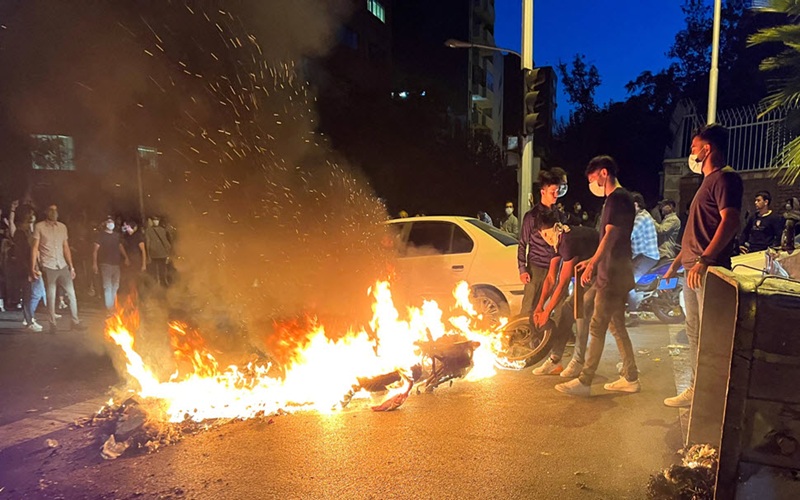

As living costs soar and discontent spreads across social groups, the regime is increasingly treating ordinary protesters as security threats—a sign of deepening fear inside the ruling establishment.
Iran’s regime is once again escalating its threats against protesters, with senior security officials warning that anyone who takes part in unrest will be treated as an enemy.
The latest warning came from Ahmad-Reza Radan, the regime’s police chief, who declared that the country was in a “war situation” and warned that anyone allegedly seeking to create insecurity would be confronted as an enemy. He emphasized that the security forces were fully prepared to respond.
Radan also claimed that more than 6,000 people had been arrested as “rioters” and referred to alleged arrests of members of the People’s Mojahedin Organization of Iran (PMOI/MEK).
Behind the regime’s increasingly aggressive rhetoric, however, lies a broader question: Why does the ruling establishment feel compelled to portray protesters as enemies in the first place?
When a Protester Becomes an “Enemy”
The regime’s language effectively eliminates the distinction between a citizen demanding better living conditions and an armed adversary.
This is significant because it reveals how the authorities view any independent expression of public discontent. Rather than addressing the economic and social grievances driving protests, the regime frames dissent as a security threat and prepares its forces to suppress it accordingly.
Radan’s statement that the police are ready for confrontation is therefore more than a routine security warning. It is a message directed at a society where economic pressures are affecting an increasingly broad range of people.
The regime’s repeated references to the PMOI and organized resistance also indicate the extent to which it sees the combination of popular discontent and organized opposition as a threat to its survival.
At the same time, reports of activities by Resistance Units demonstrate that the regime’s security apparatus has not succeeded in eliminating organized opposition. The authorities continue to announce arrests and security operations even as resistance activities persist.
A Growing Gap Between Wages and the Poverty Line
The economic backdrop makes the regime’s concern over renewed protests easier to understand.
Officially cited figures indicate that wages for large sections of Iranian society remain around or below 25 million tomans per month, while estimates cited in the discussion put the poverty line above 65 million tomans.
Even allowing for differences in methodology and household circumstances, the enormous gap illustrates the scale of the economic pressure facing ordinary Iranians.
This is no longer a problem confined to one occupational group. Workers and government employees are affected, but so are retirees, teachers, small business owners, and other sections of society whose incomes have failed to keep pace with inflation.
When basic living costs rise far faster than wages, economic grievances inevitably acquire a broader social dimension.
The question for the regime is therefore not simply whether another isolated protest will occur. It is whether economic hardship can bring together different social groups around common grievances.
Why the Regime’s Threats Matter
The use of increasingly harsh language against protesters can itself be read as an indication of the authorities’ concerns.
A government confident in its political stability does not necessarily need to describe ordinary dissent as an enemy action. By defining protesters as enemies, the regime is preparing the political and security justification for treating demonstrations as a confrontation requiring force.
The language also serves another purpose: intimidation.
By warning that protesters will be treated like enemies, the regime seeks to raise the perceived cost of participation and discourage people from entering the streets.
Yet such threats can have the opposite effect when the underlying grievances remain unresolved. Suppression may temporarily reduce visible demonstrations, but it cannot by itself resolve unemployment, inflation, declining purchasing power, unpaid wages, or the widening gap between incomes and living costs.
Echoes of Iran’s Revolutionary History
There is also a historical precedent for such rhetoric in Iran.
During the final years of the Shah’s rule, security officials similarly portrayed protesters and opponents as threats to national security. Following the September 8, 1978 massacre—known as Black Friday—official warnings continued to characterize further demonstrations as disorder and a threat requiring a forceful response.
The comparison should not be understood as suggesting that current events are identical to those of 1978. Rather, it highlights a recurring pattern in authoritarian rule: when widespread social dissatisfaction becomes difficult to contain, authorities often redefine political opposition as a security threat.
The language changes little: protesters are portrayed as enemies, unrest is described as a conspiracy, and repression is presented as necessary to preserve security.
“The Enemy Is Here”
There is another revealing dimension to the regime’s rhetoric.
For decades, Iran’s rulers have sought to direct public attention toward external enemies, presenting foreign powers as the primary source of the country’s problems. But when the regime itself declares that anyone protesting inside Iran is an “enemy,” it inadvertently shifts the focus back to the domestic confrontation.
The slogan long raised by Iranian protesters—“The enemy is right here”—captures this political reality.
The regime’s own rhetoric increasingly defines the opposing sides in stark terms: on one side, the ruling establishment and its security apparatus; on the other, a population facing mounting economic hardship and a resistance movement seeking fundamental political change.
Fear Behind the Threats
The latest threats should therefore be viewed in the context of a regime confronting multiple pressures simultaneously.
The economy is weakening, household purchasing power is shrinking, and grievances are spreading beyond individual social groups. At the same time, the authorities remain concerned about organized resistance and the possibility that economic protests could develop into broader political unrest.
Calling protesters “enemies” does not resolve any of these problems. It only reveals the regime’s chosen response: confrontation rather than reform.
The sharper the threats become, the clearer the regime’s underlying calculation appears. Its priority is not to address why people are protesting, but to prevent their grievances from converging into a broader challenge to its rule.
For a population already struggling with economic hardship, however, repression cannot permanently substitute for solutions. And when an entire society is being told that its demands constitute an enemy threat, the regime may be exposing precisely what it fears most: a widening confrontation between the ruling establishment and the people it claims to govern.