


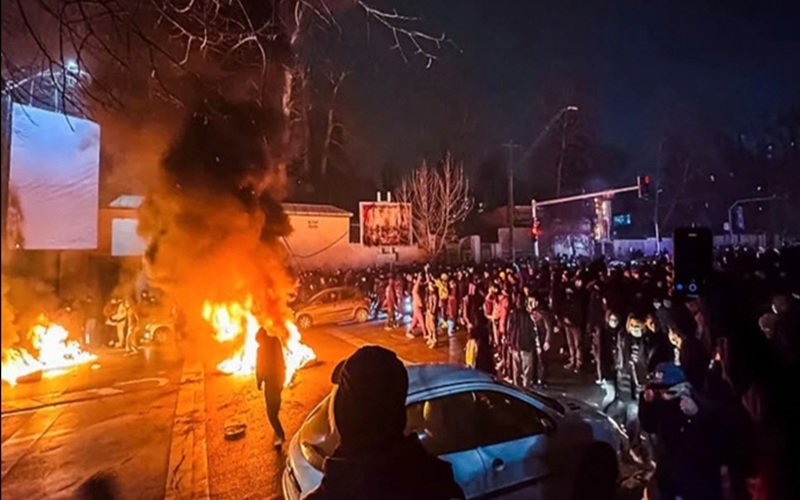

A successful transition from dictatorship requires more than political rhetoric—it demands an organized, independent movement capable of confronting repression and leading democratic change.
The question of Iran’s political future has become increasingly urgent as the country’s multiple crises deepen and public dissatisfaction continues to grow. While many observers agree that the current regime faces mounting internal and external pressures, an equally important question remains: what kind of political alternative is capable of leading Iran through a democratic transition?
History has repeatedly shown that the collapse of authoritarian systems alone does not guarantee democracy. A successful transition requires a credible alternative with the organization, legitimacy, and practical capacity to replace dictatorship with democratic governance.
Three fundamental characteristics define such an alternative.
Confronting the Regime’s Machinery of Repression
Any movement seeking democratic change in Iran must first demonstrate that it is prepared to confront the regime’s principal instrument of repression: the Islamic Revolutionary Guard Corps (IRGC).
For decades, the IRGC has functioned as far more than a military organization. It has become the backbone of the regime’s political control, economic influence, intelligence operations, and suppression of dissent. As a result, meaningful political change cannot occur without challenging the institution that safeguards the regime’s survival.
Ignoring this reality reduces political strategies to theoretical exercises disconnected from conditions on the ground. A viable democratic alternative must be prepared to bear the costs and risks of confronting the regime’s coercive apparatus rather than assuming that change will emerge through rhetoric alone.
Rooted in Iranian Society, Not Foreign Patronage
A second defining characteristic is genuine national legitimacy.
A credible alternative must emerge from within Iranian society itself, maintaining an active presence inside the country while remaining politically and financially independent of foreign governments. Its organizational strength, logistical capabilities, and communications should derive primarily from support among the Iranian people.
This independence is essential not only for political credibility but also for ensuring that any future democratic government reflects the aspirations of Iran’s citizens rather than the interests of outside powers.
Throughout modern history, externally dependent political projects have struggled to gain lasting public trust. Sustainable democratic change requires domestic legitimacy built through engagement with society rather than sponsorship from abroad.
Organization, Commitment, and Sacrifice
Political aspirations alone are insufficient without disciplined organization.
A movement capable of guiding democratic transition must consist of organized, committed individuals who consciously choose the risks associated with resistance. Effective leadership during periods of political upheaval requires more than popular support—it demands structure, coordination, and a network capable of operating despite intense repression.
Supporters of Iran’s organized resistance argue that the Resistance Units have demonstrated this capacity by continuing their activities despite extensive arrests, surveillance, and security crackdowns. They contend that these networks have expanded their presence across major Iranian cities while maintaining operational resilience under exceptionally difficult conditions.
According to reports published by the Iranian Resistance, these networks carried out hundreds of operations targeting regime centers during periods of nationwide unrest. They also cite a coordinated operation involving approximately 250 resistance members against a heavily secured regime facility in Tehran shortly before the recent conflict, presenting it as evidence of increasing organizational capability.
Whether viewed through the lens of political organization or operational effectiveness, such developments illustrate the importance of disciplined structures in sustaining long-term resistance under authoritarian rule.
The Strategic Importance of Organized Resistance
Authoritarian governments often survive widespread public dissatisfaction because spontaneous protests alone rarely produce lasting political change.
The greatest challenge for the Iranian regime has historically emerged when public unrest converges with organized resistance capable of sustaining momentum beyond individual demonstrations. This convergence transforms isolated protests into a broader political movement with strategic direction.
From the perspective of the regime itself, this combination represents one of the most significant threats to its continued rule. Public anger may emerge unexpectedly, but when coupled with established organizational networks, it acquires greater resilience and long-term impact.
Beyond Theory: The Challenge of Democratic Transition
Ultimately, a democratic alternative cannot exist merely as an abstract political concept or an aspiration discussed in exile.
It must be a tangible, organized force capable of operating under repression, maintaining independence, mobilizing public support, and demonstrating practical leadership during periods of national crisis.
Iran’s future will depend not only on the weakening of the current regime but also on whether an organized democratic movement possesses the capacity to channel widespread public demands for freedom into a stable political transition.
The defining challenge is therefore not simply ending authoritarian rule. It is ensuring that a democratic alternative exists with the credibility, organization, and popular legitimacy necessary to lead Iran beyond dictatorship and toward a democratic republic.