


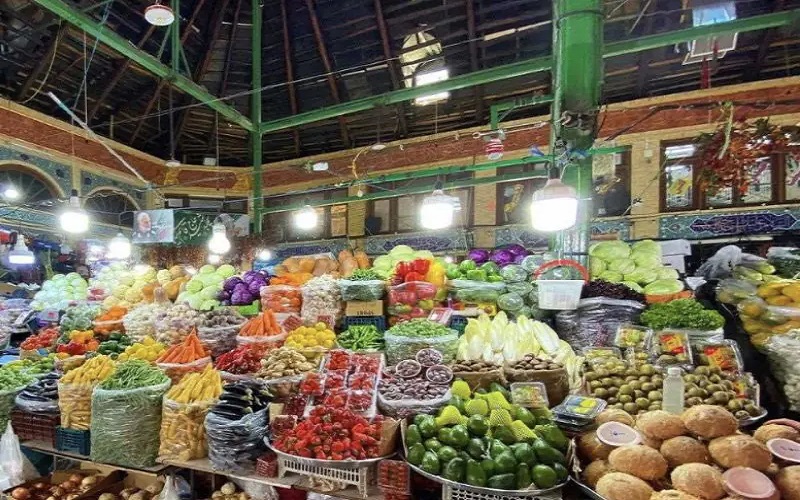

Inflation in Iran, particularly in the food sector, has reached unprecedented levels this April, setting new records and deepening the economic hardship for workers and low-income families. Basic goods have become significantly more expensive compared to the previous year, pushing essential food items off the tables of millions.
In these conditions, the four to five million tomans wage increase approved by the Supreme Labor Council—and promoted by the government as a major achievement—proved ineffective within the very first month of the new year. Workers continue to face poverty, deprivation, and empty dinner tables.
Alarming Surge in Food Prices
According to the latest Consumer Price Index report from the Statistics Center of Iran, food inflation has resumed its upward trajectory, with monthly figures exceeding 4.1 percent. Among food items, fruits and nuts experienced the steepest rise, with a staggering 11.7 percent increase in just one month.
Broader inflation indicators also reveal a historic surge. Point-to-point inflation for Iranian households in April 2025 reached 38.9 percent, while food inflation soared by 42.7 percent compared to the same month last year. Vegetables and legumes saw the most dramatic increase, with prices jumping by 89.1 percent, followed by fruits and nuts with a 65 percent rise.
Although ILNA News Agency notes that official figures tend to be conservative and somewhat disconnected from the true market situation, they still paint a grim picture: in April 2025, Iranian families must spend nearly 90 percent more than the previous year to afford basic goods such as vegetables and legumes—items that have become substitutes for meat after years of relentless economic shocks.
Wage Increases Fall Drastically Short
While the cost of living has exploded, wage increases have lagged far behind. Workers’ wages rose by only 45 percent, and wages in other sectors increased by a mere 32 percent. This leaves a 50 percent gap between income growth and the actual cost of purchasing basic food items.
Other inflation measures confirm the worsening situation. Monthly household inflation rose by 0.6 percentage points compared to March, reaching 3.9 percent in April. In the “food, beverages, and tobacco” category, monthly inflation was recorded at 4.2 percent, while “non-food goods and services” saw a 3.8 percent increase. Meanwhile, annual household inflation climbed to 33.2 percent in April, up 0.7 percentage points from March 2025.
The Crisis on the Store Shelves
Despite official price caps—such as the Market Regulation Committee’s decision to set the price of first-grade Hashemi and Tarom rice at 130,000 tomans per kilogram—these staple goods are largely absent from major chain stores like Ofogh Kourosh and Janbo. Instead, shelves are filled with cheaper Indian rice, while Iranian rice is sold at twice the official price in the open market.
Today, a kilogram of Hashemi rice costs about 250,000 tomans, and even lower-quality Iranian rice is priced around 200,000 tomans per kilogram. Given that the newly approved daily wage for workers is 346,000 tomans, a worker’s entire day’s pay is barely enough to buy two kilograms of rice. Thus, the so-called wage increase announced in March has already lost its real value.
Currency Volatility and Inflation Waves
The steep increase in the exchange rate over the past year has had a devastating impact on the working class. A simple calculation shows that from March 2024 to February 2025, the dollar’s value rose by 79 percent, while wages only grew by 45 percent. To merely keep pace with the dollar’s impact on consumer prices, wages would have needed to rise by an additional 34 percent—and even this estimate is conservative.
In reality, basic goods like rice, vegetables, and legumes have experienced price hikes of over 100 percent, reflecting an even deeper erosion of purchasing power.
Despite occasional minor decreases in the exchange rate, there has been no corresponding drop in consumer prices. In Iran’s volatile market, inflation operates like a relentless wave, engulfing household budgets with little hope of reprieve.
A Systemic Failure
The persistence of this crisis highlights the regime’s failure not only to grasp the depth of the country’s economic struggles but also to implement genuine reforms. Instead, officials continue to announce misleading statistics and issue hollow decrees in a futile attempt to cover up the crisis.
When wage increases fail to cover even the most basic nutritional needs of working families, slogans about “social justice,” “supporting vulnerable groups,” and “curbing inflation” ring hollow. Without structural reform, these promises will remain nothing more than empty rhetoric.