


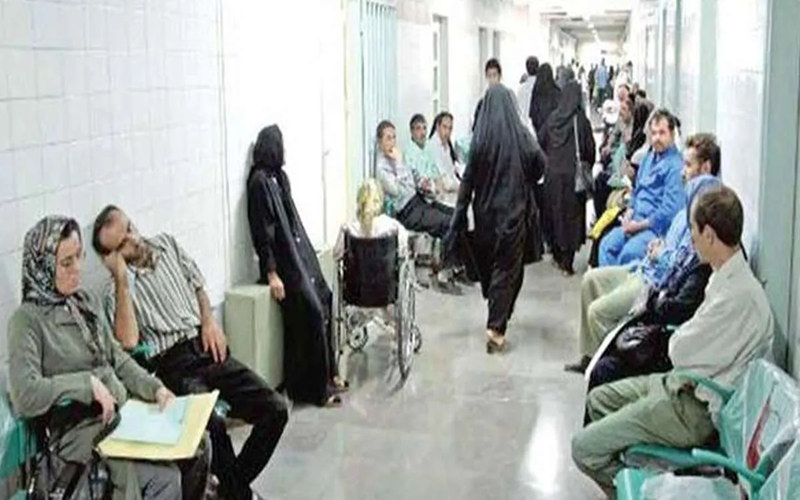

Millions of Iranian workers continue paying insurance premiums every month, yet many are denied basic medical treatment when they need it most.
In Iran, millions of workers see part of their already insufficient wages deducted every month for insurance and medical coverage. Yet today, many of those same workers find themselves abandoned when illness strikes, wandering between pharmacies and treatment centers without access to even the most basic healthcare services.
The growing crisis surrounding “treatment eligibility” within Iran’s Social Security Organization has now become one of the most serious problems facing workers and insured citizens across the country. The crisis is not rooted in workers failing to pay their share. Rather, it is the product of contradictory laws, bureaucratic dysfunction, administrative delays, and failing digital infrastructure — all of which ultimately punish the most vulnerable layers of society.
According to the state-run newspaper Tose’e Irani, under Article 39 of Iran’s Social Security law, employers are given up to 30 days to submit insurance lists for the previous month without penalty. Yet the Social Security healthcare system only recognizes a worker’s treatment eligibility for 45 days after the last registered payment. This legal mismatch has left thousands of workers trapped in bureaucratic limbo precisely when they require urgent medical care.
The contradiction exposes a brutal reality inside Iran’s labor system: workers continue paying the price for delays and failures entirely outside their control.
Ehsan Sohrabi, a labor activist and former member of the Ministry of Labor’s Technical Protection Committee, recently stated that workers are “the most financially disciplined group within the Social Security system.” Seven percent of every worker’s salary is automatically deducted each month for insurance contributions, while workers themselves have no role in whether employers delay official payments.
Yet despite this, workers are the first group punished when treatment eligibility is suspended.
The consequences become even more dangerous for patients suffering from chronic illnesses. In recent weeks, many diabetic patients visiting pharmacies and treatment centers have reportedly been told that their insurance eligibility had been suspended, preventing them from receiving their medication quotas.
For a worker dependent on insulin, heart medication, or urgent medical services, even a temporary interruption in insurance coverage can become a direct threat to survival.
The cruelty of the situation lies in the fact that, legally speaking, employers may still remain within their official payment deadline while workers are already denied treatment.
Labor activists argue that the treatment eligibility window should be extended to at least 60 days in order to align with employers’ legal deadlines. Otherwise, workers are effectively forced to pay for bureaucratic disorder and employer delays with their health and, in some cases, their lives.
But the crisis extends far beyond conflicting legal deadlines.
Repeated failures of Iran’s online Social Security systems have themselves become a daily nightmare for workers. Across the country, patients arriving at pharmacies or clinics are increasingly met with the same phrase: “The system is down.”
When the electronic system fails, digital prescriptions cannot be processed. Workers are then forced either to pay full market prices for medicine — often impossible under Iran’s collapsing economy — or to leave without treatment entirely.
For many Iranian workers already struggling to afford basic food and housing costs, even short interruptions in medical services can push families deeper into catastrophe.
Workers increasingly describe the system as fundamentally one-sided. Social Security authorities remain extremely strict when collecting insurance payments, yet even the smallest administrative disruption immediately results in suspended medical services.
Many now believe that the healthcare system in Iran no longer functions as social protection for workers, but rather as another mechanism of pressure against the country’s laboring class.
The crisis becomes even more painful for workers approaching retirement age.
Under current procedures, once retirement eligibility is confirmed, workers are ordered to leave their jobs immediately. However, the issuance of final retirement rulings can take months. During this bureaucratic gap, many retirees effectively lose access to healthcare services altogether.
This occurs precisely at a stage in life when medical care becomes more essential than ever.
Labor activists report that the delay between leaving employment and receiving final retirement approval can stretch to four months. Four months during which elderly workers often remain without stable income, without job security, and without access to medical treatment while trapped in endless administrative queues.
What is unfolding today inside the Social Security system of the ruling clerical establishment is not simply an administrative defect or technical oversight. It is the reflection of a broader structure that continuously shifts the burden of crisis, corruption, and inefficiency onto the shoulders of workers and the poor.
The result is a system in which those who spent decades paying insurance premiums now find themselves denied one of the most basic human rights in moments of illness and old age: access to medical treatment.
In today’s Iran, even healthcare has become another arena where ordinary citizens bear the cost of systemic failure.