


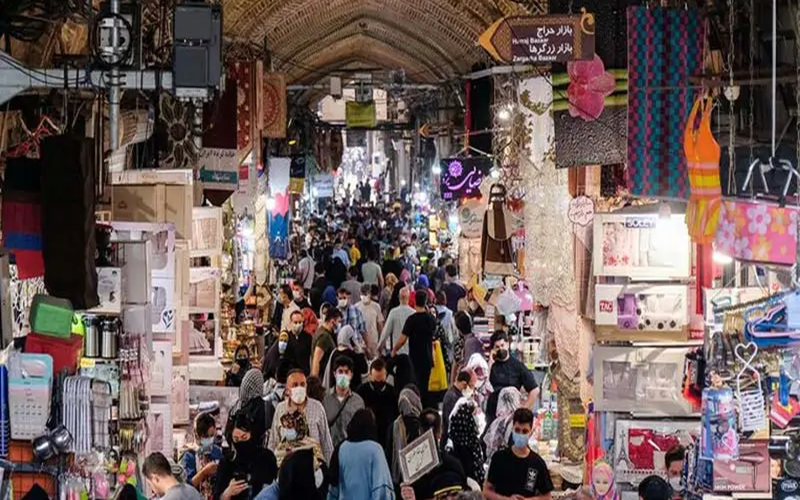

Senior regime economists acknowledge Iran has moved beyond chronic inflation, while officials admit investment, income, and economic growth continue to deteriorate.
Regime Economists Acknowledge Iran Is Approaching Hyperinflation
Signs of Iran’s deepening economic crisis are becoming increasingly difficult for the regime to conceal, as senior government economists and officials openly acknowledge the country’s deteriorating financial outlook. In recent remarks, prominent regime economist Masoud Nili warned that Iran has moved beyond chronic inflation and is now approaching what he described as the “threshold of hyperinflation.”
The admissions come amid mounting evidence of economic stagnation, declining investment, shrinking household incomes, and growing public hardship.
Masoud Nili: Iran Has Reached the “Pre-Hyperinflation Stage”
Speaking on July 20, Masoud Nili acknowledged the severity of Iran’s economic conditions, attributing the crisis to years of destructive economic policies.
According to Nili, the Iranian economy has progressed beyond the period traditionally characterized as chronic inflation and has entered a far more dangerous phase.
“Inflation in Iran was considered chronic from 1973 until the end of 2018. Since 2019, however, we have moved beyond chronic inflation and entered a period of high inflation.”
He further warned that the country is now at the “station before hyperinflation,” describing current inflationary pressures as both “very high” and “severe.”
Nili also admitted that Iran’s economic growth has effectively stalled since 2007, describing the prolonged stagnation as a warning sign of broader economic collapse.
Former Central Bank Chief Admits Declining Investment and Living Standards
Abdolnaser Hemmati, the regime’s former Central Bank governor, also painted a bleak picture of the country’s economy.
He acknowledged that Iran faces significant pressures stemming from external factors, declining production, reduced investment, budget deficits, and weaknesses throughout the banking sector.
According to Hemmati, gross fixed capital formation remained negative during the first three quarters of the Iranian year 1404, with investment contracting by 13 percent during the third quarter alone.
He also disclosed that real per capita income has fallen dramatically over the past decade.
Using constant 2021 prices, Hemmati said annual real per capita income declined from approximately 141 million tomans in 2011 to about 75 million tomans in 2024—effectively cutting average purchasing power nearly in half and reducing living standards to levels last seen in the 1990s.
Official Data Points to Continued Economic Stagnation
Official figures released by the Statistical Center of Iran further reinforce the bleak outlook.
According to data published on June 22, economic growth reached only 0.2 percent when oil revenues were included, while non-oil economic growth contracted by 0.3 percent.
The figures underscore the economy’s continued dependence on oil revenues and its inability to generate sustainable growth across productive sectors.
Officials Admit Public Cannot Endure More Economic Pressure
The worsening economic conditions have prompted rare admissions from other regime officials as well.
Mohammad Bathaei previously acknowledged that approximately 60 percent of the population can no longer tolerate additional economic pressure, highlighting the growing strain on Iranian households after years of inflation, unemployment, and declining purchasing power.
Despite these acknowledgments, senior officials continue to defend policies that shift the burden of the country’s crises onto ordinary citizens.
On July 20, Judiciary Chief Gholamhossein Mohseni Ejei declared:
“Standing against the enemy has costs, and we must accept those costs.”
His remarks came as Iranians continue to grapple with soaring prices, shrinking incomes, and worsening living conditions, reflecting what many critics view as the regime’s continued willingness to impose the consequences of its economic failures on the public rather than address the structural causes of the crisis.
Mounting Admissions Reflect a Deepening Structural Crisis
The increasingly candid statements from senior regime economists and officials illustrate the depth of Iran’s economic deterioration. While officials differ in how they describe the causes, their admissions collectively point to a country facing persistent inflation, falling investment, declining living standards, and prolonged economic stagnation.
As inflation continues to erode household incomes and growth remains weak, warnings that Iran is approaching hyperinflation underscore the scale of the challenges confronting an economy that has struggled under years of mismanagement and structural dysfunction.