


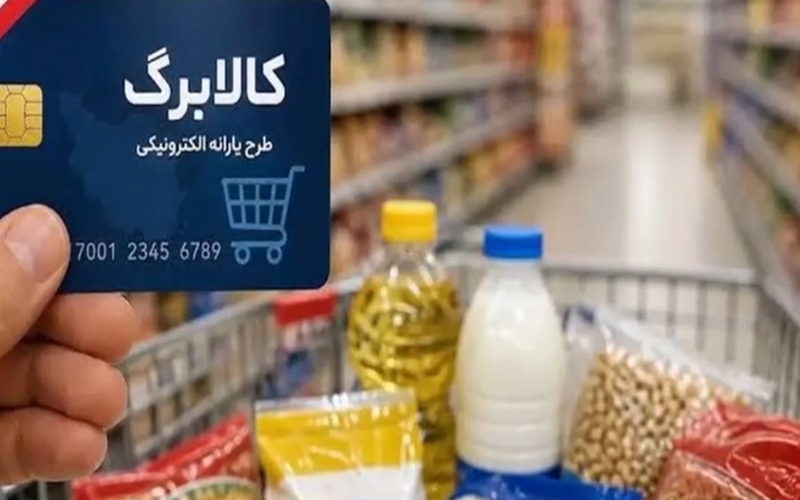

Nine months after promising a one-million-toman food voucher following the removal of preferential exchange rates, the regime has yet to deliver the promised increase. Meanwhile, rising food prices, new eligibility restrictions, and plans to remove 15 million recipients threaten to deepen the economic pressure on struggling families.
Iran’s regime is facing growing public anger over its failure to deliver promised increases in food voucher allowances, as soaring prices erode household purchasing power and millions risk losing access to the program. The food voucher scheme, presented as a measure to protect livelihoods amid the country’s deepening economic crisis, has instead become another source of frustration for families struggling to afford basic necessities.
The controversy intensified after months of delays, repeated changes to eligibility criteria, and reports that the government intends to remove millions of people from the list of beneficiaries.
Nine Months of Delays After the One-Million-Toman Promise
In December 2025, after President Masoud Pezeshkian’s government removed the preferential exchange rate, officials promised to provide food vouchers worth one million tomans to all citizens. The measure was presented as compensation for the resulting economic pressure on households.
Approximately nine months later, however, the promised support had still not materialized as announced.
On October 7, 2026, officials once again discussed changes to the program without announcing a concrete increase in the allowance. Instead, new eligibility conditions were introduced, including an income ceiling of 20 million tomans and restrictions involving home and car ownership.
The government has also revised its classification system for determining eligibility. Rather than relying on the previous ten income deciles, officials now propose grouping households into three broad categories based on their financial circumstances: lower-income, middle-income, and higher-income households.
These changes could further restrict access to assistance at a time when inflation and rising living costs are putting increasing pressure on families across the country.
Government Admits Funding Remains Uncertain
Reports in the state-run newspaper Arman-e Melli indicated that between 40 million and 44 million people had been identified as potential beneficiaries of an increased food voucher allowance.
However, the reports also acknowledged that the final amount of any increase would depend on whether the government could secure the necessary financial resources.
In practical terms, identifying millions of potential recipients has not translated into a funded and implemented support program. The regime has continued to discuss assistance without demonstrating that it can deliver the promised relief.
Meanwhile, the state-run publication Nobonyad, citing the spokesperson of Parliament’s Social Affairs Commission, reported that the government planned to remove approximately 15 million people from the list of food voucher recipients.
Those affected could include households that own a home or vehicle or fall outside the newly established eligibility categories.
The prospect of mass exclusions has added to public frustration, particularly because ownership of a basic asset does not necessarily mean a household can afford its daily expenses. Families facing high housing costs, declining real incomes, and rising food prices may remain financially vulnerable even when they possess a home or car.
Food Costs Have Risen More Than Fourfold
The gap between the promised assistance and the actual cost of living is another central problem.
According to figures cited in the discussion of the program, the cost of the 11 basic food items covered by the voucher scheme has increased approximately four-and-a-half-fold, bringing their monthly cost to more than four million tomans.
Against this background, the promised one-million-toman allowance would cover less than one-quarter of the cost of these items. The figures cited put its contribution at approximately 18 percent, leaving households to pay the remaining 82 percent themselves.
Even if the allowance were delivered in full, it would therefore fall far short of covering the cost of the designated food basket. And with the promised increase still undelivered, families cannot rely on the announced assistance to meet their basic needs.
The disparity highlights the limitations of a relief program whose nominal value has failed to keep pace with the rising cost of essential goods.
Official Response Fuels Public Frustration
The growing controversy has also exposed the disconnect between official explanations and the daily realities facing households.
During a press conference, a journalist challenged government spokesperson Fatemeh Mohajerani over the purchasing power of the food voucher, arguing that the amount was not even enough to buy a bag of pofak namaki, a popular Iranian cheese-flavored corn snack.
Mohajerani responded:
“We do not allocate food vouchers for pofak namaki.”
The exchange drew attention to the widening gap between the government’s presentation of its assistance program and public concerns about affordability.
For families struggling to purchase staple foods, the central issue is not whether a particular snack qualifies for government support. It is whether the assistance provides meaningful relief against the rising cost of food and other necessities.
Nine months after the regime promised a one-million-toman allowance, the combination of delayed implementation, uncertain funding, tighter eligibility rules, and the proposed exclusion of 15 million people has left the program falling short of its stated purpose.
As the cost of basic food continues to outstrip the value of the promised support, the food voucher controversy has become another illustration of the mounting economic pressures facing Iranian households.