


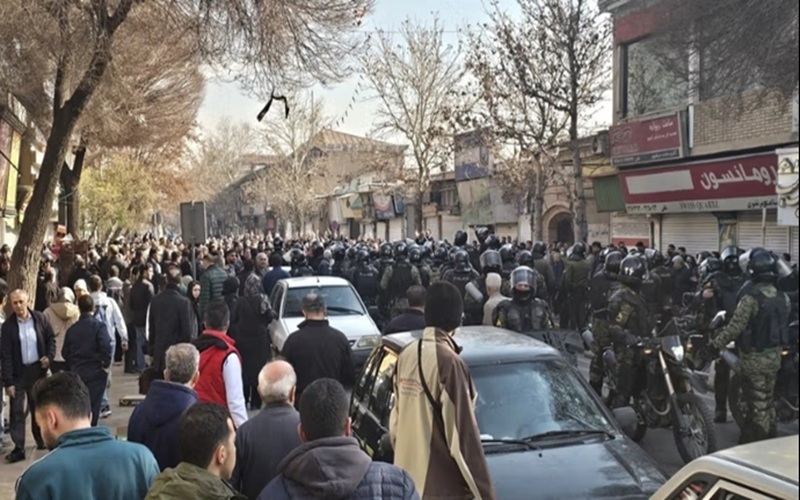

As officials admit that state resources have been exhausted and regime media warn of “hyperinflation,” economic hardship is increasingly threatening to trigger a broader social explosion.
Iran’s economic crisis has entered a phase in which even the regime’s own officials and media can no longer conceal its magnitude. What was once presented as a matter of temporary hardship, sanctions, or external pressure is increasingly being described from within the regime as a systemic crisis with potentially explosive social and political consequences.
Recent remarks by officials close to the government offer a revealing picture.
Masoud Pezeshkian previously acknowledged that substantial oil resources and foreign currency had been placed at the disposal of the armed forces, including the IRGC’s aerospace division. Now, his deputy, Saghaf Esfahani, has reportedly acknowledged that state resources have effectively been exhausted, saying: “We spent the money and the pot has reached the bottom.”
Whatever the regime’s priorities were when spending those resources, the consequences are increasingly being felt by ordinary Iranians.
When the State Runs Out of Resources, It Turns to the People
The central question is not simply where the regime’s money has gone. It is why, after years of enormous revenues and access to national resources, the government is increasingly unable to provide economic stability or protect the population from mounting hardship.
The answer lies in the regime’s priorities.
Resources that could have been directed toward rebuilding infrastructure, stabilizing the currency, improving public services, or addressing the country’s energy and water crises have instead been consumed by a sprawling state apparatus, security institutions, military programs, and policies designed to preserve the ruling structure.
Now, with financial pressure intensifying, the burden is once again being transferred to society.
Higher prices, declining purchasing power, inflation, and the prospect of further increases in essential commodities threaten to push millions of households beyond their ability to cope. Yet the regime faces a fundamental problem: there is very little room left for imposing additional economic pressure without provoking a political reaction.
The “Hyperinflation” Warning Comes From Inside the Regime
The severity of the situation is reflected in the increasingly alarmed language used by regime-affiliated media.
On August 19, the government-linked Khabar Online warned about the social and political consequences of the threat of “hyperinflation,” describing a process capable of producing cascading crises. Other regime media have gone even further, effectively arguing that the country’s economic emergency has become so obvious that sophisticated economic statistics are no longer required to demonstrate it.
This is an important shift.
For years, the regime has attempted to bury the reality of economic collapse beneath official statistics, promises of reform, and claims that external pressure is responsible for the population’s hardship. But when even regime-affiliated outlets acknowledge that the crisis is visible in everyday life, the credibility of those explanations becomes increasingly difficult to sustain.
People do not need economic reports to understand inflation when their wages buy less every month.
They do not need statistical models to recognize poverty when basic necessities become unaffordable.
And they do not need government institutions to tell them that an economic crisis exists when they experience it every day.
The Gasoline Question Is More Dangerous Than It Appears
One of the issues most clearly exposing the regime’s political vulnerability is the price of gasoline.
The memory of the November 2019 uprising remains a powerful warning for the authorities. The gasoline price increase at the time triggered protests that rapidly expanded beyond the original economic grievance and became a nationwide political confrontation.
Today, regime officials and media are openly worried that a similar decision could once again produce a much larger reaction.
But even their own analysis suggests that the next confrontation may not resemble the protests of 2019.
A recent Jamaran commentary warned against assuming that another uprising would simply repeat the previous pattern. Instead, it raised the possibility of “multilayered and combined” protests in which an economic demand becomes the starting point and then connects with broader social and political demands.
That warning deserves attention.
The regime is effectively acknowledging that the boundary between an economic protest and a political uprising has become increasingly thin.
A Small Economic Shock Could Trigger a Much Larger Explosion
This is the regime’s central dilemma.
An increase in the price of gasoline may begin as a dispute over fuel costs. But in a society already burdened by inflation, unemployment, poverty, corruption, repression, and collapsing public trust, such a decision can become a catalyst for accumulated grievances.
The same dynamic applies to other necessities.
A new price increase, the removal of subsidies, a currency shock, or another decline in living standards can provide the immediate trigger for anger that has been building for years.
Once protests begin, their trajectory may no longer be determined by the original economic issue.
A demand for affordable fuel can become a demand for economic justice. That can develop into broader demands for social rights. And those demands can rapidly become political.
This is precisely why the regime is so nervous about imposing another economic shock.
Its fear is not simply that people will complain. It is that an economic measure could unlock grievances that have accumulated across different sections of society and bring them together in the streets.
Poverty Cannot Be Used as a Substitute for Stability
The regime may hope that economic hardship will weaken society and reduce its capacity for resistance. But this strategy carries a profound political risk.
Poverty does not necessarily produce political passivity.
When people believe that their living standards are being deliberately sacrificed to preserve an entrenched ruling system, economic deprivation can become a source of political anger. When workers cannot survive on their wages, retirees cannot meet basic expenses, and families cannot afford essential goods, the question increasingly shifts from “How bad is the economy?” to “Why is this happening?”
That transformation is politically consequential.
The regime may attempt to use inflation, austerity, and economic pressure to keep society preoccupied with survival. Yet the growing warnings from its own media indicate that the opposite may occur: economic suffering can bring previously separate grievances together and create a broader challenge to the ruling structure.
The Real Fear Behind the Warnings
The statements coming from regime officials and media outlets should therefore not be interpreted simply as expressions of concern for the population’s welfare.
Their language reveals a deeper fear.
They understand that the economic crisis has become inseparable from the political crisis. They know that another severe shock could reconnect widespread economic grievances with the experience of previous uprisings. And they recognize that the next wave of unrest could be more complex and more difficult to contain than those that came before it.
This is why the regime is increasingly warning about hyperinflation, gasoline prices, social instability, and the consequences of another economic shock.
The danger it sees is not merely an empty treasury.
It is an angry society.
The regime may have reached the bottom of the barrel financially, but the Iranian people have reached the limits of their endurance. Attempts to manage the crisis by transferring its costs onto society will not eliminate the underlying causes of unrest. They risk turning economic desperation into a broader political confrontation.
Iran’s economic crisis has therefore ceased to be merely an economic story. It has become a measure of the widening distance between society and the ruling establishment—and a potential catalyst for another nationwide eruption.