


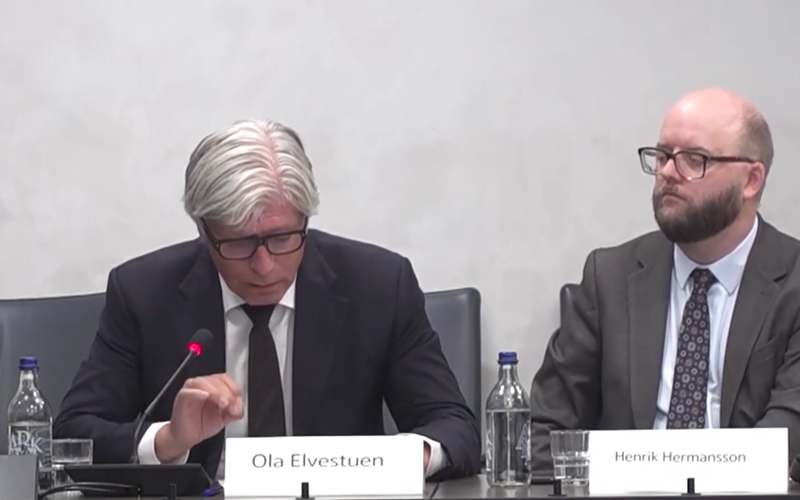

Norwegian parliamentarian Ola Elvestuen links water scarcity, land subsidence, air pollution, and ecological destruction to the broader consequences of repression and mismanagement by Iran’s regime.
The deepening human rights crisis in Iran is inseparable from a wider environmental catastrophe that is increasingly affecting the population’s access to water, clean air, health, livelihoods, and basic living conditions, Norwegian politician Ola Elvestuen said at a conference held at the European headquarters of the United Nations in Geneva.
The conference brought together political figures, legal experts, and human rights advocates to discuss the deteriorating human rights situation in Iran and the escalating use of executions by the regime.
Elvestuen, who served as Norway’s Minister of Climate and Environment from 2018 to 2020 and has been a member of parliament, focused his remarks on the environmental dimension of the crisis. He argued that environmental destruction in Iran should not be treated as a separate technical issue but as part of a broader crisis involving fundamental rights, including the right to life, health, security, access to water, and a safe environment.
Iran’s Water Crisis and Accelerating Land Subsidence
One of the most serious problems is the excessive extraction of groundwater. Elvestuen highlighted reports indicating that land subsidence in some parts of Iran has reached 20 to 30 centimeters per year, among the highest rates recorded globally.
The consequences are already visible in major population centers. Isfahan and its historic structures face serious risks, while Tehran and surrounding areas are threatened by subsidence affecting or approaching airports, railway lines, and other critical infrastructure.
Iran’s groundwater deficit has reportedly reached approximately 130 billion cubic meters, underscoring the scale of the depletion.
The environmental crisis is therefore also a question of governance and human rights. Water shortages, falling groundwater levels, disappearing wetlands and lakes, and inadequate water management are placing farmers and vulnerable communities under mounting pressure.
Air Pollution Adds to the Human Cost
Elvestuen also pointed to Iran’s severe air pollution and recurring dust storms.
Gas shortages and aging infrastructure have contributed to increased reliance on mazut, a heavy fuel oil associated with high levels of sulfur emissions. During some periods, sulfur pollution has reportedly reached several times permissible levels.
The drying of wetlands and lakes has further contributed to dust storms, particularly across western and southern Iran. Major cities, including Tehran, Isfahan, and Arak, have experienced periods in which clean-air days have become exceptionally rare.
Air pollution in Iran is associated with tens of thousands of premature deaths each year, adding another major public-health dimension to the country’s environmental emergency.
Environmental Destruction Threatens Food Security
The damage extends beyond urban areas.
More than 1.5 million hectares of oak forests in the Zagros Mountains have reportedly suffered extensive dieback and degradation. At the same time, large areas of agricultural land and rangelands are being affected by desertification each year.
Soil erosion is also reported to be roughly three times the global average, threatening agricultural productivity and, ultimately, food security.
These trends are particularly damaging for rural communities whose livelihoods depend directly on water availability, agriculture, and natural resources.
Water and Power Failures Disrupt Daily Life
The environmental crisis is increasingly intertwined with Iran’s energy crisis.
Water cuts, declining pressure, and deteriorating drinking-water quality have become sources of growing public frustration in major cities. At the same time, scheduled electricity outages have disrupted essential services and daily life.
Power cuts can interrupt water pumps in residential buildings, elevators, telecommunications, and internet access. Industrial facilities and factories have also been forced to suspend or reduce operations, contributing to lower production and employment.
The result is a chain reaction in which failures in water, energy, infrastructure, and environmental management reinforce one another.
A Human Rights Crisis Beyond Political Repression
Elvestuen’s remarks framed these environmental problems as fundamental rights issues rather than isolated ecological failures.
For millions of Iranians, the consequences involve the basic ability to obtain water, breathe clean air, maintain livelihoods, and live in a safe and sustainable environment.
Public grievances therefore extend beyond political freedoms and economic hardship. Environmental degradation has become directly connected to social discontent as communities confront water shortages, pollution, disappearing natural resources, and declining living conditions.
This convergence of environmental, economic, and human rights pressures is particularly significant in a country where public protests have repeatedly challenged the regime over water shortages, pollution, electricity failures, and deteriorating living conditions.
Iran Among the World’s Worst Climate Performers
Elvestuen also cited the Climate Change Performance Index, whose November 2025 edition placed Iran 66th out of 67 countries assessed.
The index evaluates countries according to areas including greenhouse-gas emissions, renewable energy, energy use, and climate policy. Iran’s extremely low position reflects persistent shortcomings across these areas. The assessment also notes that Iran has not ratified the Paris Agreement.
The figures underline that the environmental crisis cannot be separated from the policies and priorities governing Iran’s economy and infrastructure.
A Crisis Requiring Democratic Change
The Geneva discussion presented Iran’s environmental destruction as one of the increasingly visible consequences of the regime’s broader system of repression and mismanagement.
The argument advanced by Elvestuen was that addressing these challenges requires more than technical interventions. Iran needs an environment in which fundamental rights are protected and society can openly debate and implement solutions to its water, energy, pollution, and climate problems.
For the Iranian population, the environmental crisis has become a question of survival and quality of life. Water scarcity, polluted air, land subsidence, desertification, and energy failures are no longer distant environmental concerns; they are increasingly shaping everyday life.
The Geneva conference thus placed environmental degradation alongside Iran’s broader human rights crisis, highlighting how the regime’s policies have consequences extending from political repression to the most basic conditions of life.