



The Iranian economy continues to reel under the relentless depreciation of the national currency and soaring gold prices. On Saturday, February 22, the US dollar was traded at an unprecedented 95,020 tomans on Ferdowsi Street in Tehran. Simultaneously, the price of gold coins surged to 79,920,000 tomans, marking new record highs and intensifying concerns over inflation and economic instability.
Mounting Criticism of Pezeshkian’s Economic Policies
As the crisis escalates, president Masoud Pezeshkian’s administration faces growing criticism from parliament members, media outlets, and even figures within the regime. The so-called reformist-affiliated newspapers have also joined the chorus, demanding an explanation for his administration’s failure to curb the rapid rise in the exchange rate—a key driver of inflation affecting essential goods and food prices.
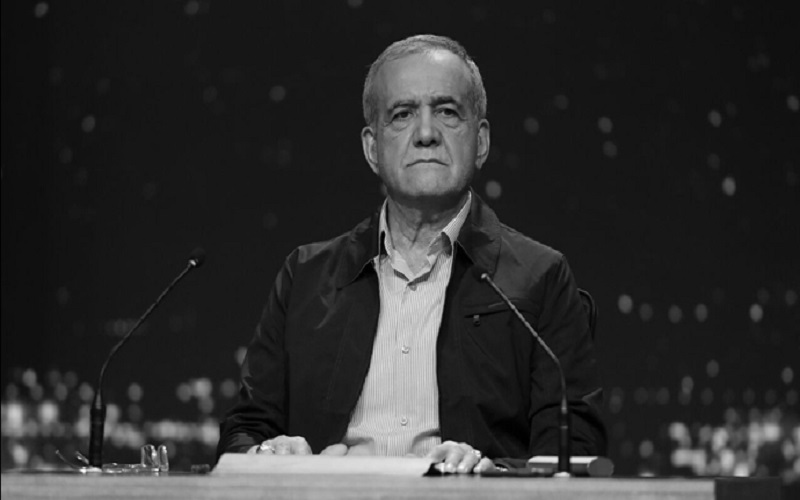
Despite the public outcry, Pezeshkian offered a stark acknowledgment of his administration’s limitations. In a speech last Thursday, he responded to growing dissatisfaction from citizens and industrialists by admitting his inability to resolve the country’s deep-rooted economic problems. “Do you think I have a magic box?” he remarked. “Six months ago, I was a parliament member, and now I am president. Everywhere we look, we see imbalances—in water, electricity, gas, money, land, schools, hospital beds. Demand is unlimited, while our capacity is limited.”
Currency Depreciation and Inflationary Pressures
The sharp depreciation of the toman is not limited to the US dollar. On February 22, the British pound crossed the 120,000-toman threshold for the first time, while the euro was traded at 99,650 tomans. The Turkish lira reached 2,660 tomans, the UAE dirham exceeded 26,050 tomans, the Canadian dollar stood at 67,000 tomans, and the Chinese yuan surpassed 13,200 tomans. Given the historical correlation between foreign currency fluctuations and consumer prices, Iranians are bracing for yet another wave of inflation ahead of Nowruz 1404.
In parallel, gold prices have surged dramatically. The new design Emami coin reached 79,920,000 tomans, while each gram of 18-karat gold was traded at 6,950,000 tomans. The price of half coins and quarter coins also set new records at 43,400,000 tomans and 22,800,000 tomans, respectively.
The Political and Economic Implications
The reformist newspaper Ham Mihan, in its February 22 edition, criticized Pezeshkian’s statements, arguing that his remarks amounted to an admission of surrender in the face of economic turmoil.
The latest currency crisis follows Supreme Leader Ali Khamenei’s directive banning any nuclear negotiations with the administration of former US President Donald Trump. This decision reignited market instability, triggering a sharp rise in the dollar’s value and accelerating inflation at an alarming rate since early February 2025.
Amidst these developments, Pezeshkian attempted to deflect responsibility for the crisis. Speaking after a meeting with Central Bank officials last Wednesday, he asserted that his administration’s economic policies were “the result of decisions made by the heads of the three branches of government,” implying that the Ministry of Economy alone should not bear the blame. This statement effectively placed accountability on institutions controlled by Khamenei, hinting at deeper fractures within the regime’s economic management.
Uncertain Future for Iran’s Economy
As the toman continues to weaken and inflationary pressures mount, the outlook for Iran’s economy remains grim. With authorities unable—or unwilling—to implement effective measures, public discontent is likely to intensify, further destabilizing an already volatile economic and political landscape. The coming weeks leading up to Nowruz will be a critical test for Pezeshkian’s government as it grapples with one of the most severe financial crises in recent history.