


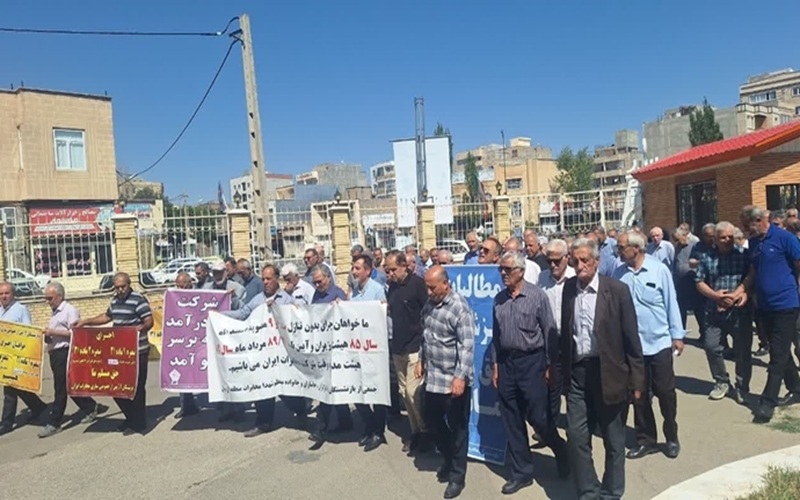

From buying food and medicine in installments to the collapse of small businesses, mounting inflation and shrinking purchasing power are pushing both households and merchants toward financial ruin.
Iran’s deepening economic crisis is increasingly visible in two interconnected developments: households that can no longer afford everyday necessities without borrowing, and small businesses that are struggling to survive as consumers cut spending.
The spread of installment purchases for food, medicine, and other basic needs, alongside warnings that as many as 95 percent of businesses in Iran’s Kurdistan province are approaching bankruptcy, reveals the depth of a crisis that is no longer confined to the poorest sections of society.
For millions of Iranians, income is disappearing almost as soon as it arrives. At the same time, businesses are facing rising operating costs, declining demand, power outages, and mounting financial obligations. The result is a vicious cycle in which falling household purchasing power weakens businesses, while struggling businesses further undermine employment and incomes.
Basic necessities are increasingly being bought on credit
According to the Iranian Labor News Agency (ILNA), the worsening cost-of-living crisis, particularly among workers and salaried employees, has made installment purchasing through online platforms a means of covering monthly income shortfalls.
A significant portion of wage earners reportedly runs out of cash shortly after receiving their salaries and turns to small lines of credit to cover ordinary expenses.
Platforms such as Digikala’s DigiPay, SnappPay, Tara, and DoctorPay have expanded their credit services in response to this demand. But what may appear to be the expansion of consumer finance is in reality an indication of declining purchasing power.
One 29-year-old editor in Tehran told ILNA that installment credit has increasingly become part of his daily life. He said he had never imagined reaching a point where he would need to buy even a book in three or four installments. Over the past three years, he said, he had used such credit services to purchase many of his basic necessities.
The consequences are particularly severe for households headed by a single income earner.
A 40-year-old woman identified as “R.A.” said rising food prices force her to turn to credit purchases from the middle of each month. Repeated borrowing, she explained, has created a permanent debt cycle in which part of each month’s salary is already committed to paying the previous month’s installments.
As a result, there is no money left to build savings or prepare for an emergency such as illness.
Debt is spreading to healthcare
The deterioration has gone beyond consumer goods.
According to comments cited by ILNA, installment payments are increasingly being used for medical expenses, including doctor visits and treatment. An earlier report by Eqtesad News also documented the spread of installment-based payments in Iran’s healthcare market, including dentistry and even medicines.
This is a particularly stark indicator of declining household solvency. When families cannot afford to pay for medical treatment at the time it is needed, healthcare ceases to be a routine expense and becomes another liability to be financed through debt.
For younger Iranians, the consequences may be even more lasting. With unstable employment, uncertain incomes, and rapidly rising living costs, installment payments are becoming financial obligations before many young people have had an opportunity to accumulate savings or establish economic security.
In other words, households are increasingly consuming tomorrow’s income simply to survive today.
Inflation is destroying purchasing power
The expansion of household debt is taking place against an extraordinary inflationary backdrop.
According to the latest figures cited from Iran’s Statistical Center, point-to-point inflation reached 87.9 percent in July 2026, while annual inflation stood at 66 percent.
At such rates, nominal wage increases rapidly lose their value. Even households that remain employed can find themselves unable to maintain their previous standard of living.
The consequence is not simply reduced consumption. Families are changing what they eat, postponing medical treatment, eliminating discretionary purchases, and increasingly relying on credit to bridge the gap between income and basic expenses.
The economy is therefore moving from a traditional pattern of consumption toward one characterized by survival, borrowing, and deferred payment.
Businesses are collapsing on the other side of the same crisis
The crisis facing households is mirrored by the condition of small businesses.
Shahab Naseri, deputy head of Iran’s Chamber of Guilds and head of the Sanandaj Chamber of Guilds, warned on August 8 that approximately 95 percent of business establishments in Kurdistan Province are at risk of bankruptcy.
Naseri said government support has been insufficient to preserve employment and prevent business closures. He also criticized banks for failing to provide adequate financing despite instructions from provincial authorities.
The financial deterioration has become so severe, he said, that even during the war some businesses have had their checks returned unpaid.
The 95 percent figure is an estimate by the provincial chamber and has not been independently verified. Nevertheless, it is consistent with broader indications of declining demand and increasing pressure on Iran’s retail and small-business sector.
A report by the Research and Education Department of Iran’s Chamber of Guilds in late 2025 showed the retail purchasing managers’ index hovering around the contraction threshold, with declining new orders and persistent inflation intensifying the recessionary pressure on businesses.
A vicious cycle of falling demand and rising costs
The underlying problem is straightforward: consumers have less money, while businesses have higher costs.
When food, rent, transportation, medicine, raw materials, and other necessities become more expensive, households reduce their purchases. Businesses then sell fewer goods and services. Lower sales reduce their ability to pay employees, suppliers, taxes, loans, and other expenses. This further weakens household incomes and purchasing power.
The cycle feeds itself.
Business owners are also dealing with repeated electricity outages, which have inflicted additional damage on production and retail activity.
In July, Industry Ministry spokesman Ezzatollah Zarei said lost industrial revenues resulting from power outages had risen from approximately 300 trillion tomans in 2024 to 400 trillion tomans in 2025.
For businesses dealing with perishable goods and raw materials, electricity cuts can cause direct losses in addition to lost sales. Naseri specifically cited spoiled materials, including bakery dough, as another source of damage to businesses.
The crisis is becoming a question of survival
The growing dependence on installment purchases and the warnings of mass business bankruptcies are not two separate economic stories. They are two sides of the same structural crisis.
Households are borrowing because they cannot afford increasingly expensive goods and services. Businesses are approaching bankruptcy because those same households can no longer afford to buy what the businesses sell.
At the center of both problems is the collapse of purchasing power.
The expansion of credit may temporarily keep consumption moving, but it does not solve the underlying problem. It simply transfers part of today’s unmet costs into tomorrow’s income. For households already living from paycheck to paycheck, that can create a debt trap in which each month begins with obligations accumulated during the previous one.
For businesses, loans and delayed payments offer little relief when demand itself is collapsing and operating costs continue to rise.
Iran’s economic crisis is therefore increasingly taking the form of a downward spiral: inflation erodes wages, falling wages reduce consumption, declining consumption weakens businesses, struggling businesses threaten jobs, and lost income pushes more families into debt.
What is emerging is not merely a temporary cost-of-living crisis. It is a broad erosion of economic security affecting workers, families, young people, consumers, and small businesses simultaneously.
The growing reliance on credit for food and healthcare—and the warning that most businesses in an entire province may be nearing bankruptcy—illustrate how far the crisis has penetrated everyday life.
For ordinary Iranians, the issue is no longer simply whether they can afford a better standard of living. Increasingly, it is whether their income can cover the necessities of the present without sacrificing their financial future.