


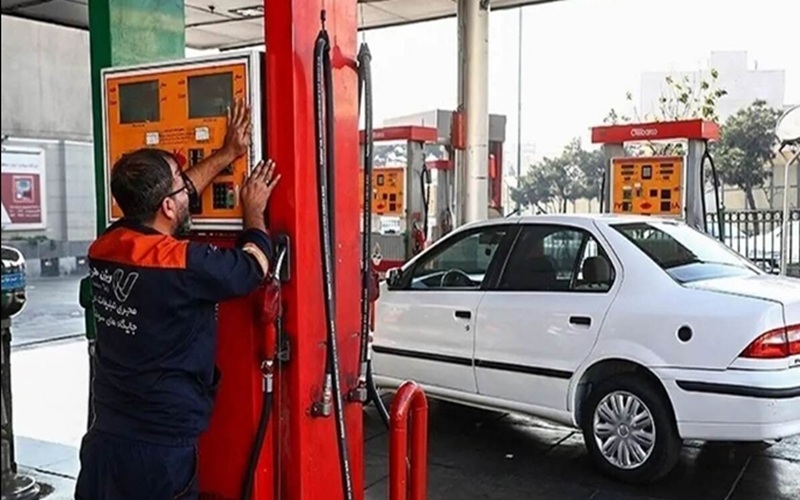

Long fuel lines and growing public anger coincide with government plans for higher gasoline prices, prompting regime media and officials to warn of potentially broader protests.
Iran’s worsening fuel crisis is generating growing public frustration as motorists face kilometers-long queues at gas stations while regime officials openly debate further gasoline price increases. Reports and videos from several provinces show people waiting for hours to obtain limited quantities of fuel, while regime-affiliated media and lawmakers warn that another price shock could trigger widespread unrest.
On August 18, 2026, reports from Iranshahr described extremely long gasoline lines, with motorists reportedly waiting from overnight until the morning to obtain as little as 15 liters of fuel. A local account expressed anger that a country possessing enormous oil and gas resources has left its population struggling to obtain basic fuel.
Similar scenes were reported in Javanrud, South Khorasan, and Hormozgan. In Hormozgan, a frustrated resident described having to wait in lengthy queues before going to work, while also facing electricity outages and other hardships. The comments reflected mounting exhaustion with what residents described as a succession of crises affecting daily life.
The fuel shortages are emerging as the government prepares the ground for higher gasoline prices and reduced subsidized fuel allocations.
Regime Media Warn of a New Social Explosion
The growing sensitivity surrounding gasoline prices was highlighted by Jamaran, a regime-affiliated media outlet, which warned that a new increase could turn an economic decision into a national-security crisis.
In an analysis of a possible gasoline price of 870,000 rials, Jamaran warned that any future protests would not necessarily resemble the November 2019 uprising.
The outlet acknowledged that gasoline is not simply another commodity. Changes in its price affect transportation, distribution, services, workers’ mobility and production, creating direct and indirect increases in the cost of living.
It also warned against assuming that another wave of protests would simply be a repeat of November 2019. Iranian society, it noted, has undergone significant economic, political and communications changes since then, meaning that a future uprising could become “multilayered and hybrid.”
The warning is significant because it reflects concern within the regime that an economic grievance could rapidly connect with broader social and political demands.
Jamaran explicitly recalled the November 2019 experience, when a sudden gasoline price increase was followed by protests across numerous Iranian cities. The outlet argued that the lesson should be treated not merely as a historical memory but as a warning for policymakers.
Its conclusion was particularly revealing: before asking how much gasoline can be sold for, authorities should first consider how much additional economic shock Iranian society can withstand.
Lawmakers Warn Against Gasoline Price Increases
Several regime lawmakers have echoed these concerns.
Mohammad Ali Naghdali, a member of the regime’s parliament, warned the government on August 16 that there is no longer room for “trial and error” over gasoline prices. He criticized sudden measures introduced without preparation, saying they could disrupt the entire situation.
He also acknowledged that price increases would disproportionately affect poorer sections of society and harm small businesses.
Another parliament member, Mohammad Nakhai, said that the current economic conditions are not suitable for raising gasoline prices. He revealed that the government had considered increasing the price of the third gasoline tier from 50,000 rials, with figures of 150,000 and later 100,000 rials reportedly discussed.
Mohammad Nakhai said that people are already under severe economic pressure and that the government has failed to present a clear plan to compensate vulnerable households for the additional burden.
Mohammad Rashidi, a member of the parliament’s presiding board and Energy Commission, similarly warned on August 18 that increasing gasoline prices under current conditions could create “social unrest.”
Rashidi said the parliament opposes a gasoline price increase under the country’s current wartime conditions, despite acknowledging that the government has the authority to implement such a measure.
Government Pushes Toward Higher Fuel Prices
Despite these warnings, Mohammad Reza Aref, the first vice president of the regime, has openly defended moving toward gasoline price liberalization.
Aref said Iran currently produces an average of 110 million liters of gasoline per day while consuming approximately 140 million liters, leaving a daily shortfall of around 30 million liters.
He said the regime is importing the additional fuel using hard currency but selling it at a heavily subsidized price. According to Aref, the government’s long-term strategy is to move toward price liberalization.
He also indicated that while the government does not intend to reduce the first gasoline quota, the second-tier allocation should gradually be reduced.
Aref acknowledged that gasoline pricing is particularly sensitive because changes in fuel prices have direct and indirect consequences for the prices of other goods and services.
At the same time, he called on the media to help preserve “calm” and “social capital,” arguing that strengthening social cohesion and national resilience is a priority under the current circumstances.
A Crisis the Regime Is Struggling to Contain
The growing fuel crisis exposes a deeper contradiction within the regime’s economic policies. Despite Iran’s enormous energy resources, the country is experiencing fuel shortages, long queues and growing pressure on consumers.
The government is simultaneously confronting a substantial gasoline supply deficit and the political consequences of removing subsidies or raising prices. Its own officials acknowledge that gasoline is deeply intertwined with the broader cost of living and that a price shock could quickly spread beyond fuel markets.
The warnings from regime media and lawmakers also reveal concern that public anger over gasoline could merge with accumulated grievances over inflation, declining purchasing power, unemployment, electricity shortages and deteriorating living conditions.
The experience of November 2019 remains a powerful reference point for the regime. But as Jamaran itself acknowledged, a future protest movement would not necessarily follow the same pattern.
With fuel shortages already producing kilometer-long queues and visible public anger, the regime faces a difficult choice: continue subsidizing an increasingly unsustainable fuel system or raise prices and risk adding another shock to a population already under severe economic pressure.
Either way, the latest developments demonstrate how the fuel crisis has become more than an economic problem. It is increasingly becoming a source of social and political tension that the regime itself fears could ignite broader unrest.