


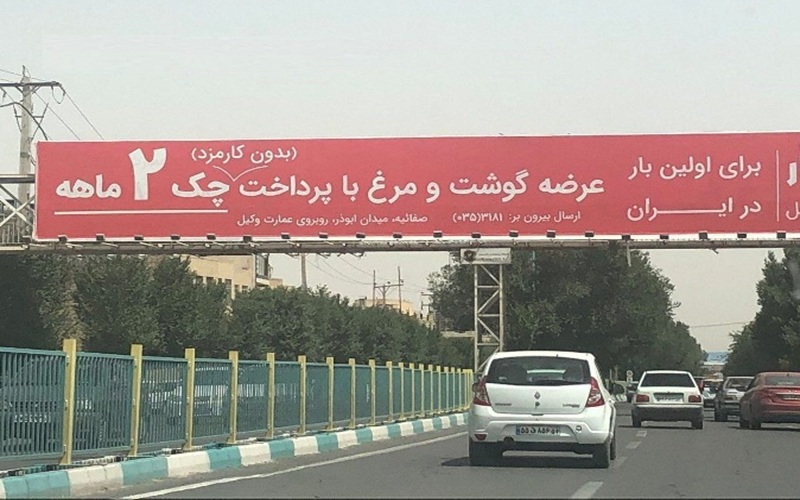

The spread of installment purchases for food and basic necessities exposes the depth of poverty in Iran, as runaway inflation forces households to sacrifice nutrition, healthcare, and education while borrowing against their future incomes.
A society in which people must borrow money to buy bread and basic food is confronting more than an inflation crisis. It is experiencing the erosion of basic economic security. Across Iran, the expansion of installment purchases for groceries, food, and even hygiene products reveals how far the cost-of-living crisis has penetrated household budgets. For millions of families, credit is no longer a means of financing major purchases or improving their standard of living. It has become a way to get through the month.
State media have reported that the Central Bank’s inflation figure has reached 83.5 percent, while the value of installment purchases increased by 103 percent in the Iranian year 1404 (March 2025–March 2026). The number of users with access to purchasing credit has also exceeded 10.5 million.
These figures should not be interpreted simply as evidence of growth in the consumer-credit market. They reveal a fundamental deterioration in purchasing power. When households cannot cover the cost of ordinary necessities with their current incomes, they are forced to transfer today’s expenses into tomorrow’s debts. Money that has not yet been earned is already committed to food that has already been consumed.
This is not economic resilience. It is the financial exhaustion of households.
When food becomes a debt obligation
Under normal economic conditions, household income should first cover essential expenses, including food, housing, healthcare, and education. Savings and discretionary spending come afterward. But in Iran, the widening gap between wages and living costs has increasingly reversed this order.
Families are being forced to make choices that directly affect their quality of life. Meat and other nutritious foods disappear from shopping lists. Medical appointments are postponed, medicines are left unpurchased, and educational expenses are reduced. Some household members take on multiple jobs simply to maintain a minimum level of income, yet even additional work may not provide enough to cover basic expenses.
Sociologist and Allameh Tabataba’i University professor Mohammad Amirpanaahi has drawn attention to this deterioration, noting that a society that reduces the quality of its diet, sacrifices healthcare and education, and increasingly relies on installment purchases and debt cannot automatically be described as resilient.
His observation points to a broader definition of poverty. Poverty is not merely the absence of money; it is the loss of choices and opportunities. A family forced to choose between buying food, purchasing medicine, and paying for a child’s education is experiencing multiple forms of deprivation simultaneously.
The consequences extend beyond immediate material hardship. Poor nutrition affects physical development and long-term health. Interrupted education narrows opportunities for younger generations, while untreated illnesses can become more serious and expensive. What begins as a household budget crisis gradually becomes a crisis affecting the country’s human and social development.
The normalization of poverty is not resilience
One of the most damaging consequences of prolonged inflation is the gradual normalization of conditions that would once have been considered unacceptable.
When families become accustomed to removing meat from their diets, reducing meals, postponing medical treatment, and purchasing basic necessities on credit, their expectations of an acceptable standard of living begin to fall. But adapting to deprivation must not be confused with accepting it.
Resilience implies having the resources, institutional support, and opportunities necessary to withstand a crisis and recover from it. Forced austerity, the abandonment of essential needs, and the accumulation of debt simply to survive represent something entirely different.
The distinction matters because the regime can point to people’s continued efforts to cope with economic hardship while ignoring the damage those efforts conceal. A family that manages to survive by sacrificing healthcare or borrowing against future income has not overcome poverty. It has postponed some of its consequences while deepening its vulnerability.
The apparent ability of households to keep functioning therefore offers no reliable indication of economic stability or social satisfaction.
Borrowing from tomorrow: The future of Iran’s younger generation
The expansion of installment purchases for food also creates a longer-term problem: it consumes income that families will need in the months ahead.
Money committed today to repaying grocery purchases will no longer be available for rent, medical expenses, education, or other essential needs. As debts accumulate, households lose the ability to save, invest in their children’s futures, or prepare for unemployment and old age.
This creates a cycle in which borrowing becomes increasingly necessary to cover ordinary expenses, while the repayment of previous debts leaves even less income available for the next month.
For younger generations, the consequences may be particularly severe. Families with limited financial resources have fewer opportunities to support higher education, vocational training, housing, or the initial steps toward independent living. Young people consequently inherit not only the economic difficulties of their parents but also a narrower range of opportunities to escape them.
An economy that forces households to finance basic consumption through debt is effectively transferring its present failures to the next generation.
Economic deprivation is an accumulating source of social discontent
The consequences of this crisis cannot be measured solely through inflation rates, purchasing-credit figures, or household expenditure statistics. Prolonged economic deprivation also changes how people perceive their place in society and their prospects for the future.
Economic researcher Samaneh Golab has described the situation as a fire smoldering beneath the ashes, warning that unresolved economic problems could produce serious social consequences.
Her warning reflects an important reality. When people work, take on multiple jobs, cut essential expenses, and still cannot afford a minimally acceptable standard of living, frustration extends beyond individual financial difficulties. It becomes a broader sense of injustice and relative deprivation.
The contradiction between continued effort and declining living standards can be particularly corrosive. People are not simply struggling because they lack employment or are unwilling to work. Many are finding that even sustained work no longer guarantees access to basic necessities.
This can deepen public resentment toward a system that has failed to provide economic security. Although hardship does not automatically translate into immediate protest, the accumulation of unresolved grievances creates conditions in which social tensions can intensify.
Nor should the outward appearance of adaptation be mistaken for consent. Families may find ways to endure each new round of hardship, but the underlying grievances do not disappear merely because people are forced to adjust their consumption.
A society borrowing against its own survival
The spread of installment purchases for bread, groceries, and hygiene products exposes the depth of Iran’s household economic crisis. When access to food depends increasingly on credit, the damage extends far beyond individual purchasing decisions.
Poor nutrition, neglected healthcare, interrupted education, and the consumption of future incomes all carry costs that cannot be captured by ordinary financial indicators. They affect public health, the development of future generations, social cohesion, and people’s confidence in tomorrow.
The fundamental problem is not that Iranian families have become increasingly dependent on installment payments. It is that millions are losing the ability to meet basic needs through their own earnings.
A society cannot indefinitely borrow against its future simply to survive the present. The normalization of poverty does not eliminate discontent; it conceals the accumulation of deprivation beneath the daily struggle to make ends meet.
Under Iran’s ruling regime, the widening gap between people’s basic needs and their ability to afford them has become more than an economic failure. It is an increasingly serious social fault line, with consequences that no amount of consumer credit can contain.