


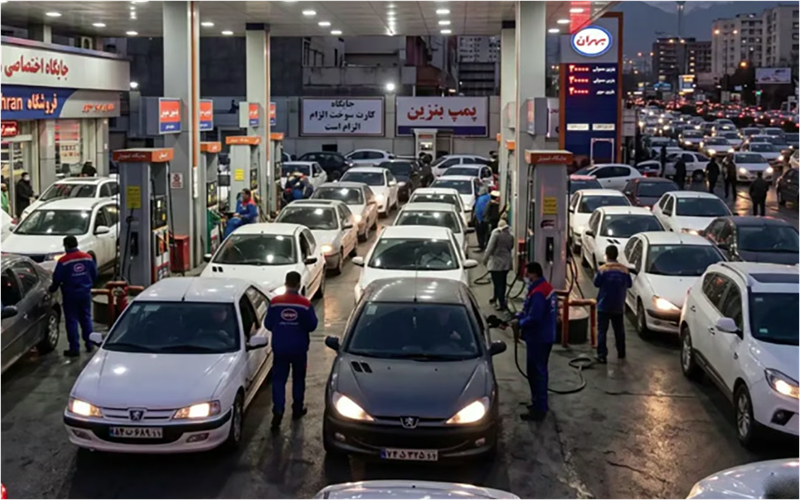

Iran’s gasoline crisis is not only about shortages and rising prices. Poor fuel quality, elevated pollutants, and toxic emissions pose a wider public-health and environmental threat.
Iran’s gasoline crisis is increasingly being defined not only by shortages, long lines, and rising prices, but also by a less visible danger: the poor quality of the fuel itself. Elevated levels of sulfur, benzene, and other chemical pollutants in gasoline are raising serious environmental and public-health concerns, potentially exposing millions of Iranians to toxic emissions.
For years, public discussion of Iran’s gasoline crisis has largely focused on shortages, rationing, price increases, and the long queues outside filling stations. Yet another dimension of the crisis has received considerably less attention: the quality of the gasoline being produced and distributed across the country.
Iranian authorities have repeatedly claimed that domestically produced gasoline meets Euro 4 and Euro 5 standards. However, available reports and comments from specialists raise serious questions about these claims.
Sulfur and Benzene Above Standards
One of the most significant concerns involves sulfur content. Under Euro 4 and Euro 5 fuel standards, sulfur in gasoline is generally limited to 10 parts per million (ppm).
A report published toward the end of last year indicated that sulfur levels in some Iranian gasoline were approximately 2.5 times higher than the levels permitted under these standards.
High sulfur content is not merely a technical issue. When gasoline containing excessive sulfur is burned, it contributes to the formation of harmful pollutants and undermines the effectiveness of vehicle emission-control systems. The resulting emissions further deteriorate urban air quality.
Another major concern is benzene, a chemical compound known to be carcinogenic. The presence of benzene in gasoline above accepted standards can increase risks associated with long-term exposure, particularly when fuel combustion releases pollutants into the atmosphere.
The issue does not end with sulfur and benzene. Fuel production also involves chemical additives designed to improve characteristics such as octane rating and combustion performance. Some additives have themselves become subjects of environmental and health concerns.
The Health Risk Extends Beyond Drivers
The consequences of poor-quality gasoline are therefore not limited to the approximately 28 million vehicles reportedly operating in Iran.
Once fuel is burned in vehicle engines, its pollutants are released through exhaust systems into the air. In densely populated cities, this means that the entire population can be exposed to the resulting pollution—not simply motorists who purchase gasoline.
Those with existing respiratory or cardiovascular vulnerabilities are particularly susceptible to the effects of air pollution. Children and infants are also especially vulnerable, because their developing respiratory systems can be more sensitive to toxic pollutants.
Long-term exposure to polluted air has been associated with a wide range of respiratory and cardiovascular problems, while exposure to carcinogenic substances such as benzene raises additional concerns.
Thus, the gasoline crisis has evolved into a broader public-health and environmental crisis.
The Technology Already Exists
Perhaps the most striking aspect of the problem is that improving gasoline quality is not considered a technological mystery.
Modern refineries around the world have established processes for reducing sulfur, controlling benzene concentrations, and removing unwanted contaminants from fuels. Countries in the Persian Gulf region, among others, have demonstrated that producing cleaner fuels at internationally accepted standards is technically achievable.
The necessary technology and expertise are therefore available.
The central question is different: Why has the regime failed to bring gasoline quality up to acceptable standards after decades of rule?
This question becomes particularly important when the authorities simultaneously demand that citizens pay more for gasoline while continuing to provide fuel whose quality remains the subject of serious concern.
A Crisis Beyond the Price at the Pump
The gasoline debate in Iran is consequently about far more than how much drivers pay at filling stations.
A population already facing economic pressure is being confronted with a fuel system characterized by shortages and rising costs, while the environmental consequences of low-quality gasoline affect people regardless of whether they own a vehicle.
The combination of fuel shortages, price increases, inadequate quality, and pollution points to a broader failure in energy policy and resource management.
After decades in which the regime has had access to substantial energy resources and has repeatedly presented Iran as a major energy-producing country, the persistence of poor-quality gasoline raises fundamental questions about priorities, investment, management, and accountability.
For millions of Iranians, the consequences are tangible: longer queues and higher prices at the pump, but also polluted air and increased exposure to hazardous substances.
Iran’s gasoline crisis is therefore not simply an energy problem. It is increasingly a public-health crisis, exposing the human cost of years of inadequate management and failure to provide fuel that meets credible international standards.