


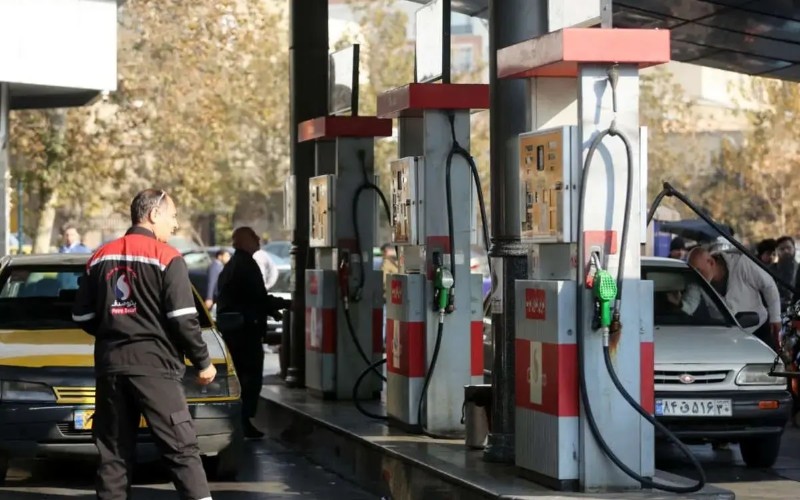

The government’s denial of revenue motives behind the latest fuel price increase clashes with decades of economic mismanagement and growing public distrust.
Statements by Fatemeh Mohajerani, spokesperson for the Pezeshkian administration, about the recent gasoline price increase once again bring a chronic fault line in the political and economic system of the Iranian regime into sharp focus: the widening gulf between the official narrative and the lived experience of ordinary citizens.
Her insistence that all additional revenue from the five-thousand-toman increase will be spent on improving livelihoods, and that the government seeks “no revenue goal,” stands at odds not only with the assessments of the regime’s own experts but also with the four-decade history of its economic decision-making.
Fuel price hikes in Iran have long served as a tool for patching budget deficits and compensating for structural inefficiencies.
A large share of the country’s resources remains controlled by institutions tied to the apex of the regime, while military and security expenditures take precedence over social welfare.
This burden is ultimately transferred onto the public, who are already navigating a landscape of inflation, recession, and steadily declining real income.
In this context, the spokesperson’s claim that the entirety of the new fuel revenue will be directed toward public welfare carries little credibility.
The regime’s track record is marked by a lack of transparency, the absence of accountability, and an unwavering prioritization of political survival over economic reform.
The contradictions between officials’ statements further underline that the decision was not grounded in a coherent or defensible economic framework.
Even state-aligned economists have acknowledged that the measure aims to cover a deepening budget deficit created by years of misguided policy, entrenched corruption, and the vast financial demands of the security apparatus.
Against this backdrop, the government’s attempt to frame the increase as a corrective step “in favor of the people” is widely viewed as an open denial of reality.
The invocation of phrases such as “economic reform” or “support for livelihoods” has become increasingly hollow in a political environment where such rhetoric functions more as a shield against rising public anger than as a reflection of tangible policy.
Past experience—particularly the sudden gasoline price shock of November 2019—demonstrates that every increase in fuel costs fuels a chain reaction of inflation and price hikes across essential goods, amplifying hardship for low-income households.
Even a seemingly modest adjustment quickly reverberates through daily expenses, widening poverty and deepening inequality.
The political dimension of the government’s claim is equally revealing. Presenting the gasoline hike as a measure exclusively benefiting the public serves more as a tactic for containing social discontent than as a serious economic argument.
Each new instance of economic pressure pushes society closer to an explosive threshold, yet instead of structural reform, the regime resorts to messaging campaigns and denials that convince few.
For a population that has endured years of instability, rising prices, and a bleak economic horizon, assurances from officials ring increasingly hollow.
People are acutely aware that substantial national resources remain under the control of institutions whose priorities lie far from public welfare and deeply embedded in preserving a political structure widely viewed as the source of the crisis.
As long as the consequences of fuel price increases are understood by the public to be nothing more than intensified poverty and expanding social divides, no promise from the regime will restore trust.
The gulf between official discourse and the concrete realities of daily life is precisely what is pushing Iranian society toward demands for fundamental change and raising the stakes of social eruption.