



With food prices rising far faster than wages, poverty is spreading beyond the unemployed and most vulnerable, threatening workers, retirees, and Iran’s shrinking middle class.
Iran’s economic crisis is rapidly turning into a broader social catastrophe. As food prices soar, wages lose purchasing power, and the cost of basic necessities rises beyond the reach of millions, poverty is no longer confined to the unemployed or traditionally vulnerable sections of society. Increasingly, workers, retirees, and families that once considered themselves part of Iran’s middle class are being pushed toward economic insecurity.
The scale of the deterioration is reflected in figures published by Iran’s own state and semi-official media.
According to a recent assessment attributed to Iran’s Parliamentary Research Center and reported by Ettelaat, Iran’s poverty rate could rise from 41% in 1405 (2026) to 45.5% by 1407 (2028) if current economic trends continue.
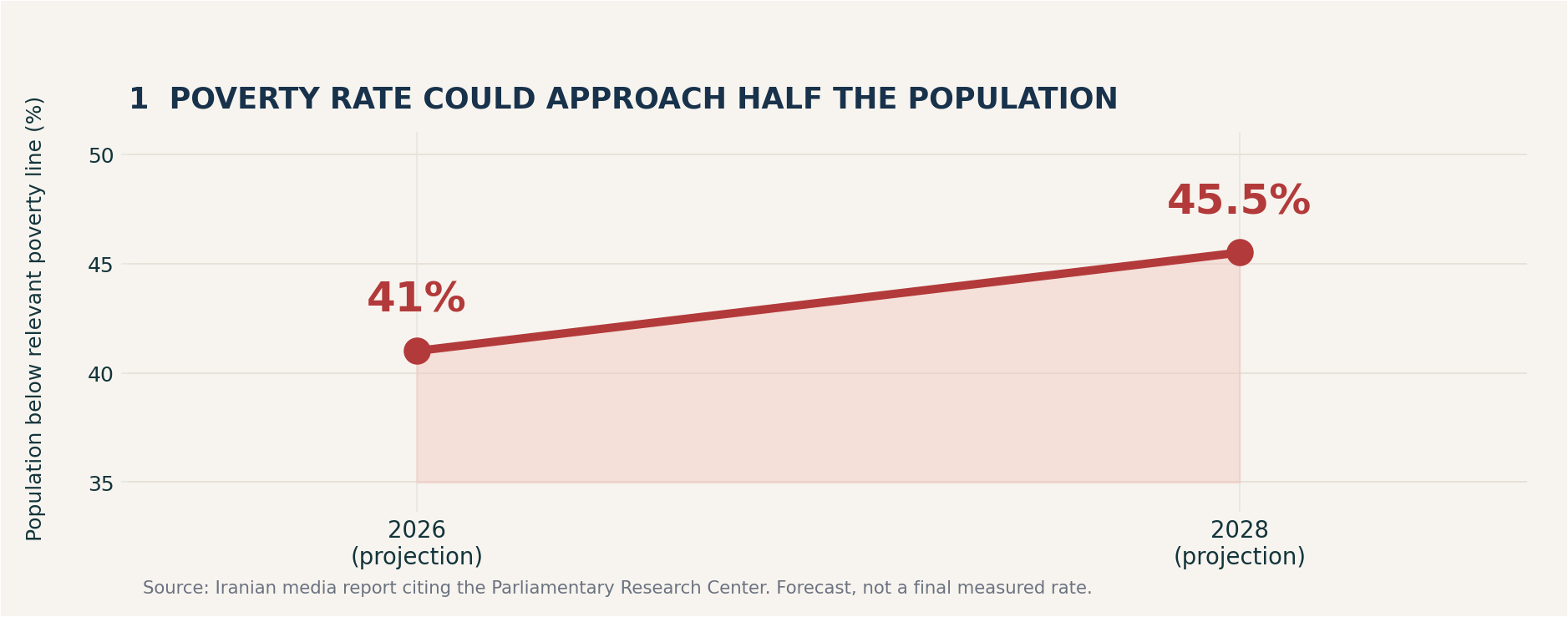
That would mean that almost half of the country’s population could fall below the relevant poverty threshold within two years.
The projection is particularly alarming because it comes amid an already severe deterioration in household purchasing power.
34 million people reportedly living in absolute poverty
The scale of poverty is already enormous.
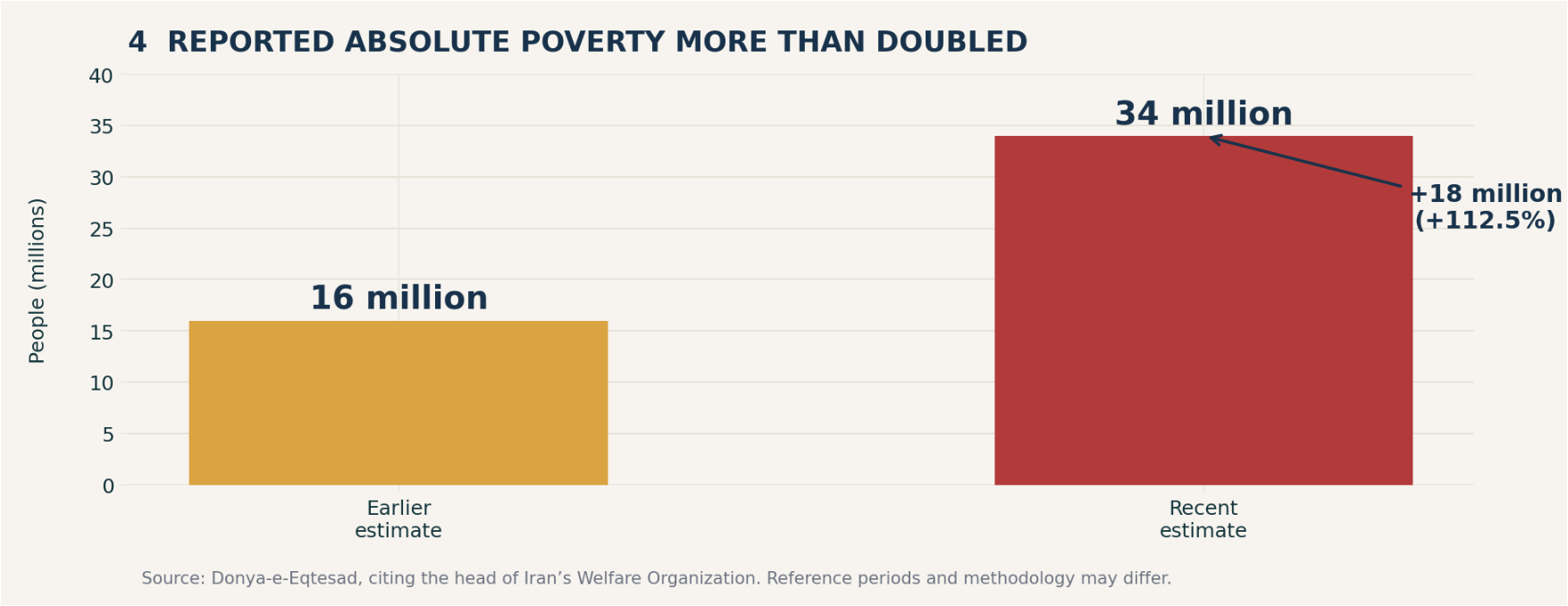
Donya-e-Eqtesad, citing remarks by the head of Iran’s Welfare Organization, reported that the number of people living below the absolute-poverty line had increased from approximately 16 million to 34 million.
The same report cited estimates putting the affected population at approximately 40% to 44% of Iran’s total population.
Absolute poverty generally refers to the inability to afford the minimum goods and services required for basic survival. While poverty estimates vary according to methodology, household size, geographical area, and the definition used, the direction of the trend is unmistakable.
Poverty in Iran is becoming a mass phenomenon.
The question is no longer simply how the poorest sections of society can survive. It is how millions of working families can maintain even a basic standard of living when their incomes are being consumed by food and other necessities.
Food inflation reaches 128.1%
The most immediate evidence of this collapse in living standards is found in the price of food.
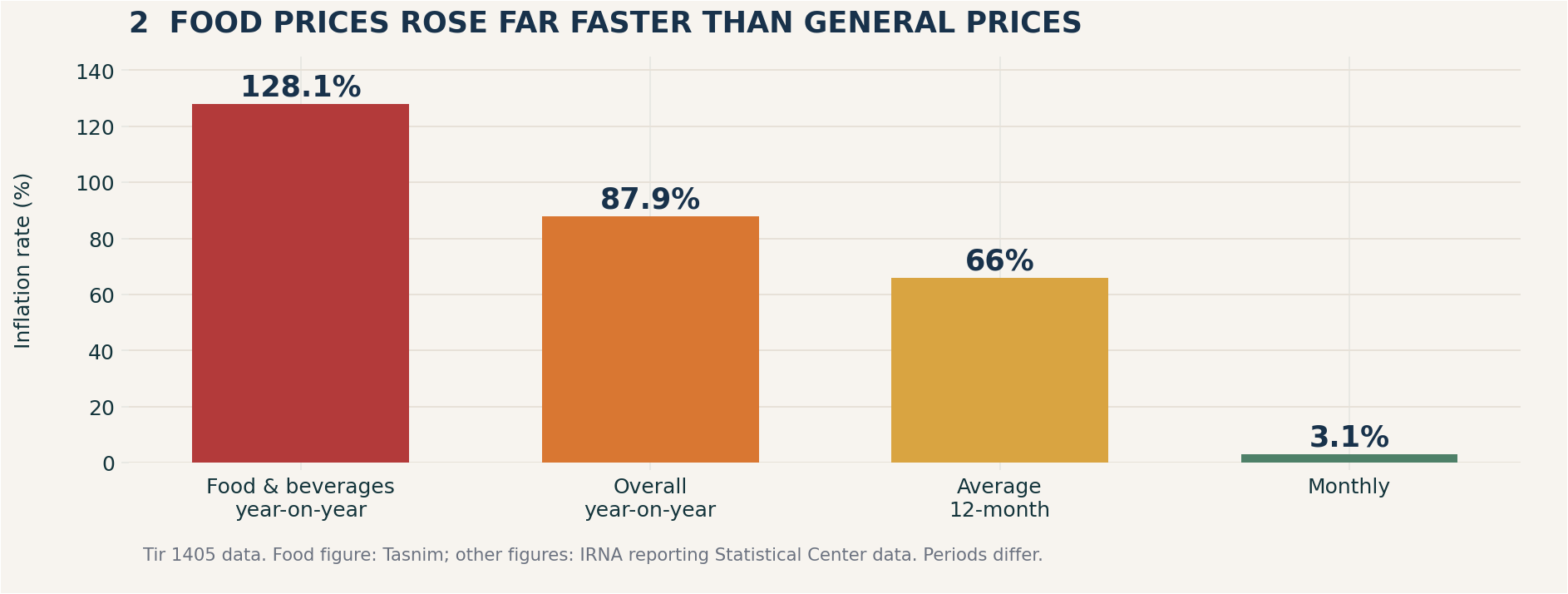
According to Tasnim, citing data from Iran’s Statistical Center, prices of food and beverages increased by 128.1% year-on-year in Tir 1405, corresponding approximately to July 2026.
That was dramatically higher than overall inflation.
The same report put point-to-point general inflation at 87.9%.
IRNA, also citing the Statistical Center of Iran, reported that consumer prices increased by 3.1% in a single month in Tir 1405. Point-to-point inflation reached 87.9%, while the average inflation rate over the preceding 12 months stood at 66%.
These figures reveal the disproportionate pressure placed on low- and middle-income households.
Food is not an optional expense. A family can postpone buying clothing, reduce entertainment, delay a trip, or cut other discretionary spending. It cannot simply stop eating.
When food prices rise by more than 128% in a year, households have only a limited number of options: reduce the quantity or quality of food they purchase, sacrifice spending on other necessities, borrow money, seek additional income, or fall deeper into poverty.
Three-quarters of the minimum wage consumed by food
The situation facing Iranian workers is even clearer when food prices are compared with wages.
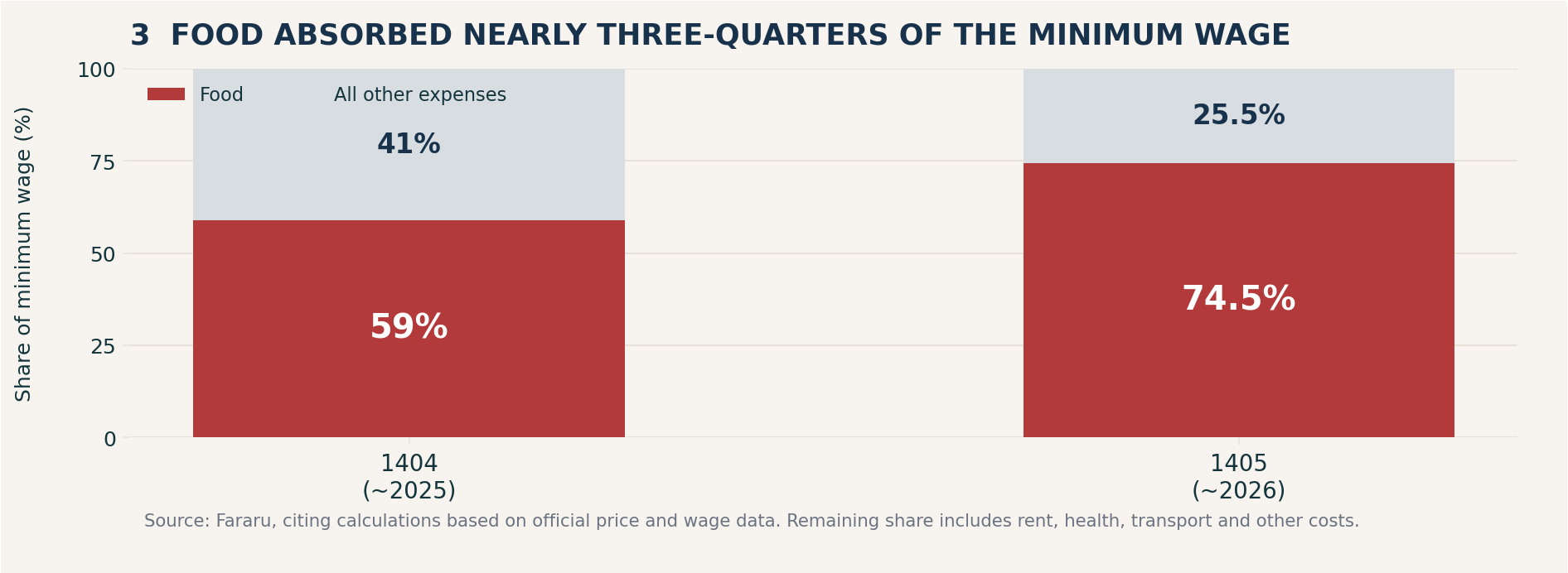
Fararu reported that 74.5% of the minimum wage in 1405 was required simply to purchase food.
One year earlier, the corresponding figure was approximately 59%.
In other words, food consumed an additional 15.5 percentage points of a minimum-wage worker’s income in just one year.
Other Iranian media reports have placed the year-on-year increase in the cost of the standard food basket at approximately 133%.
The consequence is devastating.
A minimum-wage household is potentially left with only about one-quarter of its income for everything else:
- Rent or mortgage payments
- Electricity, gas, water, and telecommunications
- Transportation
- Healthcare and medicine
- Clothing
- Education
- Debt repayment
- Childcare and other household expenses
For families in major cities, particularly Tehran, this arithmetic is increasingly impossible.
A household that spends nearly three-quarters of its income on food cannot realistically cover housing, healthcare, transportation, education, and other essential costs with what remains.
The result is not simply lower living standards. It is the systematic erosion of household security.
Poverty lines are rising faster than incomes
Another indication of the crisis is the rapidly changing poverty threshold.
Iranian media have published substantially different poverty-line estimates, partly because they use different methodologies and geographic assumptions.
One estimate cited by Donya-e-Eqtesad placed the per-capita poverty line in 1404 at approximately 7 million tomans per month. On that basis, the threshold would be around 15 million tomans for a three-person household and approximately 27 million tomans for a household in Tehran.
An ISNA report cited a considerably higher estimate of approximately 36 million tomans for a three-person household. That report also warned that annual inflation could remain close to 40%, while proposed wage increases would lag behind the expected rise in living costs.
Other assessments are even higher. A Donya-e-Eqtesad compilation of labor and economic assessments reported that the relative poverty line in Tehran had reached approximately 60 million tomans or more for a family of four.
These numbers should not be treated as directly interchangeable. A national per-capita subsistence threshold, a three-person household poverty line, and Tehran’s relative poverty line measure different forms and levels of economic deprivation.
But their differences do not obscure the central reality.
Every measure points toward a rapidly rising cost of living that wages are failing to match.
Even the regime’s official poverty line is under question
The regime previously announced a poverty-line figure of 6,128,739 tomans per person for 1403.
Donya-e-Eqtesad questioned whether this figure represented a genuine cost-of-living standard or merely the minimum amount required to meet basic food and survival needs.
Applied to a four-person household, that figure would produce a monthly threshold of approximately 24.5 million tomans.
But even such a threshold may fail to capture the real cost of living.
A family does not survive on food alone. Housing, healthcare, medicine, education, transportation, utilities, clothing, and other necessities are indispensable components of a minimally dignified life.
A poverty line that fails to adequately account for these costs can make poverty appear smaller statistically while leaving millions of families unable to meet their actual needs.
This is one reason why different poverty estimates in Iran vary so dramatically.
Rural communities face an especially severe threat
The Parliamentary Research Center’s projections also point to an increasingly severe crisis in rural areas.
Previous reporting based on its analysis warned that, if current trends continue, more than half of Iran’s rural population could fall below the poverty line by 1407.
Such a development would have consequences extending far beyond rural households.
As poverty deepens, families may be forced to migrate toward major cities in search of employment, healthcare, education, and other services.
But urban Iran offers no easy escape.
Housing costs are already soaring, food inflation is exceptionally high, and informal and precarious employment is expanding. Rural poverty could therefore contribute to a new wave of migration without eliminating deprivation, instead transferring it into urban poverty and informal settlements.
The middle class is being pushed downward
Perhaps the most consequential feature of the current crisis is that poverty is no longer exclusively a problem of the poorest households.
Iran’s middle class is also being steadily squeezed.
Families that once maintained a modest but relatively stable standard of living are cutting back on meat, dairy products, healthcare, education, and other expenditures.
A family does not necessarily have to lose its job to become poor.
It can become poor because its salary no longer buys what it did a year earlier.
This is the fundamental problem of Iran’s current inflation crisis: nominal income does not adequately reflect real purchasing power.
A worker may still receive a salary every month, but if food prices rise by 128% while wages rise much less, that salary represents an increasingly smaller share of what the household actually needs.
This is how an economy can produce working poor on a massive scale.
Why the poverty figures differ
The wide range of poverty estimates reported inside Iran requires some caution.
Different institutions measure different forms of poverty:
- Absolute poverty measures the inability to afford basic survival needs.
- Relative poverty compares household income or consumption with prevailing standards in a particular society or location.
- Food poverty focuses specifically on the inability to afford a nutritionally adequate food basket.
- Household subsistence costs estimate the monthly expenses required for basic necessities.
- International poverty lines use purchasing-power-parity thresholds designed for cross-country comparisons.
For example, a recent World Bank poverty brief projected Iran’s poverty rate at 38.8% in 2026 using its upper-middle-income poverty line of $8.30 in international purchasing-power-parity terms per day.
That figure differs from the Iranian Parliamentary Research Center’s 41% projection because the two estimates use different methodologies and poverty thresholds.
The 41% and 45.5% figures should therefore be understood specifically as a Parliamentary Research Center forecast, not as a final independently measured nationwide poverty rate.
Yet methodological differences do not change the broader picture.
Whether the figure is 38.8%, 41%, or substantially higher under other definitions, the evidence points in the same direction: poverty is expanding while real purchasing power is collapsing.
The numbers tell a single story
Taken together, the latest figures reported by Iranian institutions and media paint a devastating picture:
- 41% — projected poverty rate in 2026 according to the Parliamentary Research Center assessment cited by Ettelaat.
- 45.5% — projected poverty rate by 2028 if current trends continue.
- 34 million — people reportedly living in absolute poverty, according to figures cited by Donya-e-Eqtesad.
- 40%–44% — estimated share of the population affected by absolute poverty in the same reporting.
- 128.1% — year-on-year food and beverage inflation in Tir 1405.
- 87.9% — point-to-point general inflation in the same month.
- 66% — average 12-month inflation rate reported for the period.
- 74.5% — share of the 1405 minimum wage reportedly required to purchase food.
- 59% — corresponding share one year earlier.
- 133% — reported annual increase in the cost of the standard food basket.
- 7 million tomans — one cited per-capita poverty-line estimate for 1404.
- 15 million tomans — corresponding estimate for a three-person household under that calculation.
- 27 million tomans — cited Tehran threshold under the same methodology.
- 36 million tomans — another reported poverty-line estimate for a three-person household.
- 60 million tomans or more — reported relative poverty threshold for a four-person family in Tehran in another assessment.
- 6,128,739 tomans — poverty-line figure previously announced by the government for 1403.
- 24.5 million tomans — equivalent monthly figure for a four-person household under that government threshold.
- 38.8% — World Bank’s projected 2026 poverty rate using its $8.30 upper-middle-income poverty line.
The figures differ because the methodologies differ. But the direction is consistent: the cost of survival is rising far faster than the incomes of ordinary Iranians.
Poverty is becoming a political crisis
This is ultimately more than an economic problem.
When food consumes 74.5% of a minimum wage, there is little room left for housing, medicine, education, or a dignified life.
When tens of millions are reportedly below the absolute-poverty line, poverty ceases to be a marginal social issue.
When nearly half the population could fall below a poverty threshold within two years, the crisis becomes a direct challenge to the stability of society.
And when employed workers themselves cannot escape poverty, the regime can no longer attribute deprivation simply to unemployment or individual circumstances.
The problem lies in the economic structure and policies governing the country.
Iran possesses substantial human and natural resources. Yet decades of corruption, rent-seeking, state intervention, mismanagement, destructive policies, and the diversion of resources toward the regime’s political priorities have steadily undermined productive capacity and household welfare.
The result is an economy in which ordinary people are being asked to absorb the cost of a crisis they did not create.
Iran’s poverty crisis is therefore not merely a story about prices.
It is a story about purchasing power, dignity, and the ability of ordinary families to survive.
And the most alarming aspect is that the deterioration is occurring even while millions remain employed.
If current trends continue, the boundary between the working population, the middle class, and the poor will continue to disappear—leaving an ever-larger share of Iranian society struggling simply to afford the necessities of life.