


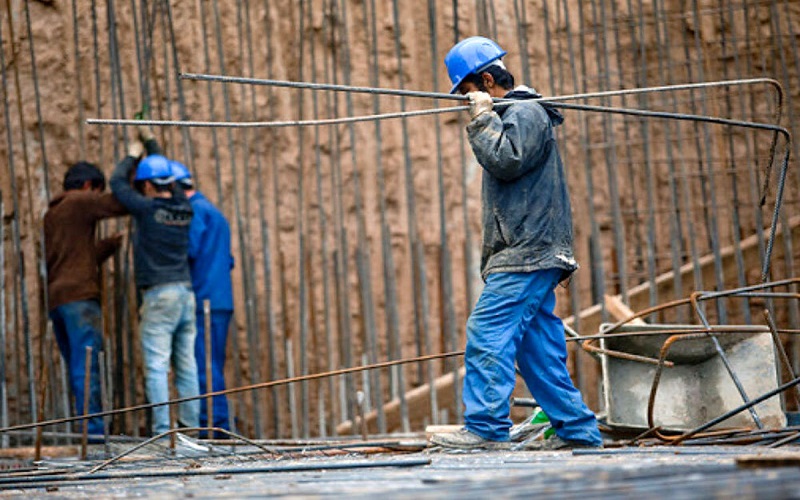

Labor activist Davoud Keshvari has raised alarm over the lack of insurance coverage for more than 500,000 construction workers in Iran, calling the situation a “social disaster.”
In an interview with ILNA news agency on Friday, May 9, Keshvari said that while Iranian law mandates the allocation of insurance funds for construction workers—drawn from building permit fees and coefficients in construction contracts—these resources are not being used for their intended purpose.
Keshvari, who also heads the Plasterers’ Association of Qom Province, stated that fewer than three percent of construction workers in Iran are currently insured. “The conditions facing these workers remain unchanged, and there is no clear plan for resolving the issue,” he said. “So far, we have seen no willingness to enforce the law or uphold justice.”
He criticized the government’s allocation of only 4,000 to 5,000 insurance quotas for a workforce of half a million, calling it an insult. “It means a worker who has toiled for years must wait a decade just to receive basic social insurance—a fundamental right of every worker,” he said. “Is this justice? This is a clear sign of mismanagement in addressing the plight of construction workers.”
Earlier, on April 10, Pejman Jozi, head of the Construction Industry Association, revealed that over 97 percent of construction workers remain without insurance due to not holding official skill cards. “In 2022, only 42,000 workers obtained skill cards, even though we have more than 1.6 million active construction workers,” he said.
Social Security Accused of Dodging Responsibilities
In a separate part of his interview, Keshvari criticized the Social Security Organization for failing to allocate insurance despite legal reforms. He noted that following a cabinet decision for the year 1404 (2025-2026), the contribution rate from construction permits increased from 25 to 27.5 percent. “Before the amendment to Article 5 of the Construction Workers Insurance Law, the contribution was only 15 percent. Despite this increase, the Social Security Organization still refuses to extend coverage to workers,” he said.
Addressing the organization’s leadership directly, Keshvari declared: “You are responsible for delivering justice through an institution meant to be the foundation of the country’s social safety net—not one that turns workers’ rights into handouts controlled by directives and quotas.”
He concluded with a stark reminder: “For the past four years, workers have repeatedly spoken out against discrimination, injustice, and neglect—only to receive empty promises. If the Social Security Organization is truly committed to justice, its first step must be to restore the insurance premiums owed to these 500,000 unprotected workers.”
In June 2024, another labor activist warned that even insured construction workers face severe risks due to the government’s removal of early retirement provisions. As part of what many see as the Islamic Republic’s ongoing anti-labor agenda, the Ministry of Labor recently issued a directive eliminating early retirement options for workers—putting their health and lives further at risk.