


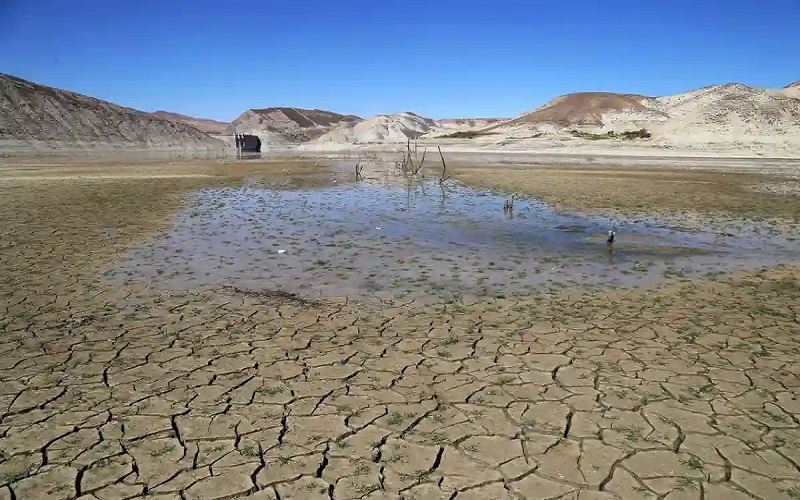

As summer approaches each year, Iran’s chronic water crisis becomes more pronounced. Alarming declines in groundwater levels, widespread land subsidence, diminishing river flows, and the salinization of drinking water in several provinces all signal the arrival of another harsh season.
Across the country, headlines tell the story: “From Water Stress to Critical Conditions,” “A Very Difficult Water Year Ahead,” “Ten-Hour Drinking Water Outages Imminent,” and “Only 18% of Tehran’s Dam Capacity Filled.” These warnings, echoed by regime officials and media outlets alike, reflect a deepening crisis that threatens the country’s environmental stability and public well-being.
Shrinking Water Resources
Experts estimate that Iran’s renewable water resources—once approximated at 130 billion cubic meters in 2015—have sharply declined. Mehdi Zare, a geologist and university professor, recently stated that even under optimistic conditions, including increased rainfall and improved agricultural policy, Iran’s renewable water reserves might not exceed 85 to 95 billion cubic meters in the coming year.
The consequences are visible in regions like Fars, Yazd, Khorasan Razavi, southern Kerman, and parts of Isfahan, which are experiencing severe land subsidence—exceeding 17 centimeters annually in some areas. Continued overreliance on groundwater extraction, fueled by unsustainable agricultural practices and misguided water infrastructure projects, has exacerbated the problem.
Dam Projects and Groundwater Depletion
Despite the worsening crisis, the regime continues to invest heavily in dam construction and inter-basin water transfer projects. These initiatives, while costly and often celebrated as development milestones, have worsened the decline of groundwater tables and triggered dangerous environmental consequences.
Officially, most of Iran’s plains are classified as “prohibited” or “critically prohibited,” indicating extreme groundwater depletion. Nevertheless, agricultural policy—by far the largest consumer of water—has seen little reform. Agriculture, once a symbol of life and self-sufficiency, has become an environmental threat due to outdated irrigation methods and inefficient water use.
A Flawed Water Management Philosophy
Iran’s water management strategy has long been based on the flawed principle of “increasing supply at any cost.” This has resulted in a proliferation of dams, large-scale desalination efforts, and inter-basin transfers, all pursued with little regard for sustainability.
Globally, modern water governance emphasizes demand management, conservation, wastewater recycling, and efficient use. In contrast, regime policymakers have largely ignored these approaches. The belief that water can be treated as a simple commodity, divorced from its complex ecological and social dimensions, continues to hinder meaningful reform.
Effective water governance requires interdisciplinary expertise and local stakeholder involvement. Yet Iran’s system remains highly centralized. The Supreme Water Council—dominated by the Ministry of Energy—often prioritizes development goals over environmental protection. Meanwhile, the Ministry of Agricultural Jihad has resisted curbing water use, and the Environmental Protection Agency, though occasionally vocal, remains politically sidelined and functionally powerless.
The Role of Corruption and Rentier Interests
A significant driver of Iran’s water crisis is the rentier structure of its economy and the entrenched corruption in infrastructure development. Projects are frequently launched without credible environmental assessments. In some cases, assessments are performed by firms with financial stakes in the very projects they are evaluating.
One prominent example is the Gotvand Dam, built despite expert warnings about underlying salt formations. Today, the dam’s reservoir is plagued by salinity issues, posing long-term challenges to water managers.
Contractors like the Iran Water and Power Resources Development Company and state-linked consulting firms such as Mahab Qods have played central roles in pushing forward these destructive projects. The economic incentives of large-scale development, combined with minimal oversight, have fueled a cycle of short-sighted planning and environmental degradation.
The IRGC’s Expanding Role
Following policy shifts under Akbar Hashemi Rafsanjani and Supreme Leader Ali Khamenei, the Islamic Revolutionary Guard Corps (IRGC), through its construction wing—the Khatam-al Anbiya Construction Headquarters—became the largest government contractor in the country. This entity has been central to the expansion of dam-building and water transfer schemes, including the controversial Karkheh and Gotvand Dams and the Qom River project.
Experts warn that the IRGC’s projects have caused widespread and often irreversible damage to aquifers, forests, villages, and cultural heritage sites. Due to its political clout, the IRGC has frequently bypassed environmental regulations and even court rulings, pushing projects forward despite public and legal opposition.
The Missing Role of Civil Society
One of the key lessons from global environmental policy is the necessity of civil society’s involvement. In Iran, grassroots efforts such as aqueduct rehabilitation, small-scale aquifer recharge initiatives, and participatory natural resource management have shown promise. However, top-down policymaking and the exclusion of local communities continue to undermine these efforts.
Without greater transparency, decentralization, and public trust, the crisis is unlikely to be resolved. As long as policymaking remains captive to contractor interests and institutional inertia, genuine reform will remain out of reach.
Climate Change and the Road Ahead
Overlaying all of these structural issues is the accelerating impact of climate change. Iran is already witnessing more erratic rainfall patterns, longer droughts, and more severe floods. These changes threaten to reduce renewable water resources even further, intensifying competition for access.
Even if governance reforms were implemented today, Iran would still face a future of diminished water availability. Urban areas, agriculture, and industry all need to adapt to this new reality—urgently and comprehensively.
Flood Mismanagement and Lost Opportunities
Iran’s flood control policies have historically relied on dam construction, overlooking the benefits of natural floodplains and aquifer recharge. Experts from the Ministry of Agricultural Jihad estimate that 30 to 45 billion cubic meters of water could be added annually to reserves through flood spreading in alluvial zones.
This method not only replenishes groundwater but also restores rangelands, stabilizes soil, and combats desertification. However, regime policymakers have continued to favor large-scale infrastructure projects that benefit politically connected contractors, neglecting more sustainable and ecologically sound alternatives.
As a result, when floods occur, the lack of strategic planning leads to widespread destruction, erosion, and the loss of valuable floodwater through evaporation—water that could otherwise sustain depleted aquifers.
Conclusion
Iran’s water crisis is not merely the result of natural factors or climate change. It is a crisis of governance, shaped by flawed policies, political interference, and systemic corruption. Without a fundamental shift toward sustainable, locally engaged, and transparent water management, the country faces an increasingly unstable future. The environmental, social, and economic costs of inaction are already visible—and they are only growing.