


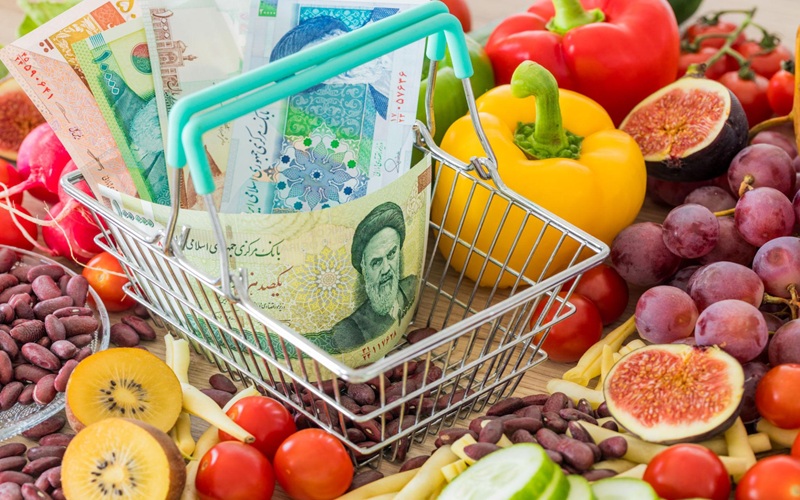

Government Subsidy Program Falls Behind Inflation as Essential Goods Become Increasingly Unaffordable
According to reports published by Tehran-based economic media outlets, the total cost of goods included in Iran’s subsidized electronic coupon basket has surged dramatically since the removal of the country’s preferential currency policy.
The price of the basket, which previously stood at approximately 2.18 million tomans before the elimination of subsidized exchange rates, has now climbed to nearly 3.78 million tomans.
The subsidized basket includes essential household goods such as chicken, cooking oil, eggs, rice, sugar, pasta, low-fat milk, cheese, yogurt, red meat, and legumes.
Figures released on May 7, show that the cost of these basic items has increased by roughly 1.6 million tomans in recent months. However, the value of the government-issued electronic coupon allocated to eligible households has remained fixed at one million tomans.
Inflation and Currency Collapse Drive Prices Higher
The continuing rise in food prices comes as Iran’s national currency experiences a historic decline in value.
Before the 12-day conflict between Iran and Israel in June 2025, the US dollar traded at around 82,000 tomans on Iran’s free market. Last week, however, the exchange rate reached new record highs, fluctuating around 180,000 tomans.
This represents an increase of more than 120 percent in the value of the dollar over roughly ten months. The collapse of the Iranian rial has placed even greater pressure on consumer prices and food costs across the country.
Economists warn that imported goods, raw materials, transportation costs, and domestic production expenses have all been heavily affected by the currency crisis, further accelerating inflation in essential commodities.
When the Iranian regime implemented the removal of preferential exchange rates, officials claimed that the savings generated by the policy would be redistributed directly to citizens through electronic coupon subsidies. Authorities also promised that the subsidy amounts would increase in proportion to inflation.
In February 2026, Ahmad Meydari, the regime’s Minister of Cooperatives, Labor and Social Welfare, stated that “according to the president’s directive, the amount of the electronic coupon will increase if inflation rises.”
At the same time, the head of Iran’s Planning and Budget Organization promised that the subsidy credit would be adjusted “every three months in accordance with inflation.”
Despite those assurances, the amount paid to households has remained unchanged.
In the latest government response, Fatemeh Mohajerani, spokesperson for the regime’s President Masoud Pezeshkian, acknowledged on May 6, that “whether the government wishes to increase the subsidy amount and whether it is financially capable of doing so are two different issues.”
Referring to the economic consequences of war, she added that officials still need to determine whether increasing the subsidy is financially possible.
Food Costs Consume Nearly Entire Worker Income
At the same time, domestic media reports and official data continue to indicate steep increases in food prices. Some reports estimate inflation in food products at more than 70 percent.
A recent assessment of rising food costs in Iran found that, following the war and accelerating inflation, household food expenses in April consumed approximately 85 percent of the minimum income earned by a married worker with two children.
The findings reflect the growing gap between wages and the actual cost of living in Iran, where millions of households are struggling to afford even basic necessities.
The regime’s President Masoud Pezeshkian responded to mounting criticism over inflation in a message posted on X, stating that he was “aware of the price increases.” He added that part of the inflation was linked to “changes in raw material prices and problems related to the war.”
Meanwhile, Mohammad Bagher Ghalibaf, speaker of the regime’s parliament, referred to the “economic pressures” facing the public and called on government officials to “fulfill their duties.” He also urged citizens to take unspecified “measures” themselves.
Ghalibaf described “saving and reducing consumption” as one of the regime’s primary expectations from the population and called on the Basij paramilitary forces to act as intermediaries between citizens, government institutions, and charitable organizations.
Low-Income Families Bear the Heaviest Burden
The continuous rise in the cost of essential goods and the decline in household purchasing power have intensified concerns among Iranian economists and analysts.
Many experts have warned that removing subsidized exchange rates without proportionally increasing compensatory support measures would disproportionately harm lower-income families.
As food inflation continues to outpace wages and government assistance remains stagnant, millions of Iranians now face worsening economic insecurity and growing difficulty securing basic daily necessities.