


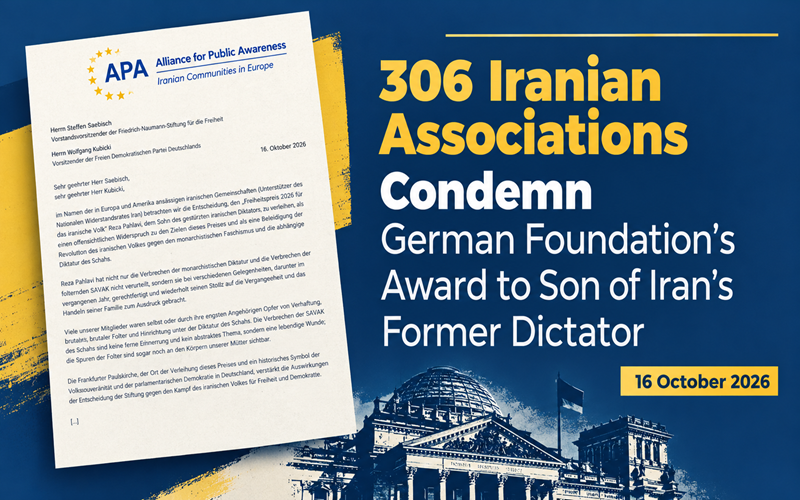

Iranian diaspora organizations, former political prisoners, and prominent German figures challenge the decision to present the 2026 Freedom Prize in the Iranian people’s name, demanding answers from the foundation over its silence.
The decision by Germany’s Friedrich Naumann Foundation for Freedom to award its 2026 Freedom Prize for the Iranian people to Reza Pahlavi, son of Iran’s ousted shah, has triggered a widening protest across the Iranian diaspora. In a letter dated October 16, 306 Iranian associations and communities from Europe, the United States, Canada, and Australia condemned the decision, including 70 organizations based in Germany. They argue that presenting the award in the name of the Iranian people contradicts the principles of freedom and democracy the prize is supposed to represent.
The controversy has intensified over plans to hold the ceremony at Frankfurt’s Paulskirche, a landmark of German parliamentary democracy and popular sovereignty. Critics argue that honoring Pahlavi at such a venue disregards Iranians who reject both the current religious dictatorship and a return to monarchy.
The latest protest adds to growing opposition from German political figures, former political prisoners, and Iranian republican organizations. On October 1, 82 prominent Germans, including former federal ministers, diplomats, a former chair of the Evangelical Church in Germany, a former Federal Constitutional Court judge, and 15 members of the Bundestag, challenged the decision to award a prize in the Iranian people’s name to what they described as a deeply polarizing figure.
Former political prisoners who suffered under the shah’s dictatorship have also protested. Six survivors of imprisonment and torture by SAVAK, the shah’s secret police, issued a separate letter describing their experiences of repression and executions and warning against diminishing the suffering of the dictatorship’s victims through the award. Another 25 Iranian organizations and political parties representing a broad republican spectrum have joined the opposition.
Former prisoners challenge Pahlavi’s record
At the heart of the controversy is Reza Pahlavi’s failure, according to his critics, to unequivocally condemn the repression and abuses committed under his father’s monarchy. The signatories of the October 16 letter argue that he has not only refrained from condemning the monarchy’s crimes and SAVAK’s torture but has also justified them on various occasions and repeatedly expressed pride in his family’s past.
For former prisoners and their families, these crimes are not merely a historical dispute. They describe imprisonment, brutal torture, and executions under the shah as a continuing source of trauma, with the physical and psychological consequences still affecting survivors and their relatives.
The letter also raises concerns about reported intimidation and violence by monarchist supporters against opponents outside Iran. According to the signatories, complaints involving alleged assaults and other serious acts have been examined by police and judicial authorities in European and North American countries.
These concerns, they argue, make the decision to honor Pahlavi in the name of the Iranian people particularly troubling. The signatories maintain that Iranians struggling against the current dictatorship are also rejecting the restoration of the monarchy. Their stated objective is a democratic republic based on the separation of religion and state, equality between women and men, and the right of Iran’s nationalities to autonomy.
Foundation’s silence deepens the controversy
The associations say their objections have yet to receive a substantive response from the Friedrich Naumann Foundation. The continued silence has intensified their dissatisfaction and raised questions about the transparency of the award decision.
The signatories are demanding that the foundation explain the criteria behind its choice and address the objections raised by hundreds of Iranian associations, former political prisoners, civil society figures, and republican organizations.
Their criticism is reinforced by the October 1 letter signed by prominent Germans, which warned that awarding a prize in the name of the Iranian people to the son of the country’s former dictator conflicts with Germany’s own democratic values. The signatories also stressed that the consequences of the decision cannot be separated from the historical record of the Pahlavi dictatorship.
The October 16 letter describes that intervention as an expression of Germany’s democratic conscience and respect for the Iranians who have sacrificed their lives in the struggle for freedom.
The controversy therefore extends beyond the selection of an individual recipient. It concerns who can legitimately be honored as representing the Iranian people and whether the struggle for democracy in Iran can be separated from the rejection of both the ruling religious dictatorship and the former monarchy.
By choosing Pahlavi to receive the 2026 Freedom Prize for the Iranian people, the foundation has faced mounting opposition from organizations that say neither dictatorship represents their aspirations. Their demand is clear: a transparent explanation of the decision and recognition of the Iranian people’s right to determine their own democratic future.