


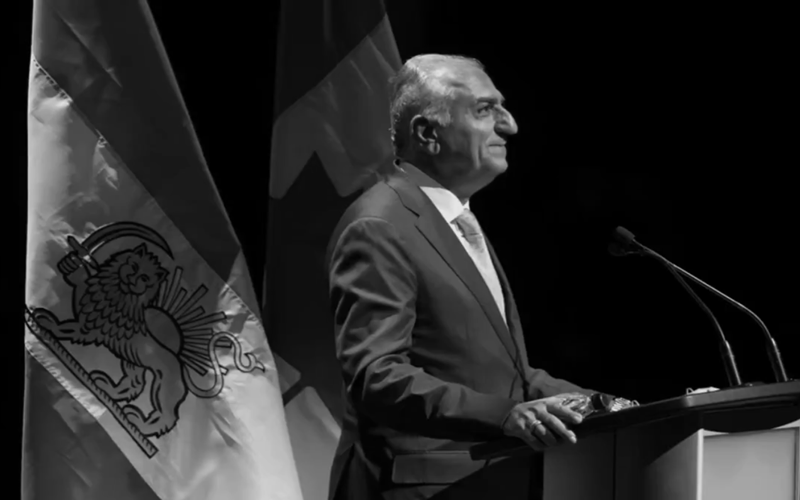

Reza Pahlavi’s latest remarks have revived a fundamental question for Iranians: Can a genuinely free Iran be built around any political project that places a person or dynasty above democratic institutions?
Reza Pahlavi’s latest remarks about the slogan “Javid Shah” have triggered renewed debate among Iranians, particularly across the diaspora, over what kind of political future his movement envisions for Iran.
Speaking at a gathering identified as Cyrus 2, Pahlavi said:
“Javid Shah is a slogan of support. Let’s make it so that the day the ballot box is established in Tehran, it becomes a vote rather than a slogan.”
The statement is significant because it links an explicitly monarchist slogan—“Long Live the Shah”—with the future establishment of a ballot box in Iran.
The issue is not whether monarchists have the right to advocate their preferred political system. In a genuinely free Iran, they should have that right, just as republicans and other democratic political currents should have the right to organize, campaign, and compete.
The fundamental question is different: Would the ballot box be genuinely free to reject the monarchy, or is the electoral process being presented as the mechanism for converting an existing monarchist movement into political legitimacy?
That distinction matters.
A Ballot Box Alone Does Not Make a Democracy
Reza Pahlavi has repeatedly presented himself as supporting a democratic transition and has said that Iran’s future political system should ultimately be determined by the Iranian people. In a July 2026 interview with Reuters, he described his objective as facilitating a transition toward a secular democracy rather than seeking a formal leadership position in the post-regime political order.
That stated position creates a clear democratic standard by which his latest remarks can be examined.
If the Iranian people are genuinely sovereign, then the ballot box must offer more than an opportunity to ratify an already established political project.
It must allow Iranians to choose against monarchy as freely as they could choose for it.
It must allow competing parties and movements to organize. It must protect freedom of expression and political dissent. It must permit criticism of the prospective head of state. And it must establish institutions strong enough to prevent any individual, family, party, military organization, or religious authority from monopolizing political power.
In other words, democracy cannot be reduced to the existence of a ballot box.
Democracy requires meaningful political choice.
This is particularly important in Iran because the country has already experienced a political system in which elections and representative institutions existed while real political power became increasingly concentrated around one person.
The Historical Warning of the Pahlavi Era
The historical record of the late Pahlavi monarchy makes this question more than an abstract debate.
In March 1975, Mohammad Reza Shah announced the creation of the Iranian Resurgence Party, replacing the country’s previous multiparty arrangement with a single-party system. A contemporaneous U.S. State Department assessment recorded that Iranians of voting age were expected to demonstrate allegiance to the new party and that those refusing to do so risked being regarded as opponents of the Shah. The same document described the move as a return to a single-party system and noted that it made Iran’s political system less flexible.
A subsequent U.S. intelligence assessment was even more explicit about the concentration of political authority. It described the Shah’s control over Iran’s internal affairs as authoritarian and stated that he had concentrated decision-making in his own hands while neutralizing potential political challengers. It also concluded that political parties, parliamentary debate, and elections had little effect on the actual direction of political decision-making.
These documents do not establish what Reza Pahlavi personally intends to do in a future Iran. They establish something different and historically important: the Pahlavi name is associated with a political system in which formal electoral institutions did not prevent the concentration of power in the hands of the monarch.
That history cannot simply be erased by invoking the ballot box.
“Javid Shah” Is Not Politically Neutral
There is also a distinction that should not be blurred.
“Javid Shah” is not simply a generic expression of support for a political candidate. It explicitly invokes the Shah and the monarchy.
Pahlavi is entitled to receive that support. His supporters are entitled to chant it. But when that slogan is described as something that should eventually “become a vote,” the democratic implications deserve scrutiny.
What exactly would voters be voting for?
A constitutional monarchy?
A referendum on the form of government?
A transitional role for Pahlavi followed by a referendum?
A restoration of the monarchy?
Or simply a political movement led by Pahlavi that would leave the question of the country’s permanent institutions to a later process?
These are not interchangeable propositions.
A democratic movement committed to the sovereignty of the Iranian people should make the distinction unmistakable.
No Shah, No Mullahs: The Principle Must Be Larger Than a Slogan
For Iranians who have suffered under authoritarian rule, the central issue should not be whether the next ruler carries a crown, a turban, or no title at all.
It should be whether anyone can acquire unchecked power.
Iran’s experience under the current regime demonstrates the danger of placing ultimate political authority beyond meaningful public accountability. The experience of the late Pahlavi monarchy demonstrates that elections and state institutions are likewise insufficient if political power becomes concentrated around one individual and meaningful opposition is constrained.
The lesson should therefore be universal:
No political leader should stand above the institutions of a free Iran.
A democratic republic would have to meet that standard. A constitutional monarchy would have to meet that standard. Any transitional authority would have to meet that standard.
The Iranian people must be free to choose their political system—and free to change it through constitutional and democratic means.
That is why the most important question raised by Pahlavi’s “Javid Shah” remark is not whether monarchists should be allowed to participate in a future election. They should, if the election is genuinely free.
The question is whether the same democratic rules would apply when the people choose something else.
Would monarchists accept a free vote for a republic?
Would Pahlavi accept a political system in which he holds no special constitutional position?
Would his movement accept institutions designed to prevent a Pahlavi—or any other individual—from accumulating unchecked authority?
Those are the questions that must be answered.
Iran Needs Institutions, Not Another Political Savior
The Iranian people’s struggle for freedom cannot be reduced to replacing one supreme authority with another.
The goal of a free Iran should be the establishment of institutions in which sovereignty belongs to the people, political power is limited by law, governments can be peacefully replaced, opposition is protected, and no individual is indispensable to the state.
The experience of both the clerical regime and the late Pahlavi monarchy makes the principle especially clear.
Iran does not need another system built around the presumed wisdom, legitimacy, or permanence of one person.
It needs a political order in which no one is above the vote—and no one is above the law.
If “Javid Shah” is ultimately to become a vote, then the democratic test is straightforward: the same ballot must be allowed to say “No.”
That is what makes a vote a vote rather than a ceremony of political succession.