


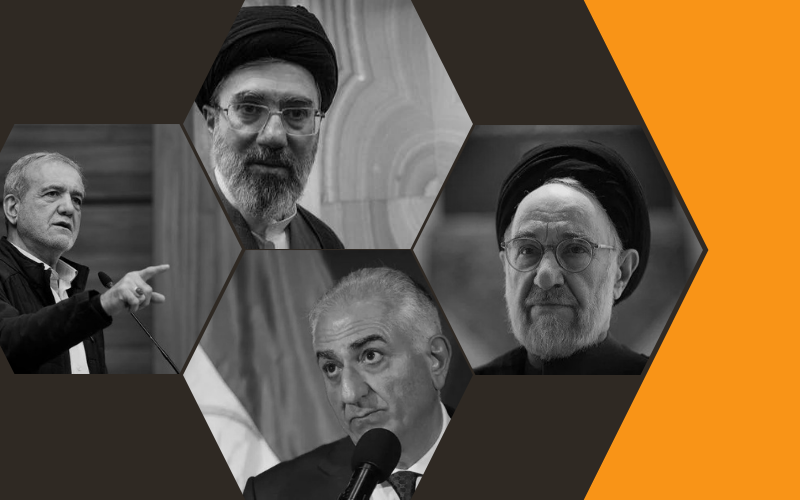

Two wars and a nationwide uprising have underscored a fundamental reality: Iran’s future cannot be built by restoring a hereditary monarchy or by recycling divisions among the forces opposing the regime.
The defining lesson of Iran’s two wars and one major uprising in 2026 is not merely that the ruling regime has entered a deeper crisis. It is that every attempt to revive a failed political order—whether clerical or hereditary—runs against the aspirations of Iranian society.
The notion that Iran can return to a monarchist system under the Pahlavi family is, at best, a political mirage. Iran’s history has known many dynasties, most of which established themselves through military conquest and the exercise of power. The Pahlavi dynasty, however, emerged in the aftermath of the 1921 coup and the subsequent political transformation of the country under Reza Shah. Its restoration would therefore not represent a return to some natural historical order. It would amount to reviving a system that large sections of Iranian society rejected decades ago.
Yet Reza Pahlavi continues to promote the idea that he can play a central role in Iran’s political future. The question is not simply whether he personally seeks such a role. The more consequential question is whether the political project associated with him can offer anything beyond another form of concentrated and hereditary power.
The answer increasingly appears to be no.
A politics of division
For years, monarchist propaganda and political theatrics surrounding Reza Pahlavi have occupied considerable space in the opposition landscape. Rather than weakening the ruling regime, such polarization has often deepened divisions among its opponents.
This is not merely a criticism voiced by opponents of monarchism. At various points, regime-affiliated media themselves have acknowledged that conflicts among opposition groups can serve the interests of the ruling establishment. One such publication argued that monarchists had created divisions within the opposition that ultimately benefited the regime.
That observation deserves serious consideration.
Since the nationwide uprising that began in December 2017, Iran has repeatedly demonstrated that the fundamental conflict is between a repressive ruling establishment and a society demanding profound political change. Every effort to redirect that conflict into an artificial contest between competing authoritarian alternatives risks weakening the broader democratic movement.
The question, therefore, is what might have happened if the political arena had not been repeatedly consumed by personality cults, monarchist restorationism, and disputes over who should inherit political power.
No one can rewrite history. But the experience of the past decade makes one conclusion difficult to ignore: the Iranian people need a democratic alternative, not another form of centralized rule.
The dangerous politics of external manipulation
The history of Iran and Iraq also demonstrates why claims involving foreign intelligence operations and political intermediaries must be treated with extreme seriousness—and with evidence.
Following the U.S.-led invasion of Iraq, reports in the American media raised questions about the activities of Ahmad Chalabi and his relationship with Iranian intelligence networks. Los Angeles Times reported allegations concerning Chalabi’s intelligence-gathering operation and its possible use as a cover for Iranian intelligence activities. Newsweek subsequently reported on allegations surrounding his contacts with Iranian officials.
The broader lesson is more important than any individual case: foreign powers and intelligence services have repeatedly sought to influence political developments in the Middle East through intermediaries, political networks, and competing factions.
That history should make Iranians—and the international community—skeptical of political projects that rely heavily on foreign sponsorship, external lobbying, or personalities presenting themselves as the inevitable alternative to the ruling regime.
Assertions about specific individuals’ alleged intelligence connections, however, require documentary evidence and should not be treated as established facts merely because they circulate politically. What can be established is that the Iranian political landscape has repeatedly been targeted by competing state interests, making transparency and political independence essential criteria for any credible alternative.
Two hereditary projects, one authoritarian logic
There is also a striking parallel between the monarchist camp and the post-Khamenei power structure inside the regime.
Both approaches place extraordinary political importance on lineage and personal succession.
The ruling establishment has attempted to preserve its system through the transfer of supreme authority within a tightly controlled political structure. At the same time, monarchists have sought to place Reza Pahlavi at the center of discussions about Iran’s future largely because of his family name and his position as the son of the former shah.
These are different political projects, but they share a fundamental weakness: neither offers a convincing answer to the Iranian people’s demand for political sovereignty.
Iran’s future cannot be determined by the son of a former monarch any more than it can be determined by the son of a former supreme leader.
The people of Iran should not have to choose between hereditary authoritarianism and religious authoritarianism.
Even inside the regime, the cracks are widening
Meanwhile, the regime’s internal crisis continues to deepen.
The political struggle between competing factions has become increasingly visible, particularly over the consequences of war and the possibility of reaching an agreement that could reduce tensions.
Former president Mohammad Khatami’s recent comments provide an extraordinary glimpse into this internal debate. On August 19, Khatami urged the authorities not to squander what he described as an important opportunity created by the agreement and praised President Masoud Pezeshkian for signing it.
Khatami said:
“A window of opportunity has been created, and if we lose this opportunity, we will face extraordinary problems. Where has this opportunity appeared? In the memorandum of understanding. Go and read this memorandum. There is nothing like it. Since World War II, no memorandum or document signed by the president of the United States has given so many concessions to the opposing side and secured so many commitments in return.”
He continued by praising the commitments concerning sovereignty and the cessation of hostilities, before declaring: “I really kiss Mr. Pezeshkian’s hand for courageously and selflessly going and signing this. It is truly an honor for the system.”
Whatever the political calculations behind these remarks, they expose the regime’s predicament. After years of confrontation, its own former president is publicly warning that an opportunity for de-escalation must not be lost.
At the same time, hardline elements within the power structure resist concessions because they view the preservation of authority as a matter of survival.
This is not a sign of strength. It is a sign of structural exhaustion.
Iran’s future cannot be inherited
The central political question facing Iran is therefore not whether the country should return to the monarchy, nor whether the clerical establishment can somehow reform itself.
It is whether the Iranian people will finally be allowed to determine their own political future.
The experience of 2026 has made one point increasingly clear: war does not create legitimacy, hereditary succession does not create legitimacy, and foreign sponsorship does not create legitimacy.
Legitimacy comes from the people.
A democratic Iran cannot be built around the political inheritance of either the Pahlavi family or the ruling clerical establishment. It must be based on universal suffrage, separation of religion and state, equality before the law, political pluralism, and the right of the Iranian people to choose and change their government.
The regime’s crisis is real. So is the danger of allowing that crisis to be exploited by another authoritarian project.
Iran does not need a new dynasty.
It needs a democratic republic—and a political future in which no family, faction, military organization, or religious establishment can claim the country as its inheritance.