


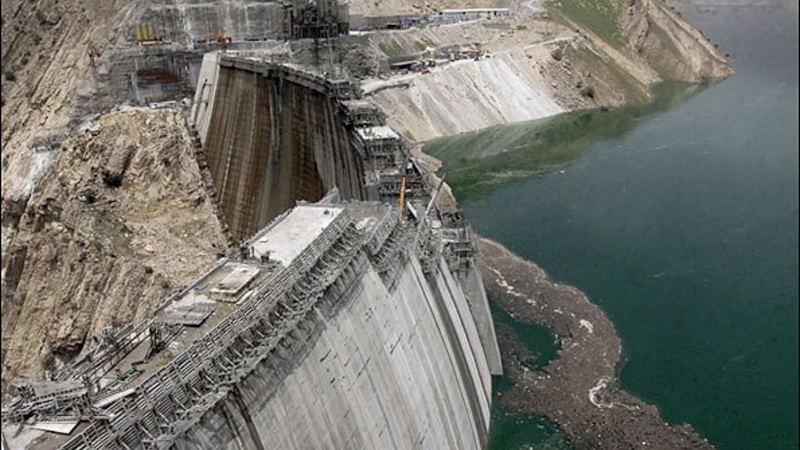

Four decades of dam-building, driven by political interests and opaque decision-making, have failed to deliver water security and instead accelerated ecological collapse
For decades, dam construction in Iran was promoted under the banner of “water security.” Massive concrete structures were presented as symbols of progress and resilience. Yet today, those same projects stand as contributing factors to the very Iran water crisis they were meant to solve.
Official and independent reports increasingly show that many dams have not alleviated water scarcity but exacerbated it. This outcome was not accidental. It reflects a centralized, authoritarian decision-making structure in which economic interests—particularly those linked to powerful networks and the Islamic Revolutionary Guard Corps—played a decisive role. For many actors involved, dam construction became less about sustainable water management and more about contracts, budgets, and rent-seeking opportunities.
Repeating Known Mistakes
Years ago, the World Commission on Dams identified seven recurring errors in large dam projects: inappropriate river selection, disregard for downstream impacts, biodiversity destruction, flawed economic calculations, neglect of public consent, poor risk management, and excessive construction.
A review of dam-building in Iran shows these failures were not isolated—they were systemic.
Iran lies within the world’s dry belt. Annual rainfall has declined. Average temperatures have risen by approximately 1.5 to 3 degrees Celsius. Evaporation consumes tens of billions of cubic meters of water annually. Surface runoff has decreased, and groundwater recharge has weakened. Despite these realities, dam construction accelerated rather than slowed.
Quantity Over Strategy
More than 180 national dams were built over four decades. Yet roughly half of reservoir capacity remains empty. This contradiction reveals a fundamental misalignment: dam construction functioned more as an infrastructure industry than as a coherent water strategy.
The objective was not sustainable resource management but project generation—allocating budgets and sustaining networks of contractors, consultants, and politically connected institutions.
The Gotvand Dam stands as a particularly telling example. Salt accumulation in its reservoir contaminated freshwater supplies, effectively salinizing stored water. Major dams on the Karun, Karkheh, and Dez rivers have also faced severe sedimentation and declining efficiency. Some never reached projected capacity. Others submerged forests, villages, and cultural heritage sites.
Environmental impact assessments were often incomplete, delayed, or sidelined. In some cases, evaluations were introduced only after construction was well underway. Local opposition was marginalized, and decisions were imposed from above, with minimal public participation.
The Political Economy of Concrete
Over time, dam-building evolved into an entrenched industry. Each administration sought large projects for ribbon-cutting ceremonies. Provinces competed for development funds. A network of contractors and affiliated entities—many tied to power centers and the security establishment—became economically dependent on the continuation of construction cycles.
Within such a structure, halting projects meant disrupting entrenched interests. Thus, even as reservoirs remained half-empty, plans for 113 additional dams were proposed. Engineering logic dominated ecological reasoning.
Dams also created an illusion of water abundance. Water-intensive agriculture expanded. Inter-basin water transfers intensified. Groundwater extraction increased dramatically. The consequences are now visible: land subsidence in plains such as Isfahan, Khuzestan, and Kerman; wetlands drying up; rivers like the Zayandeh River reduced to seasonal flows.
Energy Security That Never Materialized
Hydropower, often cited as a secondary benefit, has proven unreliable. During drought years, its share of electricity generation has dropped to around two percent. In summer—when electricity demand peaks—reservoir levels are typically at their lowest. The dams delivered neither water security nor energy security.
Simultaneously, extensive flaring of natural gas and heavy reliance on fossil fuels have placed Iran among significant greenhouse gas emitters. Rising temperatures intensify drought cycles. Yet planning models continue to rely on outdated precipitation patterns, disconnected from climatic realities.
Beyond Climate Change
Climate change is a contributing factor to Iran’s water stress, but it is not the sole cause. Chronic mismanagement and disregard for scientific expertise have magnified the crisis. In an authoritarian governance framework, accountability mechanisms are weak. Projects fail, yet decision-makers often face no consequences.
Four decades of dam-building have not produced water security. Instead, they have deepened vulnerability. Villages have been abandoned. Agricultural land has shrunk. Historic sites have been submerged. In some instances, poorly designed flood-control infrastructure has even worsened flood damage.
These are not isolated technical miscalculations. They are structural outcomes of a development model that equates progress with concrete volume rather than ecological balance.
An Existential Crisis
The water crisis has now reached existential proportions. Social and ethnic tensions over water access are rising. Regional disputes are intensifying. Forced migration is increasing as livelihoods collapse.
Continuing along the same path promises only repetition of failure. Dam construction in Iran symbolizes a broader policy pattern: centralized decision-making without transparency or public participation. It has depleted natural resources while eroding public trust.
The experience of the past four decades demonstrates that the problem was never a shortage of dams. The problem lies in a governance structure that sidelines scientific expertise and prioritizes short-term political and economic gains over long-term sustainability.
Dams were built to secure water. Instead, in many cases, they accelerated its disappearance. This is not rhetorical exaggeration—it is visible today in the dry riverbeds that cut across Iran’s landscape.