


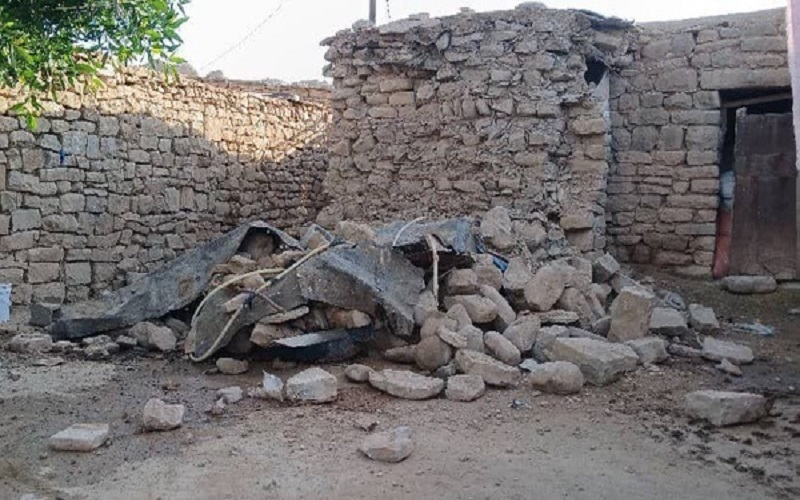

On Thursday, December 5, Mohammadreza Mowalizadeh, the governor of Khuzestan, announced that at least 29 people were injured following a series of early morning earthquakes in the province. Of these, 28 sustained only minor injuries.
The earthquakes caused significant damage to infrastructure and homes. Sanaz Hosseininejad, director of the health and treatment network in Masjed Soleyman, reported that the walls of the city’s 22 Bahman Hospital had cracked. Ali Abdollahi, the Director General of Khuzestan Crisis Management, confirmed that “a large number of homes and schools” were also damaged.
Details of the Earthquakes
The main earthquake struck Haftgol at 7:32 AM Iran time, registering a magnitude of 5.6 at a depth of 10 kilometers. Its tremors were felt as far as Lorestan province. About 20 minutes later, at 7:53 AM, a second quake with a magnitude of 4.8 struck Masjed Soleyman, adding to the damage and casualties. In total, 11 aftershocks were recorded in various parts of Khuzestan.
Damage and Emergency Response
Peyman Moulai, the governor of Masjed Soleyman, described the destruction as “serious” in some areas. More than 100 houses were damaged, and electricity, water, and gas supplies were disrupted in many urban and rural areas. Landslides blocked two village roads, which emergency teams are working to reopen.
The CEO of Khuzestan Red Crescent reported that rescue teams from neighboring provinces, including Chaharmahal and Bakhtiari, Kohgiluyeh and Boyer-Ahmad, Ilam, and Lorestan, were on high alert to assist.
Beyond Haftgol and Masjed Soleyman, the cities of Izeh and Qalehtol also reported severe or relatively severe tremors. Officials confirmed damages to residential buildings in both urban and rural areas. Detailed assessments are ongoing to determine the full extent of the destruction.
A History of Earthquakes and Neglect
Southern and western Iran are crisscrossed by active fault lines, making the region highly prone to earthquakes. Over the decades, these seismic events have claimed thousands of lives. The impact is exacerbated by inadequate adherence to construction safety standards and lax enforcement of building regulations, particularly for multi-story residential and office structures.
The 2017 earthquake in Azgeleh, Kermanshah, highlights the consequences of these shortcomings. That disaster, with a magnitude of 7.3, resulted in 620 deaths and nearly 9,400 injuries. Over 70,000 people were left homeless, many forced to live in tents for extended periods without proper government support.
Conclusion
The recent earthquakes in Khuzestan underscore the urgency of addressing structural vulnerabilities and improving disaster preparedness in Iran. While the region’s seismic activity is unavoidable, the significant human and economic toll could be mitigated through stricter construction standards and more robust crisis management systems. As these disasters continue to strike, they lay bare the enduring cost of negligence and insufficient infrastructure investment.